

based on these results. We concluded that environmental transfer of
14 C in rice
paddy fields was driven by bacteria, not by fungi.
To confirm incorporation of
14 C into bacteria cells, bacteria that were isolated
from a flooding water of a paddy soil sample were cultivated on agar plates
containing [1,214 C] sodium acetate [3]. After cultivation, bacterial colonies were
formed, and their autoradiography images showed that all colonies had the ability to
take up
14 C (Fig. 26.4). In our experimental procedure, bacterial cells were consequently partitioned into the solid phase, and thus the solid phase contains the
14 C
incorporated by bacteria, which could be one of the reasons for the relatively high
K d values.
26.4 Transfer of
14
C from Soil to Rice Plants
Soil-to-rice plant transfer factors (TFs) of
14 C, which was defined as
14 C concentration in rice grains (Bq/kg-dry) divided by that in soil (Bq/kg-dry), were determined by laboratory and field experiments. In the laboratory experiment using a
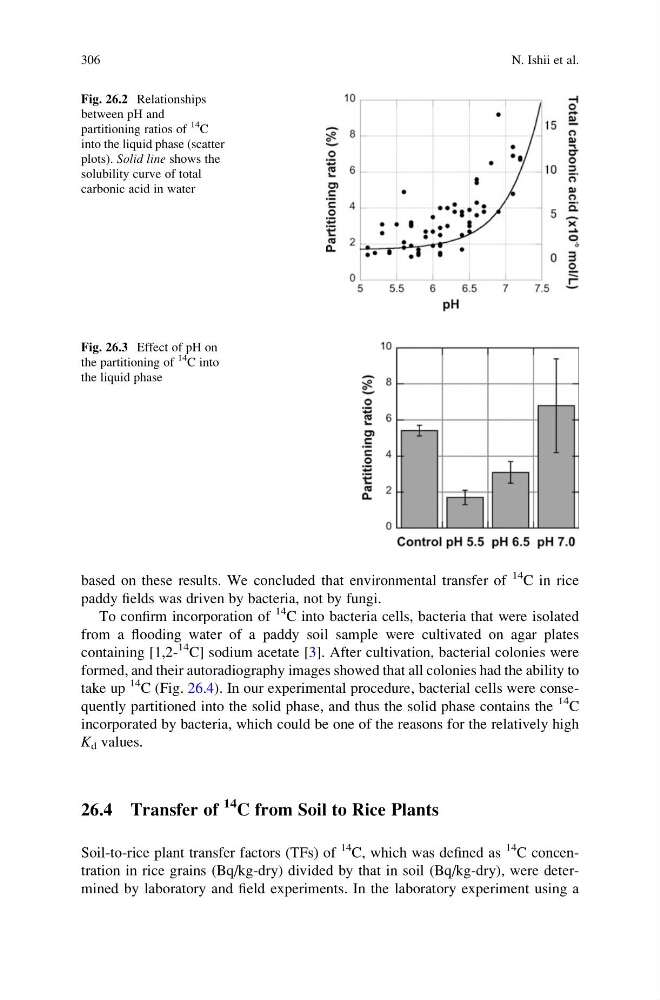
Fig. 26.2 Relationships
between pH and
partitioning ratios of
14
C
into the liquid phase (scatter
plots). Solid line shows the
solubility curve of total
carbonic acid in water
Fig. 26.3 Effect of pH on
the partitioning of
14
C into
the liquid phase
306
N. Ishii et al.
14 C in rice
paddy fields was driven by bacteria, not by fungi.
To confirm incorporation of
14 C into bacteria cells, bacteria that were isolated
from a flooding water of a paddy soil sample were cultivated on agar plates
containing [1,214 C] sodium acetate [3]. After cultivation, bacterial colonies were
formed, and their autoradiography images showed that all colonies had the ability to
take up
14 C (Fig. 26.4). In our experimental procedure, bacterial cells were consequently partitioned into the solid phase, and thus the solid phase contains the
14 C
incorporated by bacteria, which could be one of the reasons for the relatively high
K d values.
26.4 Transfer of
14
C from Soil to Rice Plants
Soil-to-rice plant transfer factors (TFs) of
14 C, which was defined as
14 C concentration in rice grains (Bq/kg-dry) divided by that in soil (Bq/kg-dry), were determined by laboratory and field experiments. In the laboratory experiment using a
Fig. 26.2 Relationships
between pH and
partitioning ratios of
14
C
into the liquid phase (scatter
plots). Solid line shows the
solubility curve of total
carbonic acid in water
Fig. 26.3 Effect of pH on
the partitioning of
14
C into
the liquid phase
306
N. Ishii et al.