

sample was prepared consisting of the soil and deionized water (pH unadjusted).
The partitioning ratio also increased with increasing pH, suggesting that the
partitioning ratio of
14
C into the liquid phase depended on the pH of the soil
solution.
Soil–soil solution distribution coefficient (K d ) is a commonly used parameter to
evaluate behaviors of radionuclides in the environment. In our study, the K d values
were calculated from activities of the
14 C in the solid and liquid phases at the end of
incubation, and the obtained K d value was 139 Æ 77 ml g
À1 on average. Negatively
charged anions generally have low K d values because of simple electrostatic
interaction. Our value, however, was higher than expected from the chemical
form of
14 CH 3
14 COO
À . For example, Kaneko et al. [1] obtained the K d value of
9.5 ml g
À1 for the sorption test of acetic acid using cement materials. The reason for
our high K d value is explained next.
26.3 Involvement of Microorganisms in the
14
C Behavior
Many microorganisms inhabit rice paddy fields, and they are responsible for
nutrient cycling. We studied the involvement of microorganisms in environmental
transfer of
14 C. Microorganisms in batch cultures were treated with autoclaving
(121
C, 15 min), mixing with glutaraldehyde [final concentration of 2.5 %
(vol/vol)], and mixing with cycloheximide (final concentration, 250 μg ml
À1 ).
Autoclaving and expose to glutaraldehyde inactivate bacteria and fungi, but exposure to cycloheximide only inhibits fungi. The partitioning ratios of
14 C into solid,
liquid, and gas phases for each treatment sample are listed in Table 26.1. When
microorganisms were treated by autoclaving and exposing to glutaraldehyde,
almost all the
14 C added remained in the liquid phase; that is, negligible transformation of
14 C occurred. On the other hand, the
14
C atoms in the control and the
cycloheximide-treated sample were partitioned into solid, liquid, and gas phases at
certain ratios, and these ratios were similar between the control and the cycloheximide samples. We confirmed fungi made no contribution to partitioning of
14 C
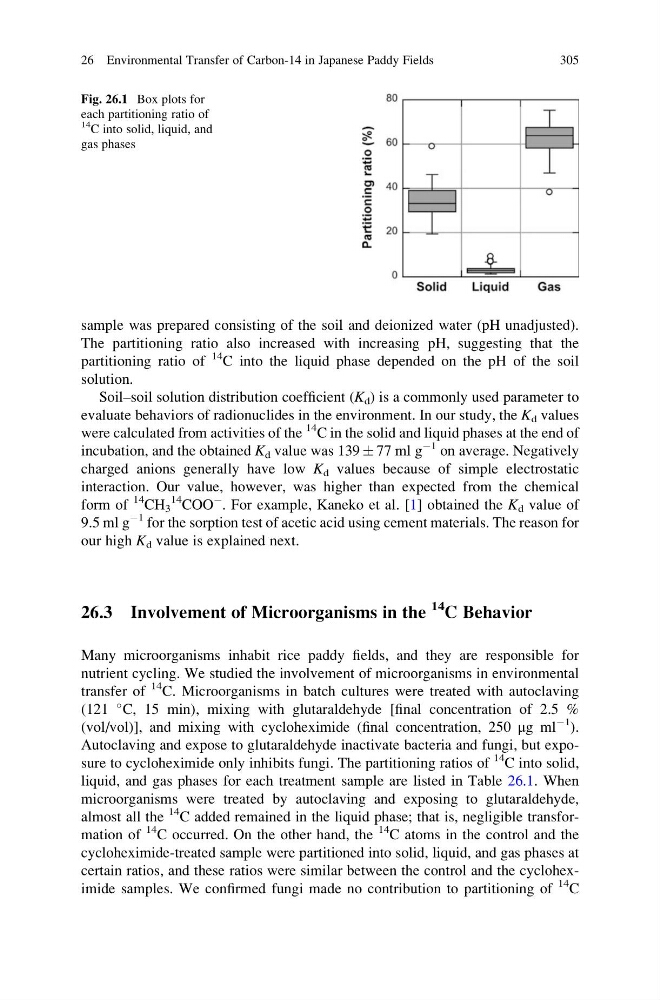
Fig. 26.1 Box plots for
each partitioning ratio of
14
C into solid, liquid, and
gas phases
26 Environmental Transfer of Carbon-14 in Japanese Paddy Fields
305
The partitioning ratio also increased with increasing pH, suggesting that the
partitioning ratio of
14
C into the liquid phase depended on the pH of the soil
solution.
Soil–soil solution distribution coefficient (K d ) is a commonly used parameter to
evaluate behaviors of radionuclides in the environment. In our study, the K d values
were calculated from activities of the
14 C in the solid and liquid phases at the end of
incubation, and the obtained K d value was 139 Æ 77 ml g
À1 on average. Negatively
charged anions generally have low K d values because of simple electrostatic
interaction. Our value, however, was higher than expected from the chemical
form of
14 CH 3
14 COO
À . For example, Kaneko et al. [1] obtained the K d value of
9.5 ml g
À1 for the sorption test of acetic acid using cement materials. The reason for
our high K d value is explained next.
26.3 Involvement of Microorganisms in the
14
C Behavior
Many microorganisms inhabit rice paddy fields, and they are responsible for
nutrient cycling. We studied the involvement of microorganisms in environmental
transfer of
14 C. Microorganisms in batch cultures were treated with autoclaving
(121
C, 15 min), mixing with glutaraldehyde [final concentration of 2.5 %
(vol/vol)], and mixing with cycloheximide (final concentration, 250 μg ml
À1 ).
Autoclaving and expose to glutaraldehyde inactivate bacteria and fungi, but exposure to cycloheximide only inhibits fungi. The partitioning ratios of
14 C into solid,
liquid, and gas phases for each treatment sample are listed in Table 26.1. When
microorganisms were treated by autoclaving and exposing to glutaraldehyde,
almost all the
14 C added remained in the liquid phase; that is, negligible transformation of
14 C occurred. On the other hand, the
14
C atoms in the control and the
cycloheximide-treated sample were partitioned into solid, liquid, and gas phases at
certain ratios, and these ratios were similar between the control and the cycloheximide samples. We confirmed fungi made no contribution to partitioning of
14 C
Fig. 26.1 Box plots for
each partitioning ratio of
14
C into solid, liquid, and
gas phases
26 Environmental Transfer of Carbon-14 in Japanese Paddy Fields
305