

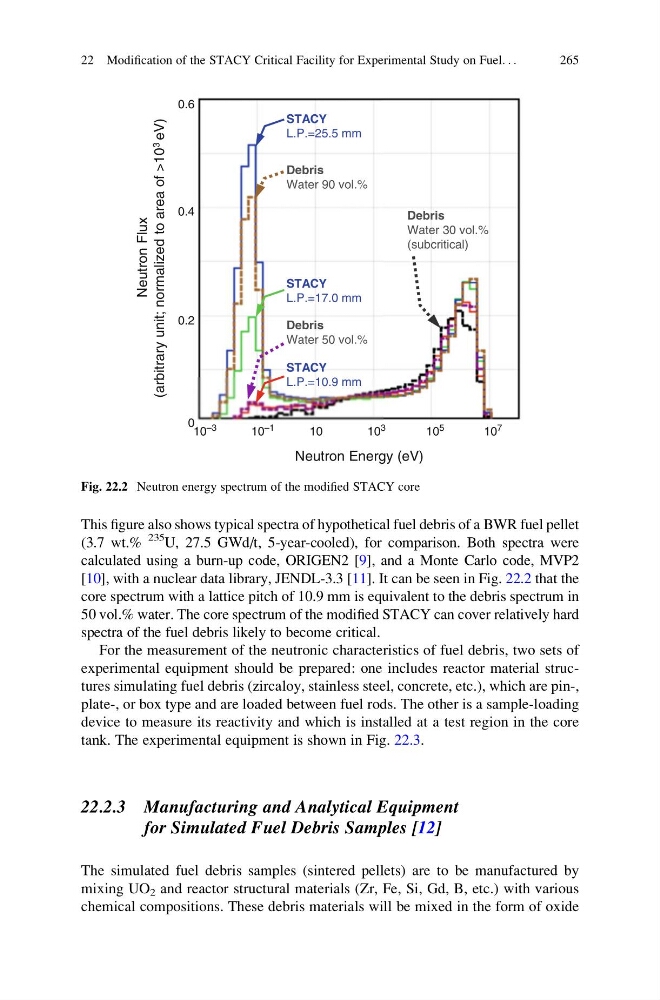
This figure also shows typical spectra of hypothetical fuel debris of a BWR fuel pellet
(3.7 wt.%
235
U, 27.5 GWd/t, 5-year-cooled), for comparison. Both spectra were
calculated using a burn-up code, ORIGEN2 [9], and a Monte Carlo code, MVP2
[10], with a nuclear data library, JENDL-3.3 [11]. It can be seen in Fig. 22.2 that the
core spectrum with a lattice pitch of 10.9 mm is equivalent to the debris spectrum in
50 vol.% water. The core spectrum of the modified STACY can cover relatively hard
spectra of the fuel debris likely to become critical.
For the measurement of the neutronic characteristics of fuel debris, two sets of
experimental equipment should be prepared: one includes reactor material structures simulating fuel debris (zircaloy, stainless steel, concrete, etc.), which are pin-,
plate-, or box type and are loaded between fuel rods. The other is a sample-loading
device to measure its reactivity and which is installed at a test region in the core
tank. The experimental equipment is shown in Fig. 22.3.
22.2.3 Manufacturing and Analytical Equipment
for Simulated Fuel Debris Samples [12]
The simulated fuel debris samples (sintered pellets) are to be manufactured by
mixing UO 2 and reactor structural materials (Zr, Fe, Si, Gd, B, etc.) with various
chemical compositions. These debris materials will be mixed in the form of oxide
Neutron Flux
(arbitrary unit; normalized to area of >10
3
eV)
Neutron Energy (eV)
10
–3
10
–1
10
10
3
10
5
10
7
0.6
0.4
0.2
0
Debris
Water 90 vol.%
Debris
Water 30 vol.%
(subcritical)
Debris
Water 50 vol.%
STACY
L.P.=25.5 mm
STACY
L.P.=17.0 mm
STACY
L.P.=10.9 mm
Fig. 22.2 Neutron energy spectrum of the modified STACY core
22 Modification of the STACY Critical Facility for Experimental Study on Fuel. . .
265
(3.7 wt.%
235
U, 27.5 GWd/t, 5-year-cooled), for comparison. Both spectra were
calculated using a burn-up code, ORIGEN2 [9], and a Monte Carlo code, MVP2
[10], with a nuclear data library, JENDL-3.3 [11]. It can be seen in Fig. 22.2 that the
core spectrum with a lattice pitch of 10.9 mm is equivalent to the debris spectrum in
50 vol.% water. The core spectrum of the modified STACY can cover relatively hard
spectra of the fuel debris likely to become critical.
For the measurement of the neutronic characteristics of fuel debris, two sets of
experimental equipment should be prepared: one includes reactor material structures simulating fuel debris (zircaloy, stainless steel, concrete, etc.), which are pin-,
plate-, or box type and are loaded between fuel rods. The other is a sample-loading
device to measure its reactivity and which is installed at a test region in the core
tank. The experimental equipment is shown in Fig. 22.3.
22.2.3 Manufacturing and Analytical Equipment
for Simulated Fuel Debris Samples [12]
The simulated fuel debris samples (sintered pellets) are to be manufactured by
mixing UO 2 and reactor structural materials (Zr, Fe, Si, Gd, B, etc.) with various
chemical compositions. These debris materials will be mixed in the form of oxide
Neutron Flux
(arbitrary unit; normalized to area of >10
3
eV)
Neutron Energy (eV)
10
–3
10
–1
10
10
3
10
5
10
7
0.6
0.4
0.2
0
Debris
Water 90 vol.%
Debris
Water 30 vol.%
(subcritical)
Debris
Water 50 vol.%
STACY
L.P.=25.5 mm
STACY
L.P.=17.0 mm
STACY
L.P.=10.9 mm
Fig. 22.2 Neutron energy spectrum of the modified STACY core
22 Modification of the STACY Critical Facility for Experimental Study on Fuel. . .
265