

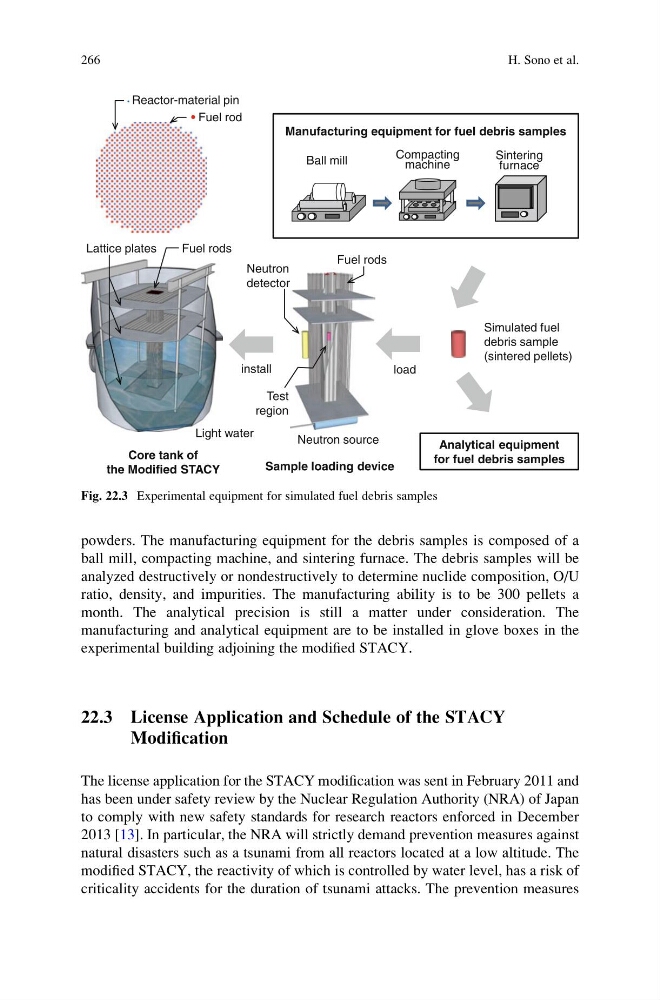
powders. The manufacturing equipment for the debris samples is composed of a
ball mill, compacting machine, and sintering furnace. The debris samples will be
analyzed destructively or nondestructively to determine nuclide composition, O/U
ratio, density, and impurities. The manufacturing ability is to be 300 pellets a
month. The analytical precision is still a matter under consideration. The
manufacturing and analytical equipment are to be installed in glove boxes in the
experimental building adjoining the modified STACY.
22.3 License Application and Schedule of the STACY
Modification
The license application for the STACY modification was sent in February 2011 and
has been under safety review by the Nuclear Regulation Authority (NRA) of Japan
to comply with new safety standards for research reactors enforced in December
2013 [13]. In particular, the NRA will strictly demand prevention measures against
natural disasters such as a tsunami from all reactors located at a low altitude. The
modified STACY, the reactivity of which is controlled by water level, has a risk of
criticality accidents for the duration of tsunami attacks. The prevention measures
Reactor-material pin
Fuel rod
Lattice plates
Fuel rods
Core tank of
the Modified STACY
Sample loading device
Neutron source
Neutron
detector
Manufacturing equipment for fuel debris samples
Ball mill
Compacting
machine
Sintering
furnace
Simulated fuel
debris sample
(sintered pellets)
load
Analytical equipment
for fuel debris samples
install
Light water
Test
region
Fuel rods
Fig. 22.3 Experimental equipment for simulated fuel debris samples
266
H. Sono et al.
ball mill, compacting machine, and sintering furnace. The debris samples will be
analyzed destructively or nondestructively to determine nuclide composition, O/U
ratio, density, and impurities. The manufacturing ability is to be 300 pellets a
month. The analytical precision is still a matter under consideration. The
manufacturing and analytical equipment are to be installed in glove boxes in the
experimental building adjoining the modified STACY.
22.3 License Application and Schedule of the STACY
Modification
The license application for the STACY modification was sent in February 2011 and
has been under safety review by the Nuclear Regulation Authority (NRA) of Japan
to comply with new safety standards for research reactors enforced in December
2013 [13]. In particular, the NRA will strictly demand prevention measures against
natural disasters such as a tsunami from all reactors located at a low altitude. The
modified STACY, the reactivity of which is controlled by water level, has a risk of
criticality accidents for the duration of tsunami attacks. The prevention measures
Reactor-material pin
Fuel rod
Lattice plates
Fuel rods
Core tank of
the Modified STACY
Sample loading device
Neutron source
Neutron
detector
Manufacturing equipment for fuel debris samples
Ball mill
Compacting
machine
Sintering
furnace
Simulated fuel
debris sample
(sintered pellets)
load
Analytical equipment
for fuel debris samples
install
Light water
Test
region
Fuel rods
Fig. 22.3 Experimental equipment for simulated fuel debris samples
266
H. Sono et al.