

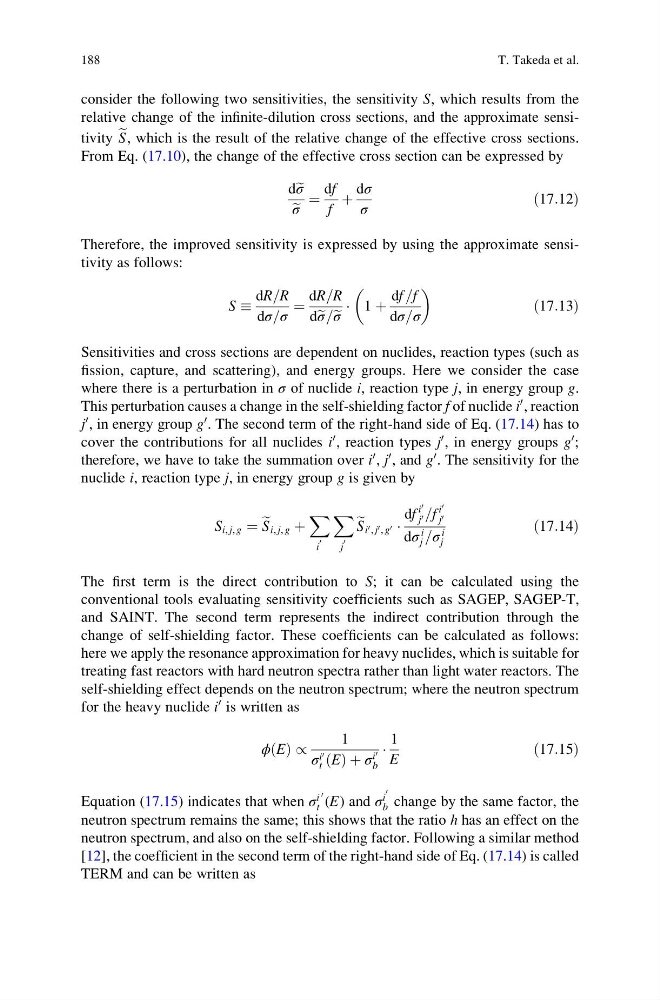
consider the following two sensitivities, the sensitivity S, which results from the
relative change of the infinite-dilution cross sections, and the approximate sensitivity e S, which is the result of the relative change of the effective cross sections.
From Eq. (17.10), the change of the effective cross section can be expressed by
de σ
e
σ
¼
df
f
þ
dσ
σ
ð17:12Þ
Therefore, the improved sensitivity is expressed by using the approximate sensitivity as follows:
S
dR=R
dσ=σ
¼
dR=R
de σ=e σ
Á 1 þ
df =f
dσ=σ
ð17:13Þ
Sensitivities and cross sections are dependent on nuclides, reaction types (such as
fission, capture, and scattering), and energy groups. Here we consider the case
where there is a perturbation in σ of nuclide i, reaction type j, in energy group g.
This perturbation causes a change in the self-shielding factor f of nuclide i
0 , reaction
j
0 , in energy group g
0 . The second term of the right-hand side of Eq. (17.14) has to
cover the contributions for all nuclides i
0 , reaction types j
0 , in energy groups g
0 ;
therefore, we have to take the summation over i
0 , j
0 , and g
0 . The sensitivity for the
nuclide i, reaction type j, in energy group g is given by
S i, j, g ¼ e S i, j, g þ
X
i
0
X
j
0
e S i 0 , j 0 , g 0 Á
df
i
0
j 0 =f
i
0
j 0
dσ i
j =σ i
j
ð17:14Þ
The first term is the direct contribution to S; it can be calculated using the
conventional tools evaluating sensitivity coefficients such as SAGEP, SAGEP-T,
and SAINT. The second term represents the indirect contribution through the
change of self-shielding factor. These coefficients can be calculated as follows:
here we apply the resonance approximation for heavy nuclides, which is suitable for
treating fast reactors with hard neutron spectra rather than light water reactors. The
self-shielding effect depends on the neutron spectrum; where the neutron spectrum
for the heavy nuclide i
0 is written as
ϕ E
ð Þ /
1
σ i 0
t E
ð Þ þ σ i 0
b
Á
1
E
ð17:15Þ
Equation (17.15) indicates that when σ
i
0
t (E) and σ
i
0
b change by the same factor, the
neutron spectrum remains the same; this shows that the ratio h has an effect on the
neutron spectrum, and also on the self-shielding factor. Following a similar method
[12], the coefficient in the second term of the right-hand side of Eq. (17.14) is called
TERM and can be written as
188
T. Takeda et al.
relative change of the infinite-dilution cross sections, and the approximate sensitivity e S, which is the result of the relative change of the effective cross sections.
From Eq. (17.10), the change of the effective cross section can be expressed by
de σ
e
σ
¼
df
f
þ
dσ
σ
ð17:12Þ
Therefore, the improved sensitivity is expressed by using the approximate sensitivity as follows:
S
dR=R
dσ=σ
¼
dR=R
de σ=e σ
Á 1 þ
df =f
dσ=σ
ð17:13Þ
Sensitivities and cross sections are dependent on nuclides, reaction types (such as
fission, capture, and scattering), and energy groups. Here we consider the case
where there is a perturbation in σ of nuclide i, reaction type j, in energy group g.
This perturbation causes a change in the self-shielding factor f of nuclide i
0 , reaction
j
0 , in energy group g
0 . The second term of the right-hand side of Eq. (17.14) has to
cover the contributions for all nuclides i
0 , reaction types j
0 , in energy groups g
0 ;
therefore, we have to take the summation over i
0 , j
0 , and g
0 . The sensitivity for the
nuclide i, reaction type j, in energy group g is given by
S i, j, g ¼ e S i, j, g þ
X
i
0
X
j
0
e S i 0 , j 0 , g 0 Á
df
i
0
j 0 =f
i
0
j 0
dσ i
j =σ i
j
ð17:14Þ
The first term is the direct contribution to S; it can be calculated using the
conventional tools evaluating sensitivity coefficients such as SAGEP, SAGEP-T,
and SAINT. The second term represents the indirect contribution through the
change of self-shielding factor. These coefficients can be calculated as follows:
here we apply the resonance approximation for heavy nuclides, which is suitable for
treating fast reactors with hard neutron spectra rather than light water reactors. The
self-shielding effect depends on the neutron spectrum; where the neutron spectrum
for the heavy nuclide i
0 is written as
ϕ E
ð Þ /
1
σ i 0
t E
ð Þ þ σ i 0
b
Á
1
E
ð17:15Þ
Equation (17.15) indicates that when σ
i
0
t (E) and σ
i
0
b change by the same factor, the
neutron spectrum remains the same; this shows that the ratio h has an effect on the
neutron spectrum, and also on the self-shielding factor. Following a similar method
[12], the coefficient in the second term of the right-hand side of Eq. (17.14) is called
TERM and can be written as
188
T. Takeda et al.