

df
i
0
j
0 h
i
0
À Á =f
i
0
j
0 h
i
0
À Á
dσ
i
j E
ð Þ=σ
i
j E
ð Þ
¼
σ
i
j E
ð Þ
f
i 0
j
0 h
i 0
À Á Á
N i
N i 0
1 À δ ii 0
ð
ÞÀ
σ
i
0
b
σ i
t E
ð Þ
δ ii 0
&
'
Á
∂f
i
0
j
0 h
i
0
À Á
∂σ
i 0
b
ð17:16Þ
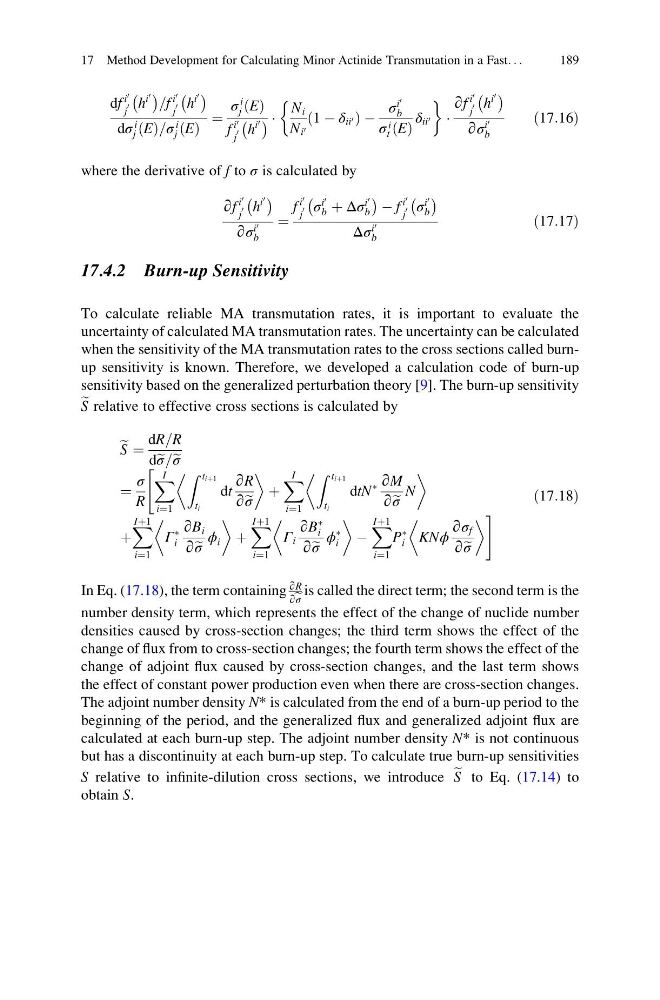
where the derivative of f to σ is calculated by
∂f
i
0
j
0 h
i
0
À Á
∂σ
i 0
b
¼
f
i
0
j
0 σ
i
0
b þ Δσ
i
0
b
À
Á À f
i
0
j
0 σ
i
0
b
À Á
Δσ
i 0
b
ð17:17Þ
17.4.2 Burn-up Sensitivity
To calculate reliable MA transmutation rates, it is important to evaluate the
uncertainty of calculated MA transmutation rates. The uncertainty can be calculated
when the sensitivity of the MA transmutation rates to the cross sections called burnup sensitivity is known. Therefore, we developed a calculation code of burn-up
sensitivity based on the generalized perturbation theory [9]. The burn-up sensitivity
e S relative to effective cross sections is calculated by
e S ¼
dR=R
de σ=e σ
¼
σ
R
X I
i¼1
Z t iþ1
t i
dt
∂R
∂e σ
(
)
þ
X I
i¼1
Z t iþ1
t i
dtN
à ∂M
∂e σ
N
(
)
"
þ
X Iþ1
i¼1
Γ
Ã
i
∂B i
∂e σ
ϕ i
(
)
þ
X Iþ1
i¼1
Γ i
∂B
Ã
i
∂e σ
ϕ
Ã
i
(
)
À
X Iþ1
i¼1
P
Ã
i KNϕ
∂σ f
∂e σ
(
) #
ð17:18Þ
In Eq. (17.18), the term containing
∂R
∂e σ
is called the direct term; the second term is the
number density term, which represents the effect of the change of nuclide number
densities caused by cross-section changes; the third term shows the effect of the
change of flux from to cross-section changes; the fourth term shows the effect of the
change of adjoint flux caused by cross-section changes, and the last term shows
the effect of constant power production even when there are cross-section changes.
The adjoint number density N* is calculated from the end of a burn-up period to the
beginning of the period, and the generalized flux and generalized adjoint flux are
calculated at each burn-up step. The adjoint number density N* is not continuous
but has a discontinuity at each burn-up step. To calculate true burn-up sensitivities
S relative to infinite-dilution cross sections, we introduce e S to Eq. (17.14) to
obtain S.
17 Method Development for Calculating Minor Actinide Transmutation in a Fast. . .
189
i
0
j
0 h
i
0
À Á =f
i
0
j
0 h
i
0
À Á
dσ
i
j E
ð Þ=σ
i
j E
ð Þ
¼
σ
i
j E
ð Þ
f
i 0
j
0 h
i 0
À Á Á
N i
N i 0
1 À δ ii 0
ð
ÞÀ
σ
i
0
b
σ i
t E
ð Þ
δ ii 0
&
'
Á
∂f
i
0
j
0 h
i
0
À Á
∂σ
i 0
b
ð17:16Þ
where the derivative of f to σ is calculated by
∂f
i
0
j
0 h
i
0
À Á
∂σ
i 0
b
¼
f
i
0
j
0 σ
i
0
b þ Δσ
i
0
b
À
Á À f
i
0
j
0 σ
i
0
b
À Á
Δσ
i 0
b
ð17:17Þ
17.4.2 Burn-up Sensitivity
To calculate reliable MA transmutation rates, it is important to evaluate the
uncertainty of calculated MA transmutation rates. The uncertainty can be calculated
when the sensitivity of the MA transmutation rates to the cross sections called burnup sensitivity is known. Therefore, we developed a calculation code of burn-up
sensitivity based on the generalized perturbation theory [9]. The burn-up sensitivity
e S relative to effective cross sections is calculated by
e S ¼
dR=R
de σ=e σ
¼
σ
R
X I
i¼1
Z t iþ1
t i
dt
∂R
∂e σ
(
)
þ
X I
i¼1
Z t iþ1
t i
dtN
à ∂M
∂e σ
N
(
)
"
þ
X Iþ1
i¼1
Γ
Ã
i
∂B i
∂e σ
ϕ i
(
)
þ
X Iþ1
i¼1
Γ i
∂B
Ã
i
∂e σ
ϕ
Ã
i
(
)
À
X Iþ1
i¼1
P
Ã
i KNϕ
∂σ f
∂e σ
(
) #
ð17:18Þ
In Eq. (17.18), the term containing
∂R
∂e σ
is called the direct term; the second term is the
number density term, which represents the effect of the change of nuclide number
densities caused by cross-section changes; the third term shows the effect of the
change of flux from to cross-section changes; the fourth term shows the effect of the
change of adjoint flux caused by cross-section changes, and the last term shows
the effect of constant power production even when there are cross-section changes.
The adjoint number density N* is calculated from the end of a burn-up period to the
beginning of the period, and the generalized flux and generalized adjoint flux are
calculated at each burn-up step. The adjoint number density N* is not continuous
but has a discontinuity at each burn-up step. To calculate true burn-up sensitivities
S relative to infinite-dilution cross sections, we introduce e S to Eq. (17.14) to
obtain S.
17 Method Development for Calculating Minor Actinide Transmutation in a Fast. . .
189