

14.2.5 RBWR-TB2
The core concept of the RBWR-TB2 was initiated by an Electric Power Research
Institute (ERRI)-organized team of three universities in the United States [6] to
compare its core performance values with those of the ABR, which is the SFR
having the same purpose [7]. Although the RBWR-TB is assumed to be utilized in
the final stage of the nuclear power phase-out scenario, the RBWR-TB2 is assumed
to be utilized to control the amount of TRUs during the period while LWRs are
being operated as base load power sources.
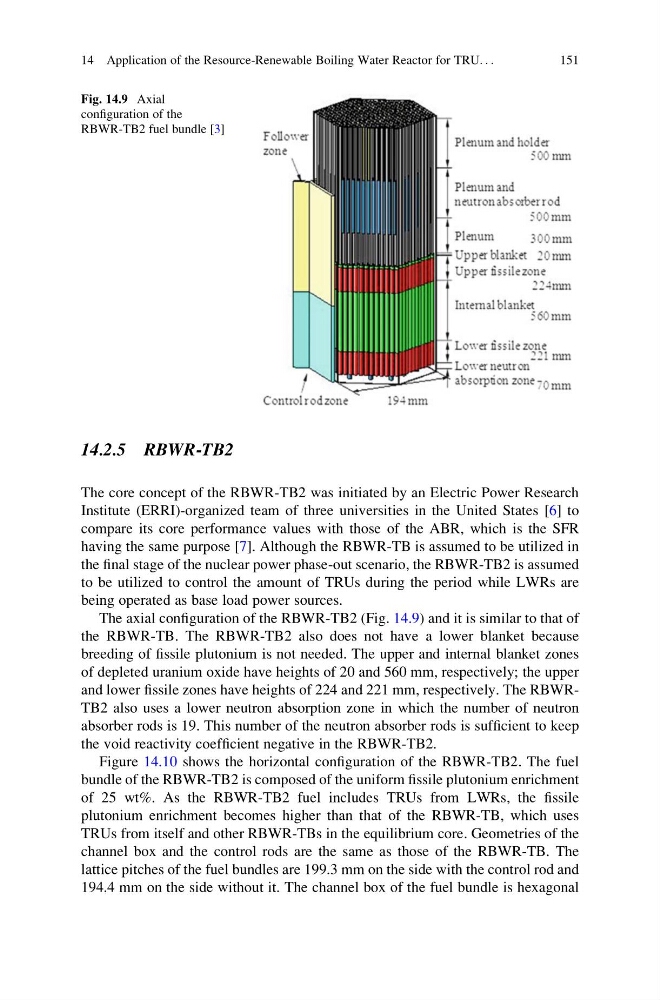
The axial configuration of the RBWR-TB2 (Fig. 14.9) and it is similar to that of
the RBWR-TB. The RBWR-TB2 also does not have a lower blanket because
breeding of fissile plutonium is not needed. The upper and internal blanket zones
of depleted uranium oxide have heights of 20 and 560 mm, respectively; the upper
and lower fissile zones have heights of 224 and 221 mm, respectively. The RBWRTB2 also uses a lower neutron absorption zone in which the number of neutron
absorber rods is 19. This number of the neutron absorber rods is sufficient to keep
the void reactivity coefficient negative in the RBWR-TB2.
Figure 14.10 shows the horizontal configuration of the RBWR-TB2. The fuel
bundle of the RBWR-TB2 is composed of the uniform fissile plutonium enrichment
of 25 wt%. As the RBWR-TB2 fuel includes TRUs from LWRs, the fissile
plutonium enrichment becomes higher than that of the RBWR-TB, which uses
TRUs from itself and other RBWR-TBs in the equilibrium core. Geometries of the
channel box and the control rods are the same as those of the RBWR-TB. The
lattice pitches of the fuel bundles are 199.3 mm on the side with the control rod and
194.4 mm on the side without it. The channel box of the fuel bundle is hexagonal
Fig. 14.9 Axial
configuration of the
RBWR-TB2 fuel bundle [3]
14 Application of the Resource-Renewable Boiling Water Reactor for TRU. . .
151
The core concept of the RBWR-TB2 was initiated by an Electric Power Research
Institute (ERRI)-organized team of three universities in the United States [6] to
compare its core performance values with those of the ABR, which is the SFR
having the same purpose [7]. Although the RBWR-TB is assumed to be utilized in
the final stage of the nuclear power phase-out scenario, the RBWR-TB2 is assumed
to be utilized to control the amount of TRUs during the period while LWRs are
being operated as base load power sources.
The axial configuration of the RBWR-TB2 (Fig. 14.9) and it is similar to that of
the RBWR-TB. The RBWR-TB2 also does not have a lower blanket because
breeding of fissile plutonium is not needed. The upper and internal blanket zones
of depleted uranium oxide have heights of 20 and 560 mm, respectively; the upper
and lower fissile zones have heights of 224 and 221 mm, respectively. The RBWRTB2 also uses a lower neutron absorption zone in which the number of neutron
absorber rods is 19. This number of the neutron absorber rods is sufficient to keep
the void reactivity coefficient negative in the RBWR-TB2.
Figure 14.10 shows the horizontal configuration of the RBWR-TB2. The fuel
bundle of the RBWR-TB2 is composed of the uniform fissile plutonium enrichment
of 25 wt%. As the RBWR-TB2 fuel includes TRUs from LWRs, the fissile
plutonium enrichment becomes higher than that of the RBWR-TB, which uses
TRUs from itself and other RBWR-TBs in the equilibrium core. Geometries of the
channel box and the control rods are the same as those of the RBWR-TB. The
lattice pitches of the fuel bundles are 199.3 mm on the side with the control rod and
194.4 mm on the side without it. The channel box of the fuel bundle is hexagonal
Fig. 14.9 Axial
configuration of the
RBWR-TB2 fuel bundle [3]
14 Application of the Resource-Renewable Boiling Water Reactor for TRU. . .
151