

The RBWR-TB aims at burning MAs by transmuting them into fissile isotopes
using relatively low energy neutrons as well as by direct fissioning using relatively
high energy neutrons. Both capture and fission reactions occur in a broad neutron
energy range from thermal to fast. It is expected that the balance of these reactions
at different neutron energies enables TRU burning while keeping the isotopic
composition almost the same before and after burning, as mentioned in the next
subsection.
The main core specifications and performance values of the RBWR-TB in the
equilibrium core were shown earlier in Table 14.2. The core coolant flow is
3.8 Â 10
4 t/h at a subcooling of 10 K at the entrance and has a steam quality of
21 % at the core exit. The concept of the loading pattern of fuel bundles in the
equilibrium core is the same as that of the RBWR-AC: it adopts zone loading and
the reflective boundary condition of 60
in the azimuthal direction. A maximum
linear heat generation rate of 47 kW/m and an MCPR of 1.3 after the control rod
scheduling are achieved. The RBWR-TB has a void reactivity coefficient of
À2 Â 10
À4
Δk/k/%void.
The fission efficiency of TRUs in the RBWR-TB is 51 %. Here the fission
efficiency is defined as the net decrease in TRUs divided by the total amount of
fissioned actinides through the total fuel residence time in the core. This value
indicates what amount of the TRUs can be used as fuel for generating electric power
and is related to fissioning cost of the TRUs. As the fission efficiency of TRUs
becomes higher, it is expected that the electricity-generating cost needed for
burning the same amount of TRUs becomes smaller, if the other costs such as
fuel fabrication cost are comparable.
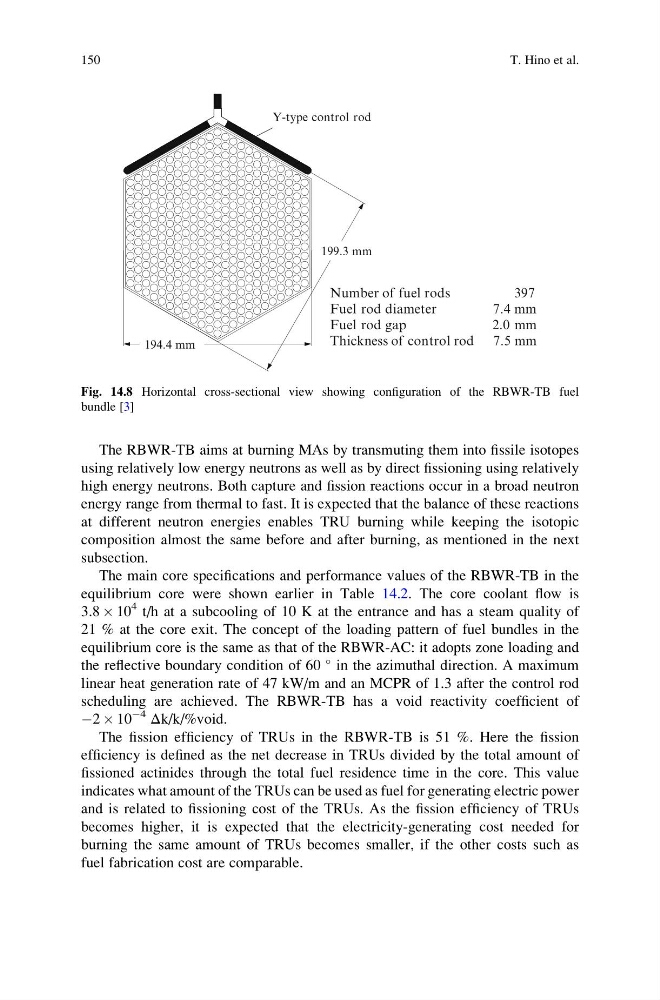
Y-type control rod
Number of fuel rods
397
Fuel rod diameter
7.4 mm
Fuel rod gap
2.0 mm
Thickness of control rod 7.5 mm
194.4 mm
199.3 mm
Fig. 14.8 Horizontal cross-sectional view showing configuration of the RBWR-TB fuel
bundle [3]
150
T. Hino et al.
using relatively low energy neutrons as well as by direct fissioning using relatively
high energy neutrons. Both capture and fission reactions occur in a broad neutron
energy range from thermal to fast. It is expected that the balance of these reactions
at different neutron energies enables TRU burning while keeping the isotopic
composition almost the same before and after burning, as mentioned in the next
subsection.
The main core specifications and performance values of the RBWR-TB in the
equilibrium core were shown earlier in Table 14.2. The core coolant flow is
3.8 Â 10
4 t/h at a subcooling of 10 K at the entrance and has a steam quality of
21 % at the core exit. The concept of the loading pattern of fuel bundles in the
equilibrium core is the same as that of the RBWR-AC: it adopts zone loading and
the reflective boundary condition of 60
in the azimuthal direction. A maximum
linear heat generation rate of 47 kW/m and an MCPR of 1.3 after the control rod
scheduling are achieved. The RBWR-TB has a void reactivity coefficient of
À2 Â 10
À4
Δk/k/%void.
The fission efficiency of TRUs in the RBWR-TB is 51 %. Here the fission
efficiency is defined as the net decrease in TRUs divided by the total amount of
fissioned actinides through the total fuel residence time in the core. This value
indicates what amount of the TRUs can be used as fuel for generating electric power
and is related to fissioning cost of the TRUs. As the fission efficiency of TRUs
becomes higher, it is expected that the electricity-generating cost needed for
burning the same amount of TRUs becomes smaller, if the other costs such as
fuel fabrication cost are comparable.
Y-type control rod
Number of fuel rods
397
Fuel rod diameter
7.4 mm
Fuel rod gap
2.0 mm
Thickness of control rod 7.5 mm
194.4 mm
199.3 mm
Fig. 14.8 Horizontal cross-sectional view showing configuration of the RBWR-TB fuel
bundle [3]
150
T. Hino et al.