

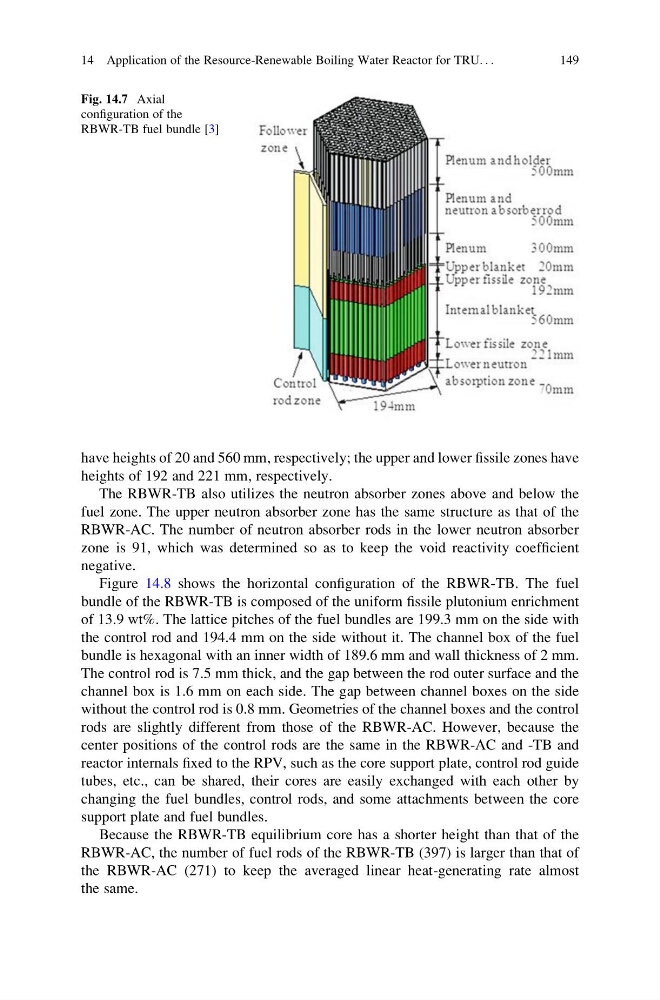
have heights of 20 and 560 mm, respectively; the upper and lower fissile zones have
heights of 192 and 221 mm, respectively.
The RBWR-TB also utilizes the neutron absorber zones above and below the
fuel zone. The upper neutron absorber zone has the same structure as that of the
RBWR-AC. The number of neutron absorber rods in the lower neutron absorber
zone is 91, which was determined so as to keep the void reactivity coefficient
negative.
Figure 14.8 shows the horizontal configuration of the RBWR-TB. The fuel
bundle of the RBWR-TB is composed of the uniform fissile plutonium enrichment
of 13.9 wt%. The lattice pitches of the fuel bundles are 199.3 mm on the side with
the control rod and 194.4 mm on the side without it. The channel box of the fuel
bundle is hexagonal with an inner width of 189.6 mm and wall thickness of 2 mm.
The control rod is 7.5 mm thick, and the gap between the rod outer surface and the
channel box is 1.6 mm on each side. The gap between channel boxes on the side
without the control rod is 0.8 mm. Geometries of the channel boxes and the control
rods are slightly different from those of the RBWR-AC. However, because the
center positions of the control rods are the same in the RBWR-AC and -TB and
reactor internals fixed to the RPV, such as the core support plate, control rod guide
tubes, etc., can be shared, their cores are easily exchanged with each other by
changing the fuel bundles, control rods, and some attachments between the core
support plate and fuel bundles.
Because the RBWR-TB equilibrium core has a shorter height than that of the
RBWR-AC, the number of fuel rods of the RBWR-TB (397) is larger than that of
the RBWR-AC (271) to keep the averaged linear heat-generating rate almost
the same.
Fig. 14.7 Axial
configuration of the
RBWR-TB fuel bundle [3]
14 Application of the Resource-Renewable Boiling Water Reactor for TRU. . .
149
heights of 192 and 221 mm, respectively.
The RBWR-TB also utilizes the neutron absorber zones above and below the
fuel zone. The upper neutron absorber zone has the same structure as that of the
RBWR-AC. The number of neutron absorber rods in the lower neutron absorber
zone is 91, which was determined so as to keep the void reactivity coefficient
negative.
Figure 14.8 shows the horizontal configuration of the RBWR-TB. The fuel
bundle of the RBWR-TB is composed of the uniform fissile plutonium enrichment
of 13.9 wt%. The lattice pitches of the fuel bundles are 199.3 mm on the side with
the control rod and 194.4 mm on the side without it. The channel box of the fuel
bundle is hexagonal with an inner width of 189.6 mm and wall thickness of 2 mm.
The control rod is 7.5 mm thick, and the gap between the rod outer surface and the
channel box is 1.6 mm on each side. The gap between channel boxes on the side
without the control rod is 0.8 mm. Geometries of the channel boxes and the control
rods are slightly different from those of the RBWR-AC. However, because the
center positions of the control rods are the same in the RBWR-AC and -TB and
reactor internals fixed to the RPV, such as the core support plate, control rod guide
tubes, etc., can be shared, their cores are easily exchanged with each other by
changing the fuel bundles, control rods, and some attachments between the core
support plate and fuel bundles.
Because the RBWR-TB equilibrium core has a shorter height than that of the
RBWR-AC, the number of fuel rods of the RBWR-TB (397) is larger than that of
the RBWR-AC (271) to keep the averaged linear heat-generating rate almost
the same.
Fig. 14.7 Axial
configuration of the
RBWR-TB fuel bundle [3]
14 Application of the Resource-Renewable Boiling Water Reactor for TRU. . .
149