

327
beginning, a target value for a necessary weight reduction is required. How to
quickly calculate a target for lightweight design (w rel ) is shown in Eq. (23.1):
w
EIP EIP
EIP EIRV
rel
a
r
a
L C
=
−
+
(23.1)
Thereby the environmental impact for the production of 1 kg of a reference material
(EIP r ) and 1 kg of an alternative material (EIP a ) plus an environmental impact
reduction value over life cycle (EIRV LC ) is needed. This value reflects the reduction
of an environmental impact per km (e.g., g CO 2 /km) over an assumed running distance in km for a weight reduction of 1 kg.
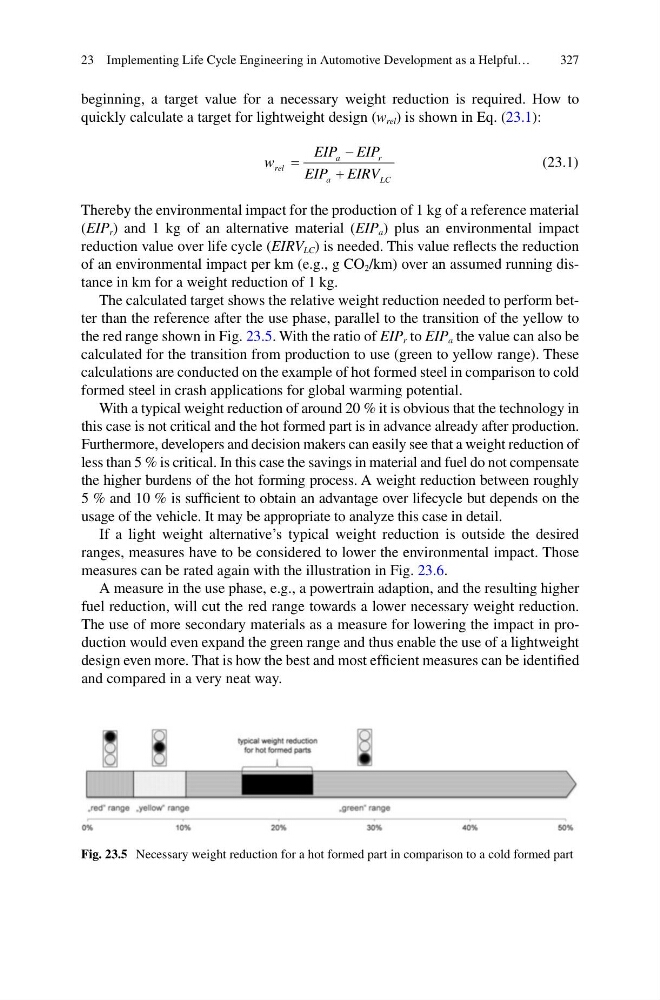
The calculated target shows the relative weight reduction needed to perform better than the reference after the use phase, parallel to the transition of the yellow to
the red range shown in Fig. 23.5. With the ratio of EIP r to EIP a the value can also be
calculated for the transition from production to use (green to yellow range). These
calculations are conducted on the example of hot formed steel in comparison to cold
formed steel in crash applications for global warming potential.
With a typical weight reduction of around 20 % it is obvious that the technology in
this case is not critical and the hot formed part is in advance already after production.
Furthermore, developers and decision makers can easily see that a weight reduction of
less than 5 % is critical. In this case the savings in material and fuel do not compensate
the higher burdens of the hot forming process. A weight reduction between roughly
5 % and 10 % is sufficient to obtain an advantage over lifecycle but depends on the
usage of the vehicle. It may be appropriate to analyze this case in detail.
If a light weight alternative’s typical weight reduction is outside the desired
ranges, measures have to be considered to lower the environmental impact. Those
measures can be rated again with the illustration in Fig. 23.6.
A measure in the use phase, e.g., a powertrain adaption, and the resulting higher
fuel reduction, will cut the red range towards a lower necessary weight reduction.
The use of more secondary materials as a measure for lowering the impact in production would even expand the green range and thus enable the use of a lightweight
design even more. That is how the best and most efficient measures can be identified
and compared in a very neat way.
Fig. 23.5 Necessary weight reduction for a hot formed part in comparison to a cold formed part
23 Implementing Life Cycle Engineering in Automotive Development as a Helpful…
beginning, a target value for a necessary weight reduction is required. How to
quickly calculate a target for lightweight design (w rel ) is shown in Eq. (23.1):
w
EIP EIP
EIP EIRV
rel
a
r
a
L C
=
−
+
(23.1)
Thereby the environmental impact for the production of 1 kg of a reference material
(EIP r ) and 1 kg of an alternative material (EIP a ) plus an environmental impact
reduction value over life cycle (EIRV LC ) is needed. This value reflects the reduction
of an environmental impact per km (e.g., g CO 2 /km) over an assumed running distance in km for a weight reduction of 1 kg.
The calculated target shows the relative weight reduction needed to perform better than the reference after the use phase, parallel to the transition of the yellow to
the red range shown in Fig. 23.5. With the ratio of EIP r to EIP a the value can also be
calculated for the transition from production to use (green to yellow range). These
calculations are conducted on the example of hot formed steel in comparison to cold
formed steel in crash applications for global warming potential.
With a typical weight reduction of around 20 % it is obvious that the technology in
this case is not critical and the hot formed part is in advance already after production.
Furthermore, developers and decision makers can easily see that a weight reduction of
less than 5 % is critical. In this case the savings in material and fuel do not compensate
the higher burdens of the hot forming process. A weight reduction between roughly
5 % and 10 % is sufficient to obtain an advantage over lifecycle but depends on the
usage of the vehicle. It may be appropriate to analyze this case in detail.
If a light weight alternative’s typical weight reduction is outside the desired
ranges, measures have to be considered to lower the environmental impact. Those
measures can be rated again with the illustration in Fig. 23.6.
A measure in the use phase, e.g., a powertrain adaption, and the resulting higher
fuel reduction, will cut the red range towards a lower necessary weight reduction.
The use of more secondary materials as a measure for lowering the impact in production would even expand the green range and thus enable the use of a lightweight
design even more. That is how the best and most efficient measures can be identified
and compared in a very neat way.
Fig. 23.5 Necessary weight reduction for a hot formed part in comparison to a cold formed part
23 Implementing Life Cycle Engineering in Automotive Development as a Helpful…