

326
CO 2 - equivalent) or photochemical ozone creation potential (kg ethene-equivalent),
but in the context of vehicle engineering like fuel consumption (liter per 100 km),
or mass reduction with lightweight design (necessary weight reduction in kg or %).
In addition to such use-phase-oriented targets it is useful to express targets in the
context of production engineering, too. Targets with a high influence factor can be
material efficiency or share of secondary material from closed-loop recycling.
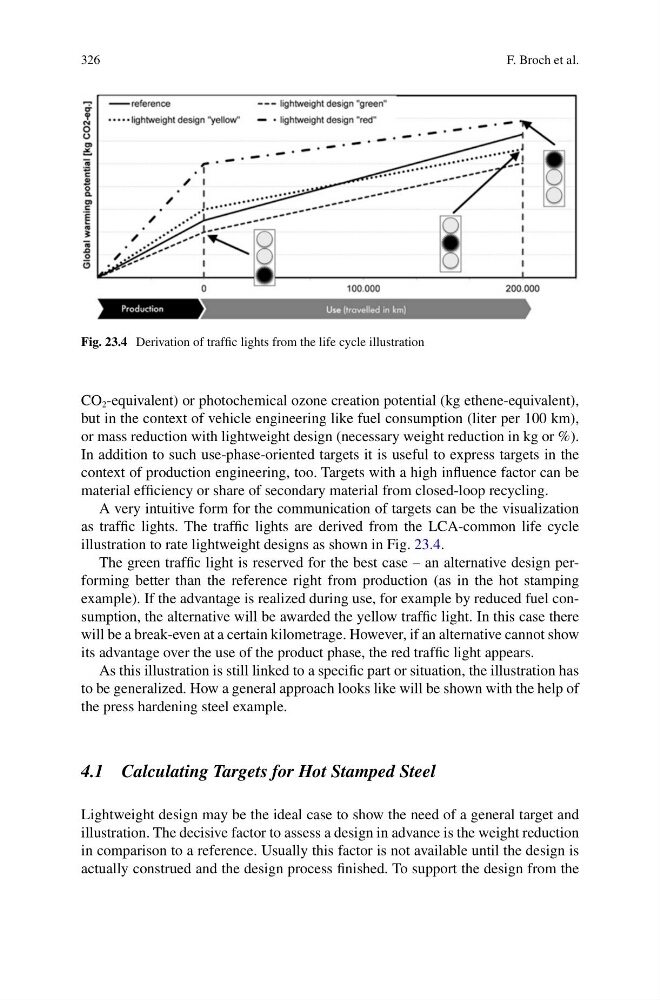
A very intuitive form for the communication of targets can be the visualization
as traffic lights. The traffic lights are derived from the LCA-common life cycle
illustration to rate lightweight designs as shown in Fig. 23.4.
The green traffic light is reserved for the best case – an alternative design performing better than the reference right from production (as in the hot stamping
example). If the advantage is realized during use, for example by reduced fuel consumption, the alternative will be awarded the yellow traffic light. In this case there
will be a break-even at a certain kilometrage. However, if an alternative cannot show
its advantage over the use of the product phase, the red traffic light appears.
As this illustration is still linked to a specific part or situation, the illustration has
to be generalized. How a general approach looks like will be shown with the help of
the press hardening steel example.
4.1 Calculating Targets for Hot Stamped Steel
Lightweight design may be the ideal case to show the need of a general target and
illustration. The decisive factor to assess a design in advance is the weight reduction
in comparison to a reference. Usually this factor is not available until the design is
actually construed and the design process finished. To support the design from the
Fig. 23.4 Derivation of traffic lights from the life cycle illustration
F. Broch et al.
CO 2 - equivalent) or photochemical ozone creation potential (kg ethene-equivalent),
but in the context of vehicle engineering like fuel consumption (liter per 100 km),
or mass reduction with lightweight design (necessary weight reduction in kg or %).
In addition to such use-phase-oriented targets it is useful to express targets in the
context of production engineering, too. Targets with a high influence factor can be
material efficiency or share of secondary material from closed-loop recycling.
A very intuitive form for the communication of targets can be the visualization
as traffic lights. The traffic lights are derived from the LCA-common life cycle
illustration to rate lightweight designs as shown in Fig. 23.4.
The green traffic light is reserved for the best case – an alternative design performing better than the reference right from production (as in the hot stamping
example). If the advantage is realized during use, for example by reduced fuel consumption, the alternative will be awarded the yellow traffic light. In this case there
will be a break-even at a certain kilometrage. However, if an alternative cannot show
its advantage over the use of the product phase, the red traffic light appears.
As this illustration is still linked to a specific part or situation, the illustration has
to be generalized. How a general approach looks like will be shown with the help of
the press hardening steel example.
4.1 Calculating Targets for Hot Stamped Steel
Lightweight design may be the ideal case to show the need of a general target and
illustration. The decisive factor to assess a design in advance is the weight reduction
in comparison to a reference. Usually this factor is not available until the design is
actually construed and the design process finished. To support the design from the
Fig. 23.4 Derivation of traffic lights from the life cycle illustration
F. Broch et al.