

311
best practice: in urban areas with a high renovation rate of sidewalks and lightweight traffi c pavements (≤15 years), asphalt is recommended for both sidewalks
and light-weight traffi c pavements: in contrast, concrete is the most suitable option
in urban areas with a low renovation rate of sidewalks (>40 years), whereas asphalt
has a maximum lifespan of 15 years and a high renovation rate is unfeasible. In
general, granite sidewalks are less environmentally due to the high resource intensive manufacture of granite tiles (Mendoza et al. 2012a , b , 2014a ).
3.2 Gas Network
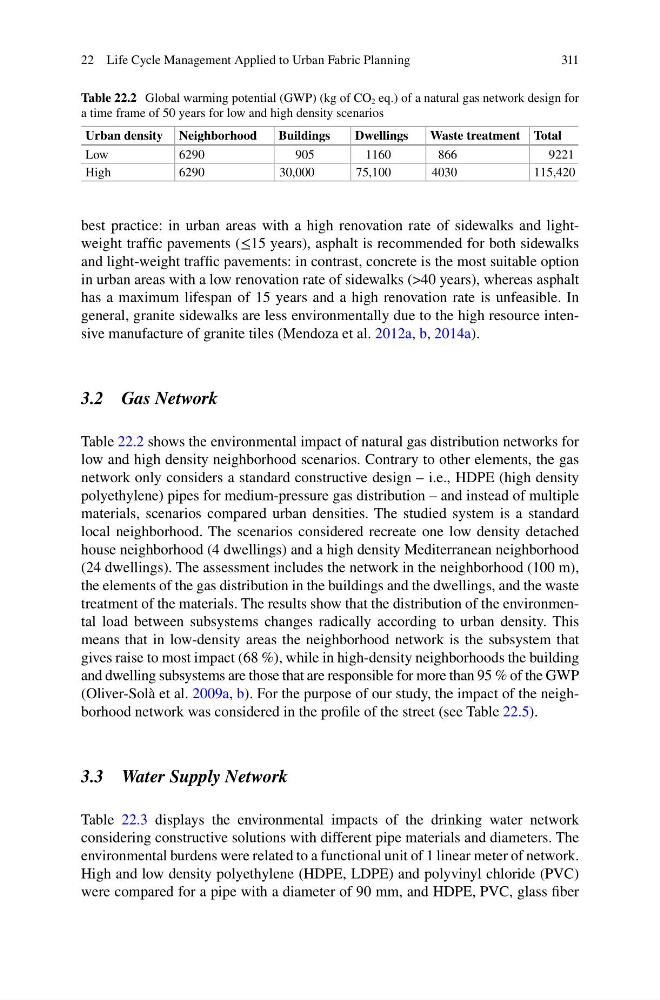
Table 22.2 shows the environmental impact of natural gas distribution networks for
low and high density neighborhood scenarios. Contrary to other elements, the gas
network only considers a standard constructive design – i.e., HDPE (high density
polyethylene) pipes for medium-pressure gas distribution – and instead of multiple
materials, scenarios compared urban densities. The studied system is a standard
local neighborhood. The scenarios considered recreate one low density detached
house neighborhood (4 dwellings) and a high density Mediterranean neighborhood
(24 dwellings). The assessment includes the network in the neighborhood (100 m),
the elements of the gas distribution in the buildings and the dwellings, and the waste
treatment of the materials. The results show that the distribution of the environmental load between subsystems changes radically according to urban density. This
means that in low-density areas the neighborhood network is the subsystem that
gives raise to most impact (68 %), while in high-density neighborhoods the building
and dwelling subsystems are those that are responsible for more than 95 % of the GWP
( Oliver-Solà et al. 2009a , b ). For the purpose of our study, the impact of the neighborhood network was considered in the profi le of the street (see Table 22.5 ).
3.3 Water Supply Network
Table 22.3 displays the environmental impacts of the drinking water network
considering constructive solutions with different pipe materials and diameters. The
environmental burdens were related to a functional unit of 1 linear meter of network.
High and low density polyethylene (HDPE, LDPE) and polyvinyl chloride (PVC)
were compared for a pipe with a diameter of 90 mm, and HDPE, PVC, glass fi ber
Table 22.2 Global warming potential (GWP) (kg of CO 2 eq.) of a natural gas network design for
a time frame of 50 years for low and high density scenarios
Urban density Neighborhood
Buildings
Dwellings
Waste treatment Total
Low
6290
905
1160
866
9221
High
6290
30,000
75,100
4030
115,420
22 Life Cycle Management Applied to Urban Fabric Planning
best practice: in urban areas with a high renovation rate of sidewalks and lightweight traffi c pavements (≤15 years), asphalt is recommended for both sidewalks
and light-weight traffi c pavements: in contrast, concrete is the most suitable option
in urban areas with a low renovation rate of sidewalks (>40 years), whereas asphalt
has a maximum lifespan of 15 years and a high renovation rate is unfeasible. In
general, granite sidewalks are less environmentally due to the high resource intensive manufacture of granite tiles (Mendoza et al. 2012a , b , 2014a ).
3.2 Gas Network
Table 22.2 shows the environmental impact of natural gas distribution networks for
low and high density neighborhood scenarios. Contrary to other elements, the gas
network only considers a standard constructive design – i.e., HDPE (high density
polyethylene) pipes for medium-pressure gas distribution – and instead of multiple
materials, scenarios compared urban densities. The studied system is a standard
local neighborhood. The scenarios considered recreate one low density detached
house neighborhood (4 dwellings) and a high density Mediterranean neighborhood
(24 dwellings). The assessment includes the network in the neighborhood (100 m),
the elements of the gas distribution in the buildings and the dwellings, and the waste
treatment of the materials. The results show that the distribution of the environmental load between subsystems changes radically according to urban density. This
means that in low-density areas the neighborhood network is the subsystem that
gives raise to most impact (68 %), while in high-density neighborhoods the building
and dwelling subsystems are those that are responsible for more than 95 % of the GWP
( Oliver-Solà et al. 2009a , b ). For the purpose of our study, the impact of the neighborhood network was considered in the profi le of the street (see Table 22.5 ).
3.3 Water Supply Network
Table 22.3 displays the environmental impacts of the drinking water network
considering constructive solutions with different pipe materials and diameters. The
environmental burdens were related to a functional unit of 1 linear meter of network.
High and low density polyethylene (HDPE, LDPE) and polyvinyl chloride (PVC)
were compared for a pipe with a diameter of 90 mm, and HDPE, PVC, glass fi ber
Table 22.2 Global warming potential (GWP) (kg of CO 2 eq.) of a natural gas network design for
a time frame of 50 years for low and high density scenarios
Urban density Neighborhood
Buildings
Dwellings
Waste treatment Total
Low
6290
905
1160
866
9221
High
6290
30,000
75,100
4030
115,420
22 Life Cycle Management Applied to Urban Fabric Planning