

310
3.1 Paved Skin: Sidewalks and Light-Weight Traffi c Road
Pavement
Table 22.1 shows the environmental impact of conventional designs of concrete,
asphalt and granite sidewalks to support pedestrian and light-weight traffi c in cities.
The design solutions have different service lives: 15 years for asphalt and 45 years
for concrete and granite. However, the GWP of each sidewalk changes according to
the variability of the service life of the constructive solutions. The shorter the service
life, the higher the number of maintenance and removal operations (top-layer
replacement) to restore the serviceability of the sidewalks during the period of
analysis (50 years). Thus, two maintenance scenarios were considered, e.g., high
and low maintenance rates. During this time frame, the most environmentally
friendly pavement design is the concrete top-layer, which had a GWP 6 % and 28 %
lower than asphalt and granite, respectively.
However, the environmental performance of pavements strongly depends on
their service life and a sensitivity assessment was conducted for a range of lifespan
from 5 to 45 years. When the same service life is considered for the three solutions
(i.e., lifespan is equivalent under certain exposure conditions), asphalt becomes the
2 m
6 m
2 m
1 m
W
W
S
S
Gas
Water supply
Subterranean pipelines
Sewer
G
W
S
G
G
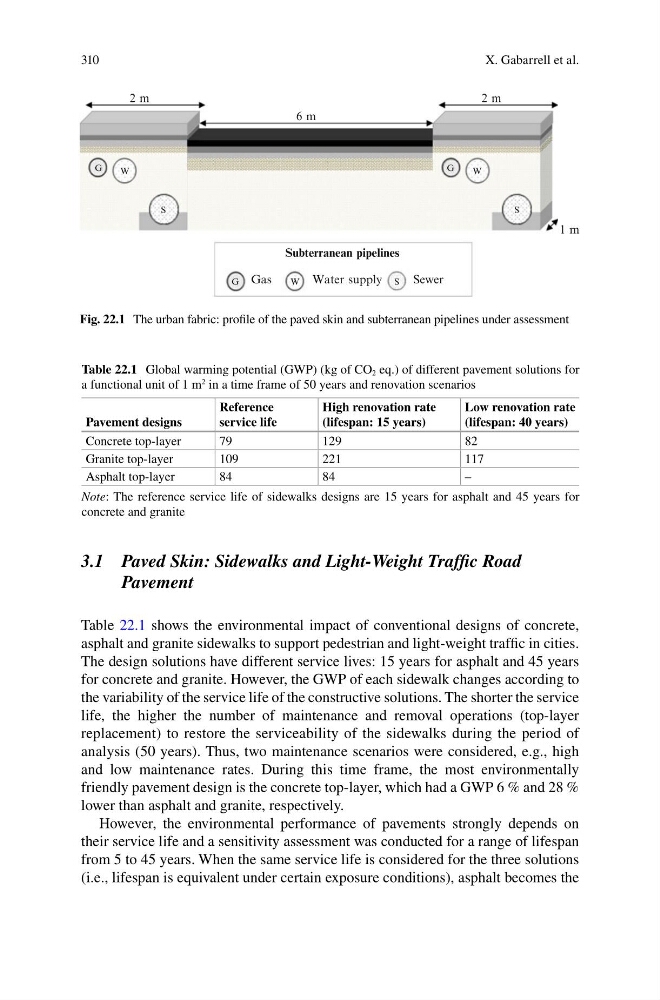
Fig. 22.1 The urban fabric: profi le of the paved skin and subterranean pipelines under assessment
Table 22.1 Global warming potential (GWP) (kg of CO 2 eq.) of different pavement solutions for
a functional unit of 1 m
2 in a time frame of 50 years and renovation scenarios
Pavement designs
Reference
service life
High renovation rate
(lifespan: 15 years)
Low renovation rate
(lifespan: 40 years)
Concrete top-layer
79
129
82
Granite top-layer
109
221
117
Asphalt top-layer
84
84
–
Note : The reference service life of sidewalks designs are 15 years for asphalt and 45 years for
concrete and granite
X. Gabarrell et al.
3.1 Paved Skin: Sidewalks and Light-Weight Traffi c Road
Pavement
Table 22.1 shows the environmental impact of conventional designs of concrete,
asphalt and granite sidewalks to support pedestrian and light-weight traffi c in cities.
The design solutions have different service lives: 15 years for asphalt and 45 years
for concrete and granite. However, the GWP of each sidewalk changes according to
the variability of the service life of the constructive solutions. The shorter the service
life, the higher the number of maintenance and removal operations (top-layer
replacement) to restore the serviceability of the sidewalks during the period of
analysis (50 years). Thus, two maintenance scenarios were considered, e.g., high
and low maintenance rates. During this time frame, the most environmentally
friendly pavement design is the concrete top-layer, which had a GWP 6 % and 28 %
lower than asphalt and granite, respectively.
However, the environmental performance of pavements strongly depends on
their service life and a sensitivity assessment was conducted for a range of lifespan
from 5 to 45 years. When the same service life is considered for the three solutions
(i.e., lifespan is equivalent under certain exposure conditions), asphalt becomes the
2 m
6 m
2 m
1 m
W
W
S
S
Gas
Water supply
Subterranean pipelines
Sewer
G
W
S
G
G
Fig. 22.1 The urban fabric: profi le of the paved skin and subterranean pipelines under assessment
Table 22.1 Global warming potential (GWP) (kg of CO 2 eq.) of different pavement solutions for
a functional unit of 1 m
2 in a time frame of 50 years and renovation scenarios
Pavement designs
Reference
service life
High renovation rate
(lifespan: 15 years)
Low renovation rate
(lifespan: 40 years)
Concrete top-layer
79
129
82
Granite top-layer
109
221
117
Asphalt top-layer
84
84
–
Note : The reference service life of sidewalks designs are 15 years for asphalt and 45 years for
concrete and granite
X. Gabarrell et al.