

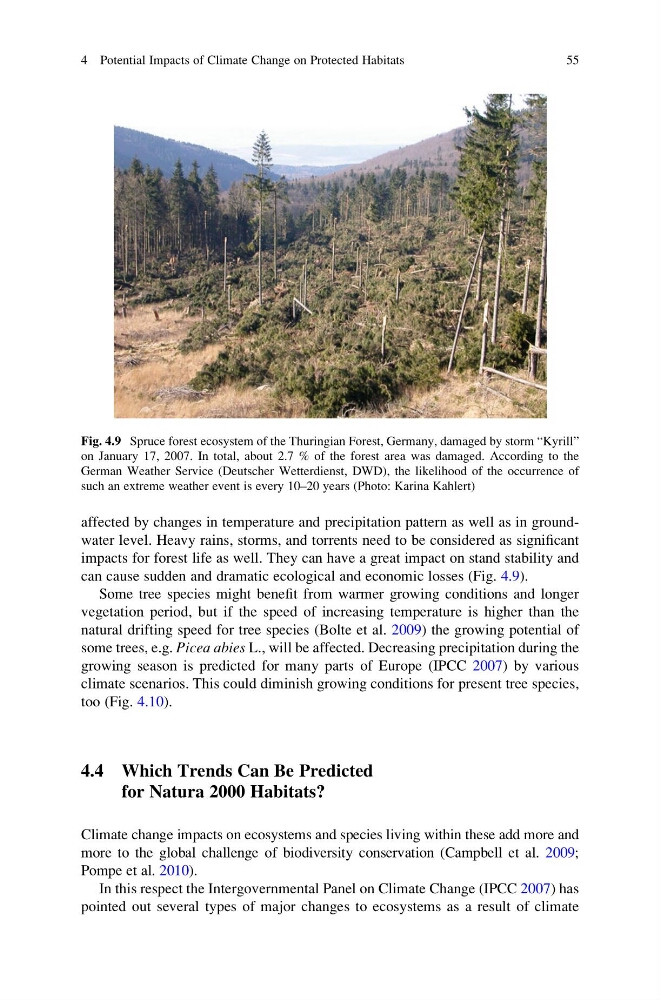
affected by changes in temperature and precipitation pattern as well as in groundwater level. Heavy rains, storms, and torrents need to be considered as significant
impacts for forest life as well. They can have a great impact on stand stability and
can cause sudden and dramatic ecological and economic losses (Fig. 4.9).
Some tree species might benefit from warmer growing conditions and longer
vegetation period, but if the speed of increasing temperature is higher than the
natural drifting speed for tree species (Bolte et al. 2009) the growing potential of
some trees, e.g. Picea abies L., will be affected. Decreasing precipitation during the
growing season is predicted for many parts of Europe (IPCC 2007) by various
climate scenarios. This could diminish growing conditions for present tree species,
too (Fig. 4.10).
4.4 Which Trends Can Be Predicted
for Natura 2000 Habitats?
Climate change impacts on ecosystems and species living within these add more and
more to the global challenge of biodiversity conservation (Campbell et al. 2009;
Pompe et al. 2010).
In this respect the Intergovernmental Panel on Climate Change (IPCC 2007) has
pointed out several types of major changes to ecosystems as a result of climate
Fig. 4.9 Spruce forest ecosystem of the Thuringian Forest, Germany, damaged by storm “Kyrill”
on January 17, 2007. In total, about 2.7 % of the forest area was damaged. According to the
German Weather Service (Deutscher Wetterdienst, DWD), the likelihood of the occurrence of
such an extreme weather event is every 10–20 years (Photo: Karina Kahlert)
4 Potential Impacts of Climate Change on Protected Habitats
55
impacts for forest life as well. They can have a great impact on stand stability and
can cause sudden and dramatic ecological and economic losses (Fig. 4.9).
Some tree species might benefit from warmer growing conditions and longer
vegetation period, but if the speed of increasing temperature is higher than the
natural drifting speed for tree species (Bolte et al. 2009) the growing potential of
some trees, e.g. Picea abies L., will be affected. Decreasing precipitation during the
growing season is predicted for many parts of Europe (IPCC 2007) by various
climate scenarios. This could diminish growing conditions for present tree species,
too (Fig. 4.10).
4.4 Which Trends Can Be Predicted
for Natura 2000 Habitats?
Climate change impacts on ecosystems and species living within these add more and
more to the global challenge of biodiversity conservation (Campbell et al. 2009;
Pompe et al. 2010).
In this respect the Intergovernmental Panel on Climate Change (IPCC 2007) has
pointed out several types of major changes to ecosystems as a result of climate
Fig. 4.9 Spruce forest ecosystem of the Thuringian Forest, Germany, damaged by storm “Kyrill”
on January 17, 2007. In total, about 2.7 % of the forest area was damaged. According to the
German Weather Service (Deutscher Wetterdienst, DWD), the likelihood of the occurrence of
such an extreme weather event is every 10–20 years (Photo: Karina Kahlert)
4 Potential Impacts of Climate Change on Protected Habitats
55