

affected by changes in seasonality (Milad et al. 2011; Profft and Frischbier 2009),
temperature increase, and changes in precipitation pattern. They are also sensitive
to increased drought stress associated with fluctuation in frequency, amplitude and
moment of a drought’s appearance, and to changes in groundwater level and in
flooding regime. Torrents, storms, and heavy rains can all be ranked as heavy
impacts. Cumulative impacts could lead to the loss of relevant and sensitive
species, changes in the structure of the forest community, drying out of forest
areas, an increased advantage of the propagation of pests, and improved conditions
for the development of alien plants. Monitoring data show a significant relation
between warmer growing conditions and the distribution and abundance of pest
insects, such as bark beetles on spruce or larch (e.g. Ips typographus Linne ´), as well
as oak processionary (Thaumetopoea processionea Linne ´) or horse chestnut leaf
miner (Cameraria ohridella Deschka and Dimic).
Temperate coniferous forests dominated by trees depending on water supply
(mesophytes, mesohygrophytes) and low temperatures (microthermophytes) are
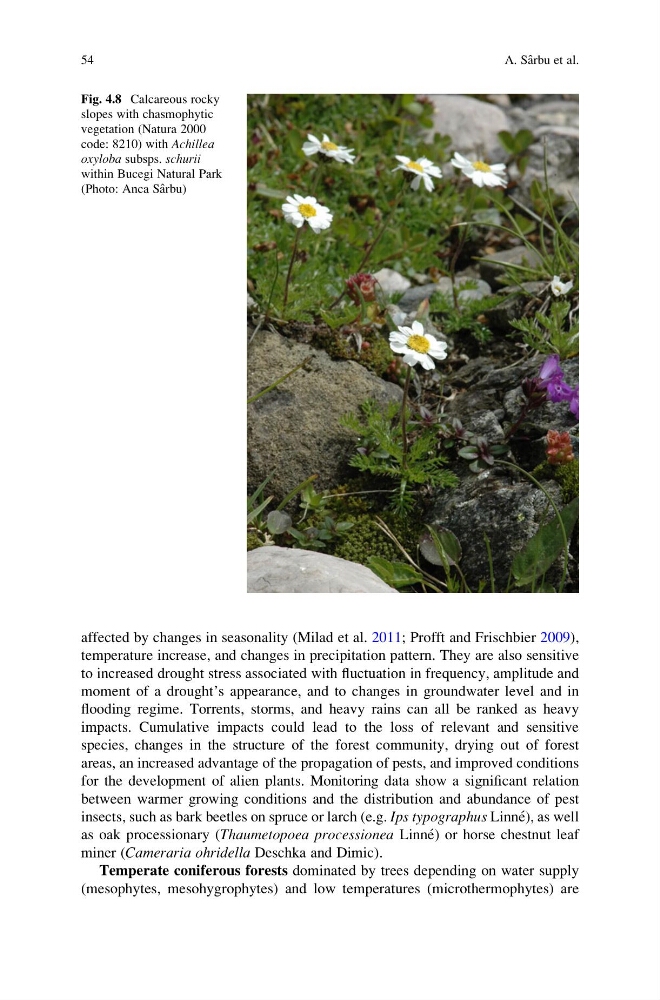
Fig. 4.8 Calcareous rocky
slopes with chasmophytic
vegetation (Natura 2000
code: 8210) with Achillea
oxyloba subsps. schurii
within Bucegi Natural Park
(Photo: Anca Sa ˆrbu)
54
A. Sa ˆrbu et al.
temperature increase, and changes in precipitation pattern. They are also sensitive
to increased drought stress associated with fluctuation in frequency, amplitude and
moment of a drought’s appearance, and to changes in groundwater level and in
flooding regime. Torrents, storms, and heavy rains can all be ranked as heavy
impacts. Cumulative impacts could lead to the loss of relevant and sensitive
species, changes in the structure of the forest community, drying out of forest
areas, an increased advantage of the propagation of pests, and improved conditions
for the development of alien plants. Monitoring data show a significant relation
between warmer growing conditions and the distribution and abundance of pest
insects, such as bark beetles on spruce or larch (e.g. Ips typographus Linne ´), as well
as oak processionary (Thaumetopoea processionea Linne ´) or horse chestnut leaf
miner (Cameraria ohridella Deschka and Dimic).
Temperate coniferous forests dominated by trees depending on water supply
(mesophytes, mesohygrophytes) and low temperatures (microthermophytes) are
Fig. 4.8 Calcareous rocky
slopes with chasmophytic
vegetation (Natura 2000
code: 8210) with Achillea
oxyloba subsps. schurii
within Bucegi Natural Park
(Photo: Anca Sa ˆrbu)
54
A. Sa ˆrbu et al.