

increase and drought, wildfires, or changes in soil quality, such erosion, soil
leaching, mineralisation of peat, and accumulation of organic material. Cumulative
effects can consist of changes in succession sequences, increasing tree cover and
spread of reed and alien plants, which affects bryophytes and other specialised
plants.
For rocky habitats and caves (Fig. 4.8) significant impacts are related to
temperature increases and precipitation decreases associated with permafrost melting and glacier retreat. Soil erosion and the frequency of avalanches as extreme
events also need to be considered. Among cumulative impacts the loss of the colder
climatic zone at high altitudes and a significant loss of plant species strongly
depending on vernalisation can be expected.
In this respect many plants found within Natura 2000 habitat type 8210 at Bucegi
Natural Park like the endemic Achillea oxyloba subsp. schurii (Sch.Bip.), Heimerl,
and the rare plants Androsace chamaejasme Wulfen, Asplenium adulterinum Milde,
Campanula carpatica Jacq. Saxifraga oppositifolia L., and Viola dacica Borba ´s s.o
can be considered under threat (Cioca ˆrlan 2009).
Forest of temperate Europe vegetation type will experience seasonal hydrological impacts on soils and related extreme events. Trees are especially negatively
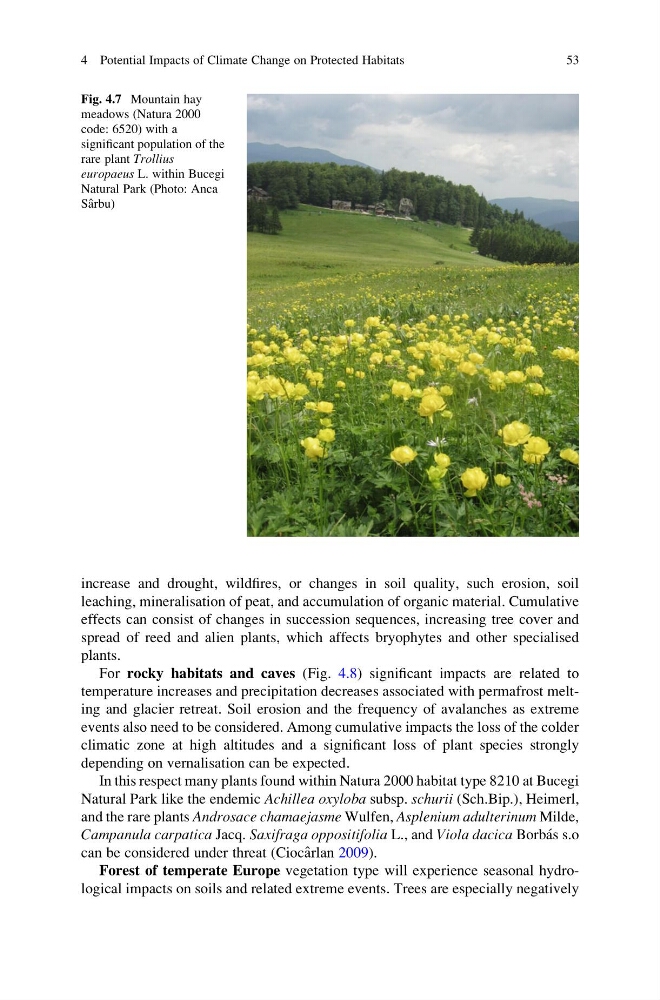
Fig. 4.7 Mountain hay
meadows (Natura 2000
code: 6520) with a
significant population of the
rare plant Trollius
europaeus L. within Bucegi
Natural Park (Photo: Anca
Sa ˆrbu)
4 Potential Impacts of Climate Change on Protected Habitats
53
leaching, mineralisation of peat, and accumulation of organic material. Cumulative
effects can consist of changes in succession sequences, increasing tree cover and
spread of reed and alien plants, which affects bryophytes and other specialised
plants.
For rocky habitats and caves (Fig. 4.8) significant impacts are related to
temperature increases and precipitation decreases associated with permafrost melting and glacier retreat. Soil erosion and the frequency of avalanches as extreme
events also need to be considered. Among cumulative impacts the loss of the colder
climatic zone at high altitudes and a significant loss of plant species strongly
depending on vernalisation can be expected.
In this respect many plants found within Natura 2000 habitat type 8210 at Bucegi
Natural Park like the endemic Achillea oxyloba subsp. schurii (Sch.Bip.), Heimerl,
and the rare plants Androsace chamaejasme Wulfen, Asplenium adulterinum Milde,
Campanula carpatica Jacq. Saxifraga oppositifolia L., and Viola dacica Borba ´s s.o
can be considered under threat (Cioca ˆrlan 2009).
Forest of temperate Europe vegetation type will experience seasonal hydrological impacts on soils and related extreme events. Trees are especially negatively
Fig. 4.7 Mountain hay
meadows (Natura 2000
code: 6520) with a
significant population of the
rare plant Trollius
europaeus L. within Bucegi
Natural Park (Photo: Anca
Sa ˆrbu)
4 Potential Impacts of Climate Change on Protected Habitats
53