

high temperature, and eutrophication, and will favour the expansion of drought
tolerant ones, the increase of scrub abundance, and will modify succession
sequences.
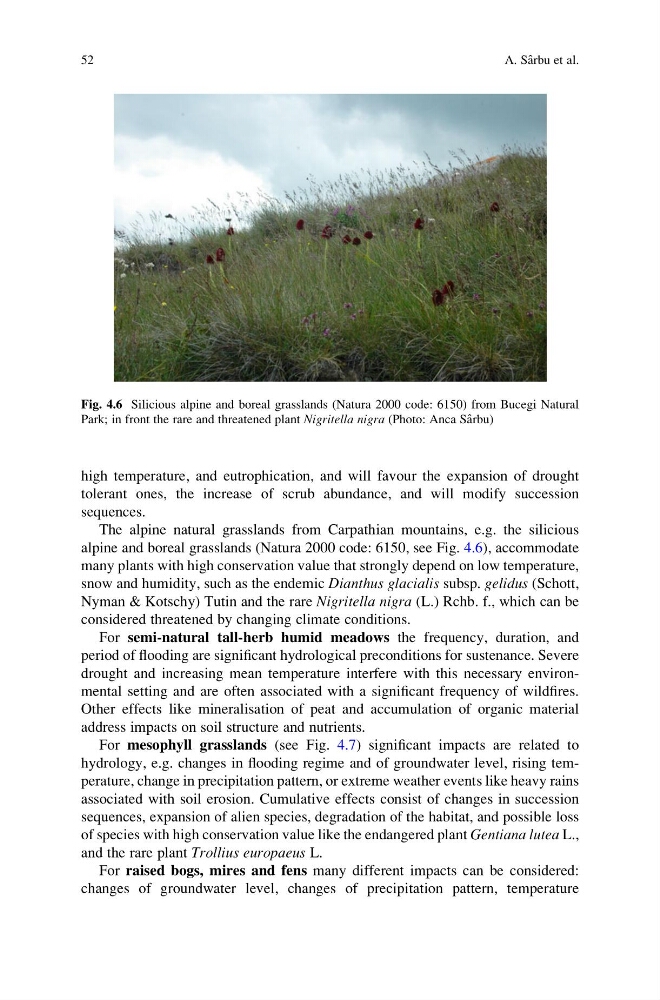
The alpine natural grasslands from Carpathian mountains, e.g. the silicious
alpine and boreal grasslands (Natura 2000 code: 6150, see Fig. 4.6), accommodate
many plants with high conservation value that strongly depend on low temperature,
snow and humidity, such as the endemic Dianthus glacialis subsp. gelidus (Schott,
Nyman & Kotschy) Tutin and the rare Nigritella nigra (L.) Rchb. f., which can be
considered threatened by changing climate conditions.
For semi-natural tall-herb humid meadows the frequency, duration, and
period of flooding are significant hydrological preconditions for sustenance. Severe
drought and increasing mean temperature interfere with this necessary environmental setting and are often associated with a significant frequency of wildfires.
Other effects like mineralisation of peat and accumulation of organic material
address impacts on soil structure and nutrients.
For mesophyll grasslands (see Fig. 4.7) significant impacts are related to
hydrology, e.g. changes in flooding regime and of groundwater level, rising temperature, change in precipitation pattern, or extreme weather events like heavy rains
associated with soil erosion. Cumulative effects consist of changes in succession
sequences, expansion of alien species, degradation of the habitat, and possible loss
of species with high conservation value like the endangered plant Gentiana lutea L.,
and the rare plant Trollius europaeus L.
For raised bogs, mires and fens many different impacts can be considered:
changes of groundwater level, changes of precipitation pattern, temperature
Fig. 4.6 Silicious alpine and boreal grasslands (Natura 2000 code: 6150) from Bucegi Natural
Park; in front the rare and threatened plant Nigritella nigra (Photo: Anca Sa ˆrbu)
52
A. Sa ˆrbu et al.
tolerant ones, the increase of scrub abundance, and will modify succession
sequences.
The alpine natural grasslands from Carpathian mountains, e.g. the silicious
alpine and boreal grasslands (Natura 2000 code: 6150, see Fig. 4.6), accommodate
many plants with high conservation value that strongly depend on low temperature,
snow and humidity, such as the endemic Dianthus glacialis subsp. gelidus (Schott,
Nyman & Kotschy) Tutin and the rare Nigritella nigra (L.) Rchb. f., which can be
considered threatened by changing climate conditions.
For semi-natural tall-herb humid meadows the frequency, duration, and
period of flooding are significant hydrological preconditions for sustenance. Severe
drought and increasing mean temperature interfere with this necessary environmental setting and are often associated with a significant frequency of wildfires.
Other effects like mineralisation of peat and accumulation of organic material
address impacts on soil structure and nutrients.
For mesophyll grasslands (see Fig. 4.7) significant impacts are related to
hydrology, e.g. changes in flooding regime and of groundwater level, rising temperature, change in precipitation pattern, or extreme weather events like heavy rains
associated with soil erosion. Cumulative effects consist of changes in succession
sequences, expansion of alien species, degradation of the habitat, and possible loss
of species with high conservation value like the endangered plant Gentiana lutea L.,
and the rare plant Trollius europaeus L.
For raised bogs, mires and fens many different impacts can be considered:
changes of groundwater level, changes of precipitation pattern, temperature
Fig. 4.6 Silicious alpine and boreal grasslands (Natura 2000 code: 6150) from Bucegi Natural
Park; in front the rare and threatened plant Nigritella nigra (Photo: Anca Sa ˆrbu)
52
A. Sa ˆrbu et al.