

Other significant examples can be found along the Slovenian seacoast of the
Mediterranean Sea (Sec ˇovlje Salina and S ˇ kocjan Inlet) where four different coastal
wetland habitat types are affected by sea-level rise: rush salt marches dominated by
Juncus maritimus Lam. and/or Juncus acutus L. (Natura 2000 code: 1410)
(Kaligaric ˇ and S ˇ kornik 2007), Spartina sp. Schreb. swards (Natura 2000 code:
1320), Salicornia sp. L., and other annuals colonising mud and sand (Natura
2000 code: 1310, see Fig. 4.2) and Mediterranean and thermo-Atlantic halophilic
scrub (Natura 2000 code: 1420).
The main threat to these four coastal habitat types is the rising sea-level. The
long-term trend of this process was 1 mm p.a., but in the past 25 years this trend
changed to 5 mm p.a. (Kaligaric ˇ and S ˇ kornik 2007). Considering this development
it is possible that many Mediterranean seacoast habitats will be flooded or changed
in the near future. The problem is that the enlargement of coastal habitats in case of
sea-level rise is impossible since they are surrounded by urban or industrial zones,
agricultural areas, or infrastructure. Buffer zones for potential migration usually do
not exist.
For sea dunes of the Atlantic, North Sea and Baltic coasts (plus Black Sea),
the major impact of climate change will be the decline of groundwater level.
The old and decalcified inland dunes are complex habitats including pioneer
communities of terophytes and lichen communities growing on barren lands (Gafta
and Mountford 2008). Hydrological changes and changes of soil structure can be
considered as significant impacts.
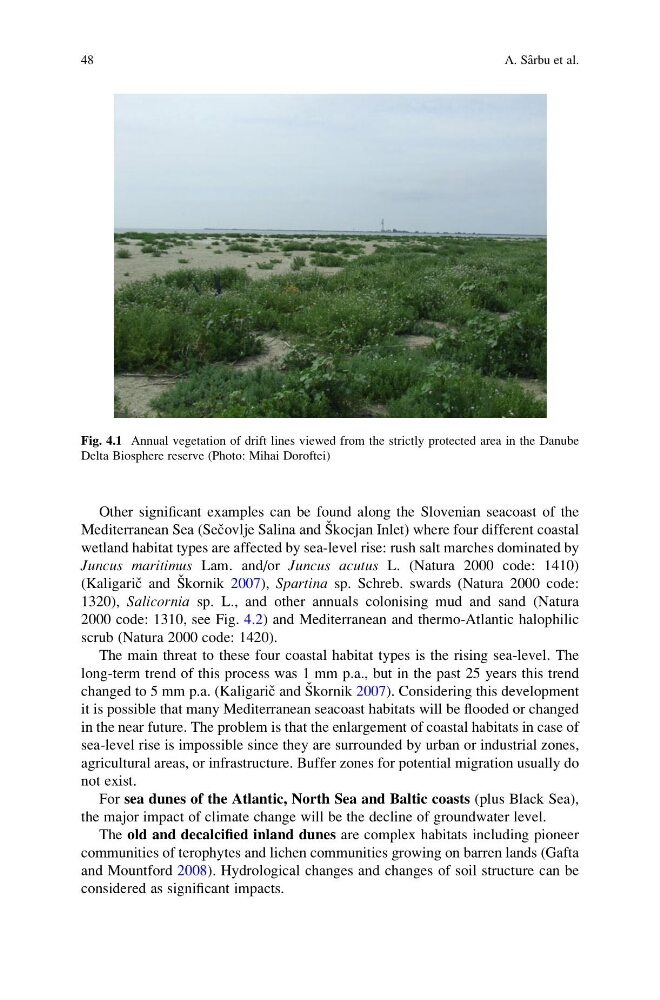
Fig. 4.1 Annual vegetation of drift lines viewed from the strictly protected area in the Danube
Delta Biosphere reserve (Photo: Mihai Doroftei)
48
A. Sa ˆrbu et al.
Mediterranean Sea (Sec ˇovlje Salina and S ˇ kocjan Inlet) where four different coastal
wetland habitat types are affected by sea-level rise: rush salt marches dominated by
Juncus maritimus Lam. and/or Juncus acutus L. (Natura 2000 code: 1410)
(Kaligaric ˇ and S ˇ kornik 2007), Spartina sp. Schreb. swards (Natura 2000 code:
1320), Salicornia sp. L., and other annuals colonising mud and sand (Natura
2000 code: 1310, see Fig. 4.2) and Mediterranean and thermo-Atlantic halophilic
scrub (Natura 2000 code: 1420).
The main threat to these four coastal habitat types is the rising sea-level. The
long-term trend of this process was 1 mm p.a., but in the past 25 years this trend
changed to 5 mm p.a. (Kaligaric ˇ and S ˇ kornik 2007). Considering this development
it is possible that many Mediterranean seacoast habitats will be flooded or changed
in the near future. The problem is that the enlargement of coastal habitats in case of
sea-level rise is impossible since they are surrounded by urban or industrial zones,
agricultural areas, or infrastructure. Buffer zones for potential migration usually do
not exist.
For sea dunes of the Atlantic, North Sea and Baltic coasts (plus Black Sea),
the major impact of climate change will be the decline of groundwater level.
The old and decalcified inland dunes are complex habitats including pioneer
communities of terophytes and lichen communities growing on barren lands (Gafta
and Mountford 2008). Hydrological changes and changes of soil structure can be
considered as significant impacts.
Fig. 4.1 Annual vegetation of drift lines viewed from the strictly protected area in the Danube
Delta Biosphere reserve (Photo: Mihai Doroftei)
48
A. Sa ˆrbu et al.