

4.3 Impacts of Climate Change on Natura 2000 Habitats
Out of 169 habitat types described in the EEA Natura 2000 Database of Europe,
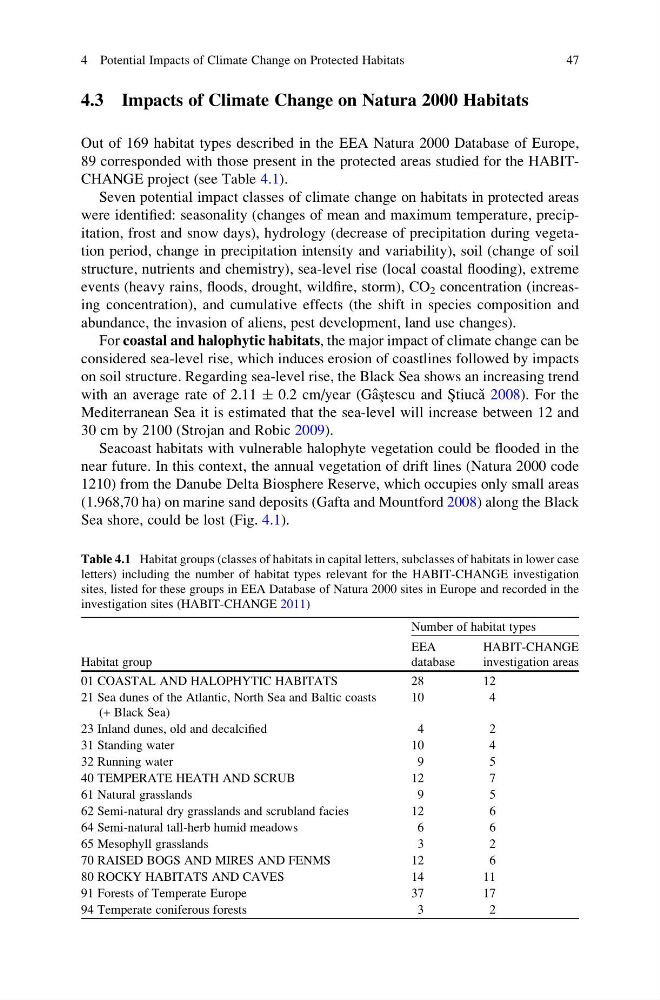
89 corresponded with those present in the protected areas studied for the HABITCHANGE project (see Table 4.1).
Seven potential impact classes of climate change on habitats in protected areas
were identified: seasonality (changes of mean and maximum temperature, precipitation, frost and snow days), hydrology (decrease of precipitation during vegetation period, change in precipitation intensity and variability), soil (change of soil
structure, nutrients and chemistry), sea-level rise (local coastal flooding), extreme
events (heavy rains, floods, drought, wildfire, storm), CO 2 concentration (increasing concentration), and cumulative effects (the shift in species composition and
abundance, the invasion of aliens, pest development, land use changes).
For coastal and halophytic habitats, the major impact of climate change can be
considered sea-level rise, which induces erosion of coastlines followed by impacts
on soil structure. Regarding sea-level rise, the Black Sea shows an increasing trend
with an average rate of 2.11 Æ 0.2 cm/year (Ga ˆs ¸tescu and S ¸ tiuca ˘ 2008). For the
Mediterranean Sea it is estimated that the sea-level will increase between 12 and
30 cm by 2100 (Strojan and Robic 2009).
Seacoast habitats with vulnerable halophyte vegetation could be flooded in the
near future. In this context, the annual vegetation of drift lines (Natura 2000 code
1210) from the Danube Delta Biosphere Reserve, which occupies only small areas
(1.968,70 ha) on marine sand deposits (Gafta and Mountford 2008) along the Black
Sea shore, could be lost (Fig. 4.1).
Table 4.1 Habitat groups (classes of habitats in capital letters, subclasses of habitats in lower case
letters) including the number of habitat types relevant for the HABIT-CHANGE investigation
sites, listed for these groups in EEA Database of Natura 2000 sites in Europe and recorded in the
investigation sites (HABIT-CHANGE 2011)
Habitat group
Number of habitat types
EEA
database
HABIT-CHANGE
investigation areas
01 COASTAL AND HALOPHYTIC HABITATS
28
12
21 Sea dunes of the Atlantic, North Sea and Baltic coasts
(+ Black Sea)
10
4
23 Inland dunes, old and decalcified
4
2
31 Standing water
10
4
32 Running water
9
5
40 TEMPERATE HEATH AND SCRUB
12
7
61 Natural grasslands
9
5
62 Semi-natural dry grasslands and scrubland facies
12
6
64 Semi-natural tall-herb humid meadows
6
6
65 Mesophyll grasslands
3
2
70 RAISED BOGS AND MIRES AND FENMS
12
6
80 ROCKY HABITATS AND CAVES
14
11
91 Forests of Temperate Europe
37
17
94 Temperate coniferous forests
3
2
4 Potential Impacts of Climate Change on Protected Habitats
47
Out of 169 habitat types described in the EEA Natura 2000 Database of Europe,
89 corresponded with those present in the protected areas studied for the HABITCHANGE project (see Table 4.1).
Seven potential impact classes of climate change on habitats in protected areas
were identified: seasonality (changes of mean and maximum temperature, precipitation, frost and snow days), hydrology (decrease of precipitation during vegetation period, change in precipitation intensity and variability), soil (change of soil
structure, nutrients and chemistry), sea-level rise (local coastal flooding), extreme
events (heavy rains, floods, drought, wildfire, storm), CO 2 concentration (increasing concentration), and cumulative effects (the shift in species composition and
abundance, the invasion of aliens, pest development, land use changes).
For coastal and halophytic habitats, the major impact of climate change can be
considered sea-level rise, which induces erosion of coastlines followed by impacts
on soil structure. Regarding sea-level rise, the Black Sea shows an increasing trend
with an average rate of 2.11 Æ 0.2 cm/year (Ga ˆs ¸tescu and S ¸ tiuca ˘ 2008). For the
Mediterranean Sea it is estimated that the sea-level will increase between 12 and
30 cm by 2100 (Strojan and Robic 2009).
Seacoast habitats with vulnerable halophyte vegetation could be flooded in the
near future. In this context, the annual vegetation of drift lines (Natura 2000 code
1210) from the Danube Delta Biosphere Reserve, which occupies only small areas
(1.968,70 ha) on marine sand deposits (Gafta and Mountford 2008) along the Black
Sea shore, could be lost (Fig. 4.1).
Table 4.1 Habitat groups (classes of habitats in capital letters, subclasses of habitats in lower case
letters) including the number of habitat types relevant for the HABIT-CHANGE investigation
sites, listed for these groups in EEA Database of Natura 2000 sites in Europe and recorded in the
investigation sites (HABIT-CHANGE 2011)
Habitat group
Number of habitat types
EEA
database
HABIT-CHANGE
investigation areas
01 COASTAL AND HALOPHYTIC HABITATS
28
12
21 Sea dunes of the Atlantic, North Sea and Baltic coasts
(+ Black Sea)
10
4
23 Inland dunes, old and decalcified
4
2
31 Standing water
10
4
32 Running water
9
5
40 TEMPERATE HEATH AND SCRUB
12
7
61 Natural grasslands
9
5
62 Semi-natural dry grasslands and scrubland facies
12
6
64 Semi-natural tall-herb humid meadows
6
6
65 Mesophyll grasslands
3
2
70 RAISED BOGS AND MIRES AND FENMS
12
6
80 ROCKY HABITATS AND CAVES
14
11
91 Forests of Temperate Europe
37
17
94 Temperate coniferous forests
3
2
4 Potential Impacts of Climate Change on Protected Habitats
47