

For standing water as well as for running water habitats, the most significant
impacts are hydrological changes affecting water regime and water level.
For running waters these factors can induce an irreversible alteration of flood
plain areas, river bed modification, or drying out of the river. Other relevant impacts
are changes in temperature regime, which influence the development pattern of
aquatic organisms and changes in bank ecotone conditions. Higher water temperature will cause water quality to deteriorate with a negative effect on microorganisms, benthic invertebrate, plankton species, and for different categories of aquatic
macrophytes (Campbell et al. 2009).
The majority of aquatic macrophytes in the Lower Danube river system belongs
to the mesothermophyte group (Elodea canadensis Michx., Ceratophyllum
demersum L., Potamogeton crispus L., P. nodosus Poir., P. pectinatus L.,
Vallisneria spiralis L. s.o.) (Popescu and Sanda 1998). In contrast some adventive
aquatic macrophytes as Elodea nuttallii (Planch.) H.St. John (Fig. 4.3) and Lemna
minuta Kunth (Fig. 4.4) prefer warmer water temperatures and can develop an
invasive behaviour in conditions of climate change. In this respect Elodea nuttallii,
a short-time adventive species in Romania (Cioca ˆrlan et al. 1998) was found in the
majority of the Romanian Danube river corridors 8 years after its first discovery
(Sa ˆrbu et al. 2006). Lemna minuta was first discovered in Romania within the
Danube Delta in 2011 (Cioca ˆrlan 2011).
As cumulative effects changes regarding the structure of aquatic biocoenosis and
the expansion of alien species, especially more thermophylic organisms, must be
expected.
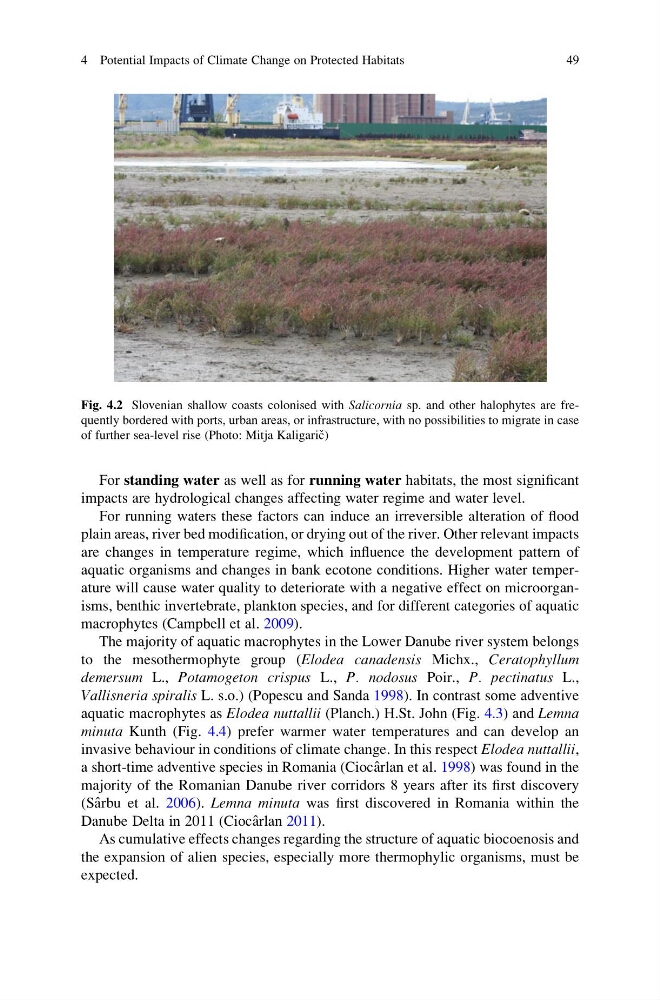
Fig. 4.2 Slovenian shallow coasts colonised with Salicornia sp. and other halophytes are frequently bordered with ports, urban areas, or infrastructure, with no possibilities to migrate in case
of further sea-level rise (Photo: Mitja Kaligaric ˇ)
4 Potential Impacts of Climate Change on Protected Habitats
49
impacts are hydrological changes affecting water regime and water level.
For running waters these factors can induce an irreversible alteration of flood
plain areas, river bed modification, or drying out of the river. Other relevant impacts
are changes in temperature regime, which influence the development pattern of
aquatic organisms and changes in bank ecotone conditions. Higher water temperature will cause water quality to deteriorate with a negative effect on microorganisms, benthic invertebrate, plankton species, and for different categories of aquatic
macrophytes (Campbell et al. 2009).
The majority of aquatic macrophytes in the Lower Danube river system belongs
to the mesothermophyte group (Elodea canadensis Michx., Ceratophyllum
demersum L., Potamogeton crispus L., P. nodosus Poir., P. pectinatus L.,
Vallisneria spiralis L. s.o.) (Popescu and Sanda 1998). In contrast some adventive
aquatic macrophytes as Elodea nuttallii (Planch.) H.St. John (Fig. 4.3) and Lemna
minuta Kunth (Fig. 4.4) prefer warmer water temperatures and can develop an
invasive behaviour in conditions of climate change. In this respect Elodea nuttallii,
a short-time adventive species in Romania (Cioca ˆrlan et al. 1998) was found in the
majority of the Romanian Danube river corridors 8 years after its first discovery
(Sa ˆrbu et al. 2006). Lemna minuta was first discovered in Romania within the
Danube Delta in 2011 (Cioca ˆrlan 2011).
As cumulative effects changes regarding the structure of aquatic biocoenosis and
the expansion of alien species, especially more thermophylic organisms, must be
expected.
Fig. 4.2 Slovenian shallow coasts colonised with Salicornia sp. and other halophytes are frequently bordered with ports, urban areas, or infrastructure, with no possibilities to migrate in case
of further sea-level rise (Photo: Mitja Kaligaric ˇ)
4 Potential Impacts of Climate Change on Protected Habitats
49