

The model output is taken from various regional model simulations driven by
different European Global Climate Models produced in the European project
ENSEMBLES (van der Linden and Mitchell 2009). The projections up to 2100
use a common forcing under A1B greenhouse gas emission scenario. The European
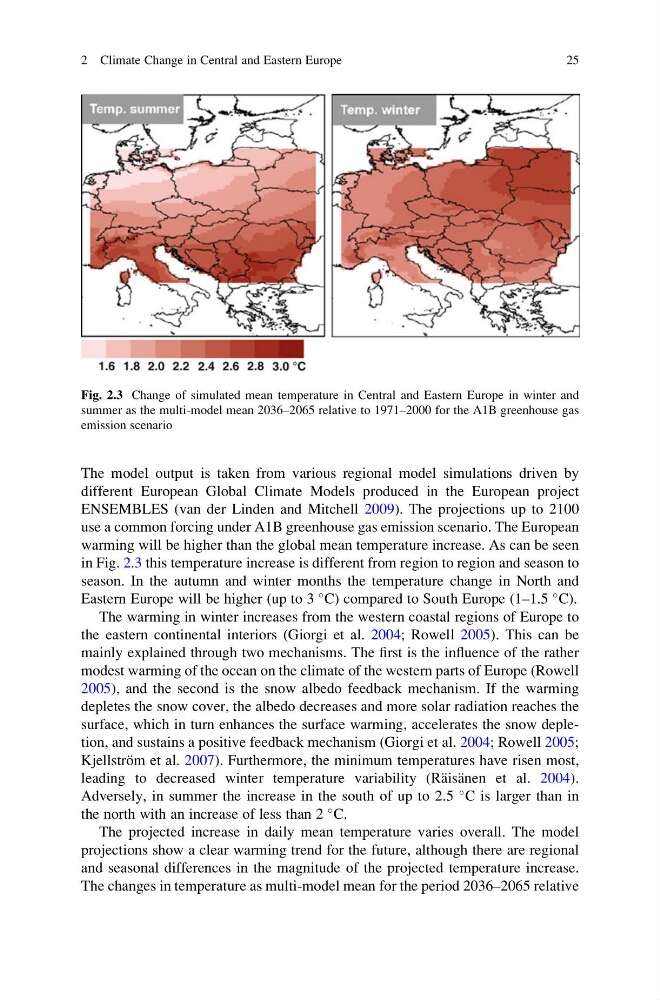
warming will be higher than the global mean temperature increase. As can be seen
in Fig. 2.3 this temperature increase is different from region to region and season to
season. In the autumn and winter months the temperature change in North and
Eastern Europe will be higher (up to 3
C) compared to South Europe (1–1.5
C).
The warming in winter increases from the western coastal regions of Europe to
the eastern continental interiors (Giorgi et al. 2004; Rowell 2005). This can be
mainly explained through two mechanisms. The first is the influence of the rather
modest warming of the ocean on the climate of the western parts of Europe (Rowell
2005), and the second is the snow albedo feedback mechanism. If the warming
depletes the snow cover, the albedo decreases and more solar radiation reaches the
surface, which in turn enhances the surface warming, accelerates the snow depletion, and sustains a positive feedback mechanism (Giorgi et al. 2004; Rowell 2005;
Kjellstro ¨m et al. 2007). Furthermore, the minimum temperatures have risen most,
leading to decreased winter temperature variability (Ra ¨isa ¨nen et al. 2004).
Adversely, in summer the increase in the south of up to 2.5
C is larger than in
the north with an increase of less than 2
C.
The projected increase in daily mean temperature varies overall. The model
projections show a clear warming trend for the future, although there are regional
and seasonal differences in the magnitude of the projected temperature increase.
The changes in temperature as multi-model mean for the period 2036–2065 relative
Fig. 2.3 Change of simulated mean temperature in Central and Eastern Europe in winter and
summer as the multi-model mean 2036–2065 relative to 1971–2000 for the A1B greenhouse gas
emission scenario
2 Climate Change in Central and Eastern Europe
25
different European Global Climate Models produced in the European project
ENSEMBLES (van der Linden and Mitchell 2009). The projections up to 2100
use a common forcing under A1B greenhouse gas emission scenario. The European
warming will be higher than the global mean temperature increase. As can be seen
in Fig. 2.3 this temperature increase is different from region to region and season to
season. In the autumn and winter months the temperature change in North and
Eastern Europe will be higher (up to 3
C) compared to South Europe (1–1.5
C).
The warming in winter increases from the western coastal regions of Europe to
the eastern continental interiors (Giorgi et al. 2004; Rowell 2005). This can be
mainly explained through two mechanisms. The first is the influence of the rather
modest warming of the ocean on the climate of the western parts of Europe (Rowell
2005), and the second is the snow albedo feedback mechanism. If the warming
depletes the snow cover, the albedo decreases and more solar radiation reaches the
surface, which in turn enhances the surface warming, accelerates the snow depletion, and sustains a positive feedback mechanism (Giorgi et al. 2004; Rowell 2005;
Kjellstro ¨m et al. 2007). Furthermore, the minimum temperatures have risen most,
leading to decreased winter temperature variability (Ra ¨isa ¨nen et al. 2004).
Adversely, in summer the increase in the south of up to 2.5
C is larger than in
the north with an increase of less than 2
C.
The projected increase in daily mean temperature varies overall. The model
projections show a clear warming trend for the future, although there are regional
and seasonal differences in the magnitude of the projected temperature increase.
The changes in temperature as multi-model mean for the period 2036–2065 relative
Fig. 2.3 Change of simulated mean temperature in Central and Eastern Europe in winter and
summer as the multi-model mean 2036–2065 relative to 1971–2000 for the A1B greenhouse gas
emission scenario
2 Climate Change in Central and Eastern Europe
25