

higher elevations. Runoff from the ridge has led to the formation of small raised
bogs and feeds a dense network of streams. Although Luzulo-Fagetum and
Asperulo-Fagetum beech forests are the predominant potential natural vegetation
types, the BR is dominated by single-layer Norway spruce (Picea abies (L.) Karst.)
monocultures established following historic overexploitation, calamities and subsequent intensive reforestation. Spruce forest types of higher conservational value
are mainly located around treeless ombrotrophic bogs and along the ridge. Except
for a handful of small populations, Silver fir – formerly a major component of
mixed mountain forests – has disappeared from the area in only a few decades due
to air pollution, acid deposition and unsuitable forest management. As most bogs
have been drained and subjected to forest management, the restoration and protection of these bogs was the main objective of the BR after its creation in 1979.
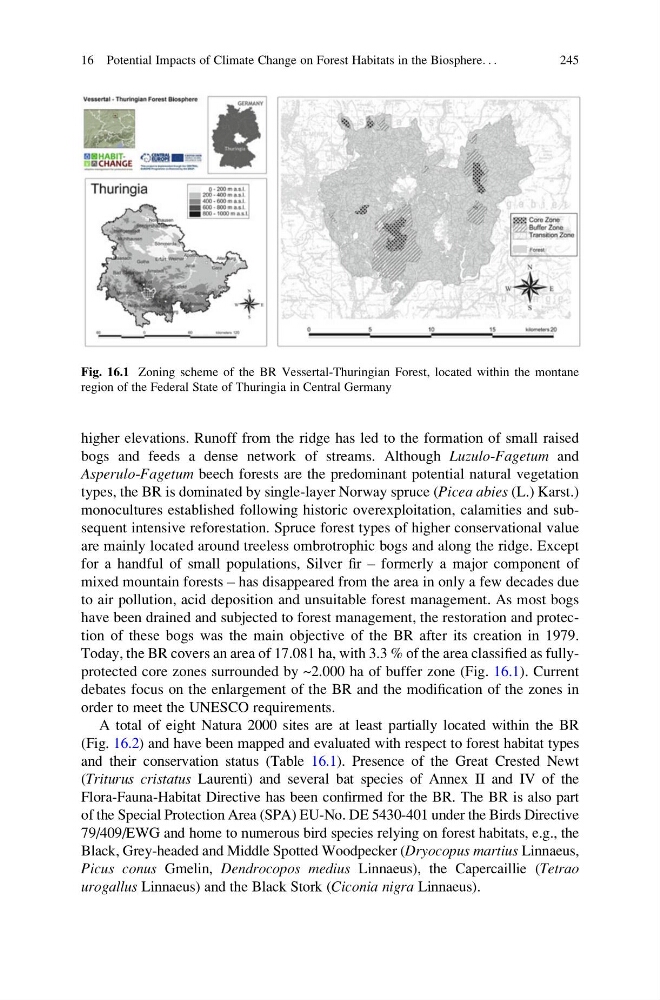
Today, the BR covers an area of 17.081 ha, with 3.3 % of the area classified as fullyprotected core zones surrounded by ~2.000 ha of buffer zone (Fig. 16.1). Current
debates focus on the enlargement of the BR and the modification of the zones in
order to meet the UNESCO requirements.
A total of eight Natura 2000 sites are at least partially located within the BR
(Fig. 16.2) and have been mapped and evaluated with respect to forest habitat types
and their conservation status (Table 16.1). Presence of the Great Crested Newt
(Triturus cristatus Laurenti) and several bat species of Annex II and IV of the
Flora-Fauna-Habitat Directive has been confirmed for the BR. The BR is also part
of the Special Protection Area (SPA) EU-No. DE 5430-401 under the Birds Directive
79/409/EWG and home to numerous bird species relying on forest habitats, e.g., the
Black, Grey-headed and Middle Spotted Woodpecker (Dryocopus martius Linnaeus,
Picus conus Gmelin, Dendrocopos medius Linnaeus), the Capercaillie (Tetrao
urogallus Linnaeus) and the Black Stork (Ciconia nigra Linnaeus).
Fig. 16.1 Zoning scheme of the BR Vessertal-Thuringian Forest, located within the montane
region of the Federal State of Thuringia in Central Germany
16 Potential Impacts of Climate Change on Forest Habitats in the Biosphere. . .
245
bogs and feeds a dense network of streams. Although Luzulo-Fagetum and
Asperulo-Fagetum beech forests are the predominant potential natural vegetation
types, the BR is dominated by single-layer Norway spruce (Picea abies (L.) Karst.)
monocultures established following historic overexploitation, calamities and subsequent intensive reforestation. Spruce forest types of higher conservational value
are mainly located around treeless ombrotrophic bogs and along the ridge. Except
for a handful of small populations, Silver fir – formerly a major component of
mixed mountain forests – has disappeared from the area in only a few decades due
to air pollution, acid deposition and unsuitable forest management. As most bogs
have been drained and subjected to forest management, the restoration and protection of these bogs was the main objective of the BR after its creation in 1979.
Today, the BR covers an area of 17.081 ha, with 3.3 % of the area classified as fullyprotected core zones surrounded by ~2.000 ha of buffer zone (Fig. 16.1). Current
debates focus on the enlargement of the BR and the modification of the zones in
order to meet the UNESCO requirements.
A total of eight Natura 2000 sites are at least partially located within the BR
(Fig. 16.2) and have been mapped and evaluated with respect to forest habitat types
and their conservation status (Table 16.1). Presence of the Great Crested Newt
(Triturus cristatus Laurenti) and several bat species of Annex II and IV of the
Flora-Fauna-Habitat Directive has been confirmed for the BR. The BR is also part
of the Special Protection Area (SPA) EU-No. DE 5430-401 under the Birds Directive
79/409/EWG and home to numerous bird species relying on forest habitats, e.g., the
Black, Grey-headed and Middle Spotted Woodpecker (Dryocopus martius Linnaeus,
Picus conus Gmelin, Dendrocopos medius Linnaeus), the Capercaillie (Tetrao
urogallus Linnaeus) and the Black Stork (Ciconia nigra Linnaeus).
Fig. 16.1 Zoning scheme of the BR Vessertal-Thuringian Forest, located within the montane
region of the Federal State of Thuringia in Central Germany
16 Potential Impacts of Climate Change on Forest Habitats in the Biosphere. . .
245