

will be far from uniform (Gregory et al. 2001; IPCC 2007). Thus, we believe that it
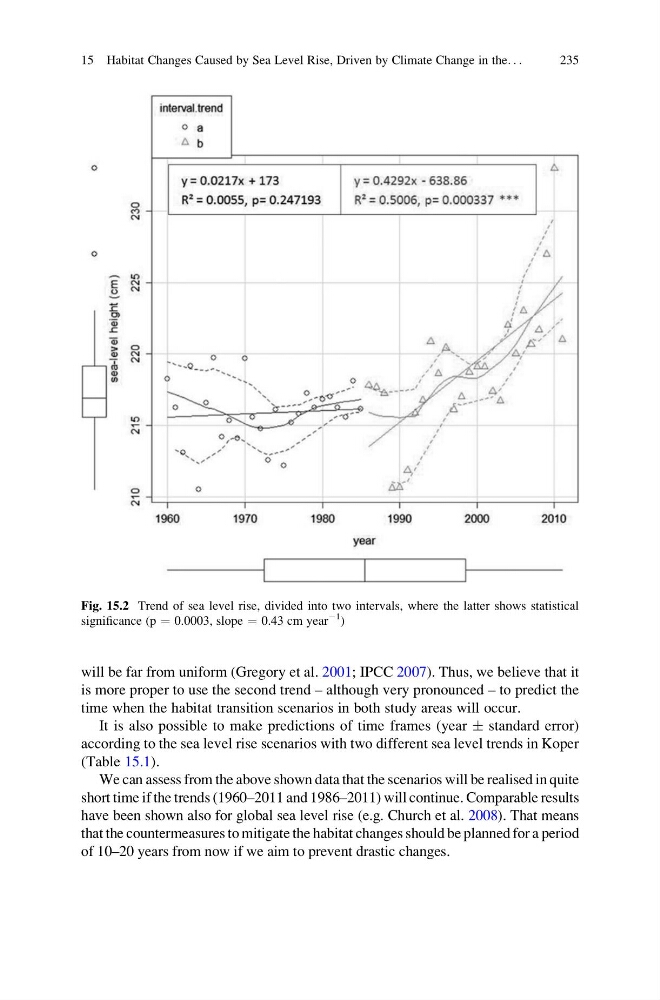
is more proper to use the second trend – although very pronounced – to predict the
time when the habitat transition scenarios in both study areas will occur.
It is also possible to make predictions of time frames (year Æ standard error)
according to the sea level rise scenarios with two different sea level trends in Koper
(Table 15.1).
We can assess from the above shown data that the scenarios will be realised in quite
short time if the trends (1960–2011 and 1986–2011) will continue. Comparable results
have been shown also for global sea level rise (e.g. Church et al. 2008). That means
that the countermeasures to mitigate the habitat changes should be planned for a period
of 10–20 years from now if we aim to prevent drastic changes.
Fig. 15.2 Trend of sea level rise, divided into two intervals, where the latter shows statistical
significance (p ¼ 0.0003, slope ¼ 0.43 cm year
À1
)
15 Habitat Changes Caused by Sea Level Rise, Driven by Climate Change in the. . .
235
is more proper to use the second trend – although very pronounced – to predict the
time when the habitat transition scenarios in both study areas will occur.
It is also possible to make predictions of time frames (year Æ standard error)
according to the sea level rise scenarios with two different sea level trends in Koper
(Table 15.1).
We can assess from the above shown data that the scenarios will be realised in quite
short time if the trends (1960–2011 and 1986–2011) will continue. Comparable results
have been shown also for global sea level rise (e.g. Church et al. 2008). That means
that the countermeasures to mitigate the habitat changes should be planned for a period
of 10–20 years from now if we aim to prevent drastic changes.
Fig. 15.2 Trend of sea level rise, divided into two intervals, where the latter shows statistical
significance (p ¼ 0.0003, slope ¼ 0.43 cm year
À1
)
15 Habitat Changes Caused by Sea Level Rise, Driven by Climate Change in the. . .
235