

15.2 The Investigated Areas
The two most important coastal wetlands in Slovenian seacoast are Sec ˇovlje Salina
(Sec ˇoveljske soline) and S ˇ kocjan Inlet (S ˇ kocjanski zatok). Sec ˇovlje salina area is a
Nature Park established in 2002, which covers about 650 ha along the SloveneCroatian boundary in the extreme south-western part of Slovenia. Its northern part,
where active salt-making is still taking place, is called Lera. From the Park’s
southern part, called Fontanigge, it is separated by the bed of the Drnica stream.
The Fontanigge is full of large basins which, are being gradually overgrown by
different types of halophile vegetation; many of them are classified as Natura 2000
habitats. The main freshwater vein is the Dragonja River, which after few tens of
kilometres joins the sea at the Sec ˇovlje salt-pans and creates a small estuary.
Despite the salina having been made by man in early Middle Ages, it is a mosaic
of natural habitats today, which contains not less than 6 Natura 2000 habitat types!
S ˇ kocjan Inlet Nature Reserve is a Mediterranean wetland established in 1998
and covering an area of 122 ha. Located at the outskirts of the town of Koper, the
reserve is commonly known as ‘the green heart of Koper’. After the restoration in
2007, S ˇ kocjan Inlet has regained its past biodiversity or it has even been improved
in terms of surface of coastal Natura 2000 habitats. After the vegetation succession
period of five years a lagoon with artificial islets at different altitudes enabled – the
development of mainly two valuable habitats dominated with halophytes.
15.3 Targeted Natura 2000 Habitats
There are two non-vegetated habitat types which are important predominately for
marine fauna and birds. Estuaries (N2000 code 1130, PAL.CLASS.: 13.2, 11.2)
are considered as a marine habitat and actually were not a subject of our study.
There are three estuarine habitats in the Sec ˇovlje Salina and none in S ˇ kocjan
Inlet. “Mudflats and sandflats not covered by seawater at low tide” (N2000 code
1140, PAL.CLASS.: 14) constitute a habitat type, widespread in both investigated
areas, important mainly for bird nesting and feeding. In both areas we can find very
small patches of the “tall rush salt marshes (communities of Juncetaliamaritimi)” or
“rush salt marshes dominated by Juncusmaritimus and/or J. acutus” (N2000 code
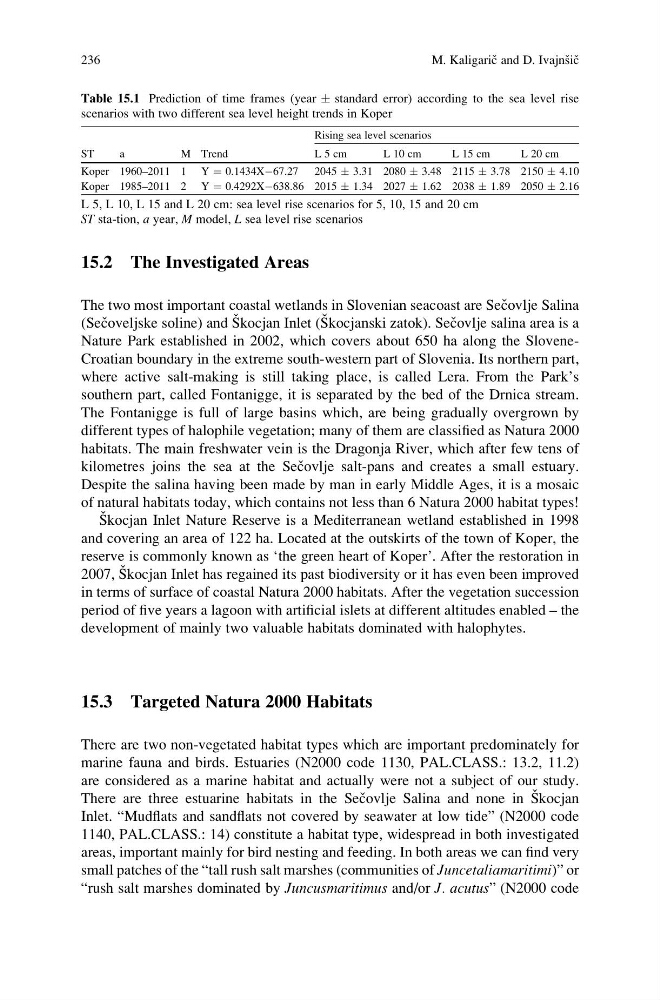
Table 15.1 Prediction of time frames (year Æ standard error) according to the sea level rise
scenarios with two different sea level height trends in Koper
ST
a
M Trend
Rising sea level scenarios
L 5 cm
L 10 cm
L 15 cm
L 20 cm
Koper 1960–2011 1 Y ¼ 0.1434XÀ67.27 2045 Æ 3.31 2080 Æ 3.48 2115 Æ 3.78 2150 Æ 4.10
Koper 1985–2011 2 Y ¼ 0.4292XÀ638.86 2015 Æ 1.34 2027 Æ 1.62 2038 Æ 1.89 2050 Æ 2.16
L 5, L 10, L 15 and L 20 cm: sea level rise scenarios for 5, 10, 15 and 20 cm
ST sta-tion, a year, M model, L sea level rise scenarios
236
M. Kaligaric ˇ and D. Ivajns ˇic ˇ
The two most important coastal wetlands in Slovenian seacoast are Sec ˇovlje Salina
(Sec ˇoveljske soline) and S ˇ kocjan Inlet (S ˇ kocjanski zatok). Sec ˇovlje salina area is a
Nature Park established in 2002, which covers about 650 ha along the SloveneCroatian boundary in the extreme south-western part of Slovenia. Its northern part,
where active salt-making is still taking place, is called Lera. From the Park’s
southern part, called Fontanigge, it is separated by the bed of the Drnica stream.
The Fontanigge is full of large basins which, are being gradually overgrown by
different types of halophile vegetation; many of them are classified as Natura 2000
habitats. The main freshwater vein is the Dragonja River, which after few tens of
kilometres joins the sea at the Sec ˇovlje salt-pans and creates a small estuary.
Despite the salina having been made by man in early Middle Ages, it is a mosaic
of natural habitats today, which contains not less than 6 Natura 2000 habitat types!
S ˇ kocjan Inlet Nature Reserve is a Mediterranean wetland established in 1998
and covering an area of 122 ha. Located at the outskirts of the town of Koper, the
reserve is commonly known as ‘the green heart of Koper’. After the restoration in
2007, S ˇ kocjan Inlet has regained its past biodiversity or it has even been improved
in terms of surface of coastal Natura 2000 habitats. After the vegetation succession
period of five years a lagoon with artificial islets at different altitudes enabled – the
development of mainly two valuable habitats dominated with halophytes.
15.3 Targeted Natura 2000 Habitats
There are two non-vegetated habitat types which are important predominately for
marine fauna and birds. Estuaries (N2000 code 1130, PAL.CLASS.: 13.2, 11.2)
are considered as a marine habitat and actually were not a subject of our study.
There are three estuarine habitats in the Sec ˇovlje Salina and none in S ˇ kocjan
Inlet. “Mudflats and sandflats not covered by seawater at low tide” (N2000 code
1140, PAL.CLASS.: 14) constitute a habitat type, widespread in both investigated
areas, important mainly for bird nesting and feeding. In both areas we can find very
small patches of the “tall rush salt marshes (communities of Juncetaliamaritimi)” or
“rush salt marshes dominated by Juncusmaritimus and/or J. acutus” (N2000 code
Table 15.1 Prediction of time frames (year Æ standard error) according to the sea level rise
scenarios with two different sea level height trends in Koper
ST
a
M Trend
Rising sea level scenarios
L 5 cm
L 10 cm
L 15 cm
L 20 cm
Koper 1960–2011 1 Y ¼ 0.1434XÀ67.27 2045 Æ 3.31 2080 Æ 3.48 2115 Æ 3.78 2150 Æ 4.10
Koper 1985–2011 2 Y ¼ 0.4292XÀ638.86 2015 Æ 1.34 2027 Æ 1.62 2038 Æ 1.89 2050 Æ 2.16
L 5, L 10, L 15 and L 20 cm: sea level rise scenarios for 5, 10, 15 and 20 cm
ST sta-tion, a year, M model, L sea level rise scenarios
236
M. Kaligaric ˇ and D. Ivajns ˇic ˇ