

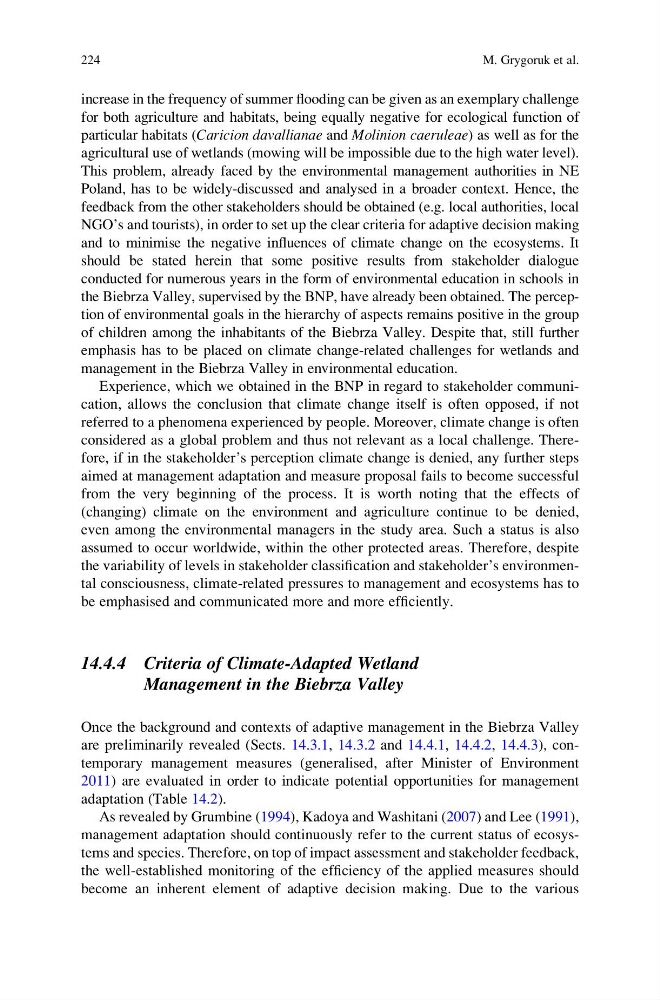
increase in the frequency of summer flooding can be given as an exemplary challenge
for both agriculture and habitats, being equally negative for ecological function of
particular habitats (Caricion davallianae and Molinion caeruleae) as well as for the
agricultural use of wetlands (mowing will be impossible due to the high water level).
This problem, already faced by the environmental management authorities in NE
Poland, has to be widely-discussed and analysed in a broader context. Hence, the
feedback from the other stakeholders should be obtained (e.g. local authorities, local
NGO’s and tourists), in order to set up the clear criteria for adaptive decision making
and to minimise the negative influences of climate change on the ecosystems. It
should be stated herein that some positive results from stakeholder dialogue
conducted for numerous years in the form of environmental education in schools in
the Biebrza Valley, supervised by the BNP, have already been obtained. The perception of environmental goals in the hierarchy of aspects remains positive in the group
of children among the inhabitants of the Biebrza Valley. Despite that, still further
emphasis has to be placed on climate change-related challenges for wetlands and
management in the Biebrza Valley in environmental education.
Experience, which we obtained in the BNP in regard to stakeholder communication, allows the conclusion that climate change itself is often opposed, if not
referred to a phenomena experienced by people. Moreover, climate change is often
considered as a global problem and thus not relevant as a local challenge. Therefore, if in the stakeholder’s perception climate change is denied, any further steps
aimed at management adaptation and measure proposal fails to become successful
from the very beginning of the process. It is worth noting that the effects of
(changing) climate on the environment and agriculture continue to be denied,
even among the environmental managers in the study area. Such a status is also
assumed to occur worldwide, within the other protected areas. Therefore, despite
the variability of levels in stakeholder classification and stakeholder’s environmental consciousness, climate-related pressures to management and ecosystems has to
be emphasised and communicated more and more efficiently.
14.4.4 Criteria of Climate-Adapted Wetland
Management in the Biebrza Valley
Once the background and contexts of adaptive management in the Biebrza Valley
are preliminarily revealed (Sects. 14.3.1, 14.3.2 and 14.4.1, 14.4.2, 14.4.3), contemporary management measures (generalised, after Minister of Environment
2011) are evaluated in order to indicate potential opportunities for management
adaptation (Table 14.2).
As revealed by Grumbine (1994), Kadoya and Washitani (2007) and Lee (1991),
management adaptation should continuously refer to the current status of ecosystems and species. Therefore, on top of impact assessment and stakeholder feedback,
the well-established monitoring of the efficiency of the applied measures should
become an inherent element of adaptive decision making. Due to the various
224
M. Grygoruk et al.
for both agriculture and habitats, being equally negative for ecological function of
particular habitats (Caricion davallianae and Molinion caeruleae) as well as for the
agricultural use of wetlands (mowing will be impossible due to the high water level).
This problem, already faced by the environmental management authorities in NE
Poland, has to be widely-discussed and analysed in a broader context. Hence, the
feedback from the other stakeholders should be obtained (e.g. local authorities, local
NGO’s and tourists), in order to set up the clear criteria for adaptive decision making
and to minimise the negative influences of climate change on the ecosystems. It
should be stated herein that some positive results from stakeholder dialogue
conducted for numerous years in the form of environmental education in schools in
the Biebrza Valley, supervised by the BNP, have already been obtained. The perception of environmental goals in the hierarchy of aspects remains positive in the group
of children among the inhabitants of the Biebrza Valley. Despite that, still further
emphasis has to be placed on climate change-related challenges for wetlands and
management in the Biebrza Valley in environmental education.
Experience, which we obtained in the BNP in regard to stakeholder communication, allows the conclusion that climate change itself is often opposed, if not
referred to a phenomena experienced by people. Moreover, climate change is often
considered as a global problem and thus not relevant as a local challenge. Therefore, if in the stakeholder’s perception climate change is denied, any further steps
aimed at management adaptation and measure proposal fails to become successful
from the very beginning of the process. It is worth noting that the effects of
(changing) climate on the environment and agriculture continue to be denied,
even among the environmental managers in the study area. Such a status is also
assumed to occur worldwide, within the other protected areas. Therefore, despite
the variability of levels in stakeholder classification and stakeholder’s environmental consciousness, climate-related pressures to management and ecosystems has to
be emphasised and communicated more and more efficiently.
14.4.4 Criteria of Climate-Adapted Wetland
Management in the Biebrza Valley
Once the background and contexts of adaptive management in the Biebrza Valley
are preliminarily revealed (Sects. 14.3.1, 14.3.2 and 14.4.1, 14.4.2, 14.4.3), contemporary management measures (generalised, after Minister of Environment
2011) are evaluated in order to indicate potential opportunities for management
adaptation (Table 14.2).
As revealed by Grumbine (1994), Kadoya and Washitani (2007) and Lee (1991),
management adaptation should continuously refer to the current status of ecosystems and species. Therefore, on top of impact assessment and stakeholder feedback,
the well-established monitoring of the efficiency of the applied measures should
become an inherent element of adaptive decision making. Due to the various
224
M. Grygoruk et al.