

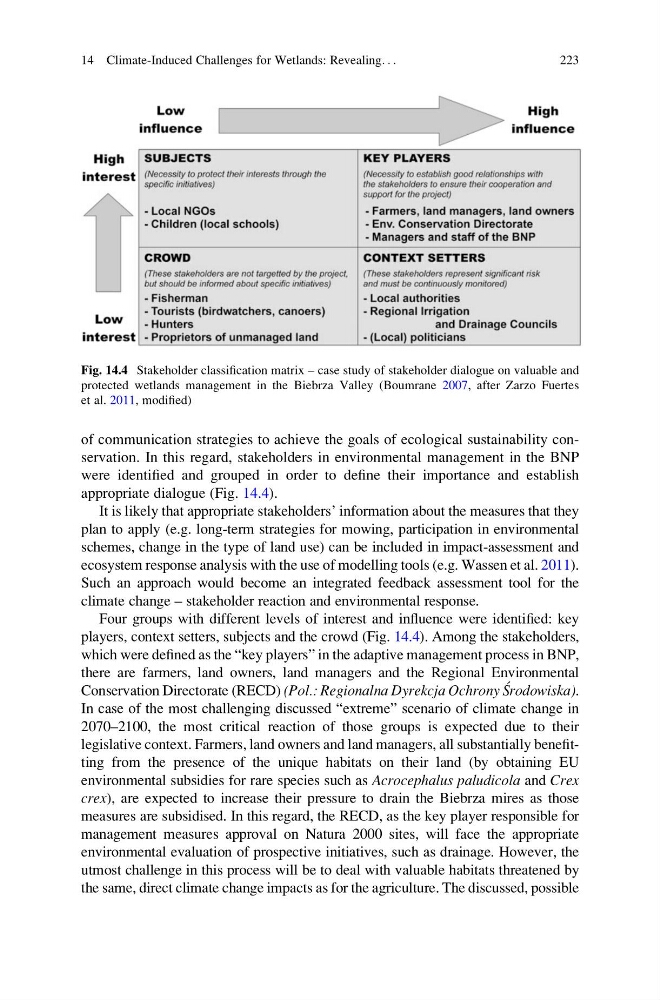
of communication strategies to achieve the goals of ecological sustainability conservation. In this regard, stakeholders in environmental management in the BNP
were identified and grouped in order to define their importance and establish
appropriate dialogue (Fig. 14.4).
It is likely that appropriate stakeholders’ information about the measures that they
plan to apply (e.g. long-term strategies for mowing, participation in environmental
schemes, change in the type of land use) can be included in impact-assessment and
ecosystem response analysis with the use of modelling tools (e.g. Wassen et al. 2011).
Such an approach would become an integrated feedback assessment tool for the
climate change – stakeholder reaction and environmental response.
Four groups with different levels of interest and influence were identified: key
players, context setters, subjects and the crowd (Fig. 14.4). Among the stakeholders,
which were defined as the “key players” in the adaptive management process in BNP,
there are farmers, land owners, land managers and the Regional Environmental
Conservation Directorate (RECD) (Pol.: Regionalna Dyrekcja Ochrony S ´ rodowiska).
In case of the most challenging discussed “extreme” scenario of climate change in
2070–2100, the most critical reaction of those groups is expected due to their
legislative context. Farmers, land owners and land managers, all substantially benefitting from the presence of the unique habitats on their land (by obtaining EU
environmental subsidies for rare species such as Acrocephalus paludicola and Crex
crex), are expected to increase their pressure to drain the Biebrza mires as those
measures are subsidised. In this regard, the RECD, as the key player responsible for
management measures approval on Natura 2000 sites, will face the appropriate
environmental evaluation of prospective initiatives, such as drainage. However, the
utmost challenge in this process will be to deal with valuable habitats threatened by
the same, direct climate change impacts as for the agriculture. The discussed, possible
Fig. 14.4 Stakeholder classification matrix – case study of stakeholder dialogue on valuable and
protected wetlands management in the Biebrza Valley (Boumrane 2007, after Zarzo Fuertes
et al. 2011, modified)
14 Climate-Induced Challenges for Wetlands: Revealing. . .
223
were identified and grouped in order to define their importance and establish
appropriate dialogue (Fig. 14.4).
It is likely that appropriate stakeholders’ information about the measures that they
plan to apply (e.g. long-term strategies for mowing, participation in environmental
schemes, change in the type of land use) can be included in impact-assessment and
ecosystem response analysis with the use of modelling tools (e.g. Wassen et al. 2011).
Such an approach would become an integrated feedback assessment tool for the
climate change – stakeholder reaction and environmental response.
Four groups with different levels of interest and influence were identified: key
players, context setters, subjects and the crowd (Fig. 14.4). Among the stakeholders,
which were defined as the “key players” in the adaptive management process in BNP,
there are farmers, land owners, land managers and the Regional Environmental
Conservation Directorate (RECD) (Pol.: Regionalna Dyrekcja Ochrony S ´ rodowiska).
In case of the most challenging discussed “extreme” scenario of climate change in
2070–2100, the most critical reaction of those groups is expected due to their
legislative context. Farmers, land owners and land managers, all substantially benefitting from the presence of the unique habitats on their land (by obtaining EU
environmental subsidies for rare species such as Acrocephalus paludicola and Crex
crex), are expected to increase their pressure to drain the Biebrza mires as those
measures are subsidised. In this regard, the RECD, as the key player responsible for
management measures approval on Natura 2000 sites, will face the appropriate
environmental evaluation of prospective initiatives, such as drainage. However, the
utmost challenge in this process will be to deal with valuable habitats threatened by
the same, direct climate change impacts as for the agriculture. The discussed, possible
Fig. 14.4 Stakeholder classification matrix – case study of stakeholder dialogue on valuable and
protected wetlands management in the Biebrza Valley (Boumrane 2007, after Zarzo Fuertes
et al. 2011, modified)
14 Climate-Induced Challenges for Wetlands: Revealing. . .
223