

8.2.3 Impact
In HABIT-CHANGE the term impact is considered as a change in the state of a
system caused by pressures like climate change or land use. The focus is set on
environmental impacts esp. on habitats. Climate impacts may be positive or negative.
They can be the result of extreme events or more gradual changes in climate variables
showing either direct or indirect effects. Examples for direct impacts are changed
abiotic conditions (e.g. soil moisture) for protected habitats. Examples of indirect
impacts are changes of agricultural practices due to increasing drought stress.
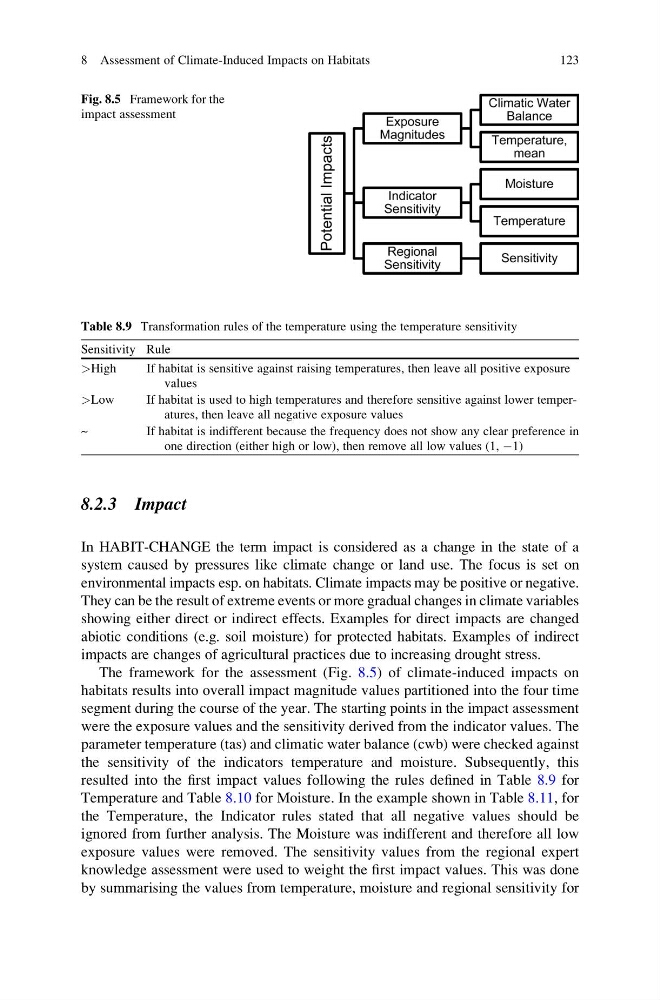
The framework for the assessment (Fig. 8.5) of climate-induced impacts on
habitats results into overall impact magnitude values partitioned into the four time
segment during the course of the year. The starting points in the impact assessment
were the exposure values and the sensitivity derived from the indicator values. The
parameter temperature (tas) and climatic water balance (cwb) were checked against
the sensitivity of the indicators temperature and moisture. Subsequently, this
resulted into the first impact values following the rules defined in Table 8.9 for
Temperature and Table 8.10 for Moisture. In the example shown in Table 8.11, for
the Temperature, the Indicator rules stated that all negative values should be
ignored from further analysis. The Moisture was indifferent and therefore all low
exposure values were removed. The sensitivity values from the regional expert
knowledge assessment were used to weight the first impact values. This was done
by summarising the values from temperature, moisture and regional sensitivity for
Fig. 8.5 Framework for the
impact assessment
Table 8.9 Transformation rules of the temperature using the temperature sensitivity
Sensitivity Rule
>High
If habitat is sensitive against raising temperatures, then leave all positive exposure
values
>Low
If habitat is used to high temperatures and therefore sensitive against lower temperatures, then leave all negative exposure values
~
If habitat is indifferent because the frequency does not show any clear preference in
one direction (either high or low), then remove all low values (1, À1)
8 Assessment of Climate-Induced Impacts on Habitats
123
In HABIT-CHANGE the term impact is considered as a change in the state of a
system caused by pressures like climate change or land use. The focus is set on
environmental impacts esp. on habitats. Climate impacts may be positive or negative.
They can be the result of extreme events or more gradual changes in climate variables
showing either direct or indirect effects. Examples for direct impacts are changed
abiotic conditions (e.g. soil moisture) for protected habitats. Examples of indirect
impacts are changes of agricultural practices due to increasing drought stress.
The framework for the assessment (Fig. 8.5) of climate-induced impacts on
habitats results into overall impact magnitude values partitioned into the four time
segment during the course of the year. The starting points in the impact assessment
were the exposure values and the sensitivity derived from the indicator values. The
parameter temperature (tas) and climatic water balance (cwb) were checked against
the sensitivity of the indicators temperature and moisture. Subsequently, this
resulted into the first impact values following the rules defined in Table 8.9 for
Temperature and Table 8.10 for Moisture. In the example shown in Table 8.11, for
the Temperature, the Indicator rules stated that all negative values should be
ignored from further analysis. The Moisture was indifferent and therefore all low
exposure values were removed. The sensitivity values from the regional expert
knowledge assessment were used to weight the first impact values. This was done
by summarising the values from temperature, moisture and regional sensitivity for
Fig. 8.5 Framework for the
impact assessment
Table 8.9 Transformation rules of the temperature using the temperature sensitivity
Sensitivity Rule
>High
If habitat is sensitive against raising temperatures, then leave all positive exposure
values
>Low
If habitat is used to high temperatures and therefore sensitive against lower temperatures, then leave all negative exposure values
~
If habitat is indifferent because the frequency does not show any clear preference in
one direction (either high or low), then remove all low values (1, À1)
8 Assessment of Climate-Induced Impacts on Habitats
123