

objectives of the national target program on poverty alleviation for 2010.
5 Poverty
rates reported by commune authorities are, without a doubt, generally influenced by
such forms of manipulation, which in turn are affected by social, political, administrative and budgetary factors.
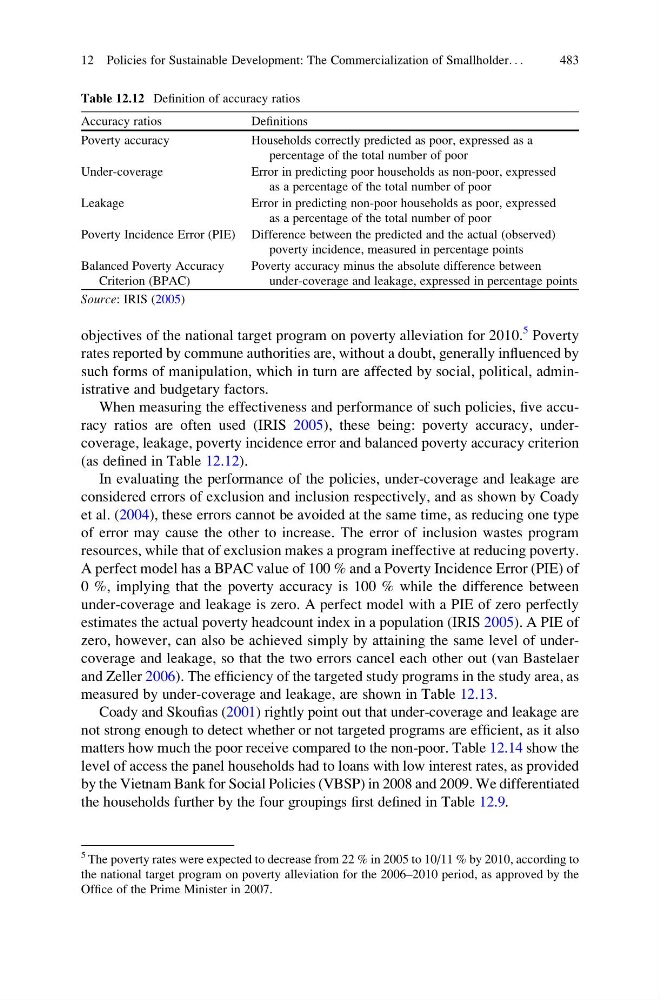
When measuring the effectiveness and performance of such policies, five accuracy ratios are often used (IRIS 2005), these being: poverty accuracy, undercoverage, leakage, poverty incidence error and balanced poverty accuracy criterion
(as defined in Table 12.12).
In evaluating the performance of the policies, under-coverage and leakage are
considered errors of exclusion and inclusion respectively, and as shown by Coady
et al. (2004), these errors cannot be avoided at the same time, as reducing one type
of error may cause the other to increase. The error of inclusion wastes program
resources, while that of exclusion makes a program ineffective at reducing poverty.
A perfect model has a BPAC value of 100 % and a Poverty Incidence Error (PIE) of
0 %, implying that the poverty accuracy is 100 % while the difference between
under-coverage and leakage is zero. A perfect model with a PIE of zero perfectly
estimates the actual poverty headcount index in a population (IRIS 2005). A PIE of
zero, however, can also be achieved simply by attaining the same level of undercoverage and leakage, so that the two errors cancel each other out (van Bastelaer
and Zeller 2006). The efficiency of the targeted study programs in the study area, as
measured by under-coverage and leakage, are shown in Table 12.13.
Coady and Skoufias (2001) rightly point out that under-coverage and leakage are
not strong enough to detect whether or not targeted programs are efficient, as it also
matters how much the poor receive compared to the non-poor. Table 12.14 show the
level of access the panel households had to loans with low interest rates, as provided
by the Vietnam Bank for Social Policies (VBSP) in 2008 and 2009. We differentiated
the households further by the four groupings first defined in Table 12.9.
Table 12.12 Definition of accuracy ratios
Accuracy ratios
Definitions
Poverty accuracy
Households correctly predicted as poor, expressed as a
percentage of the total number of poor
Under-coverage
Error in predicting poor households as non-poor, expressed
as a percentage of the total number of poor
Leakage
Error in predicting non-poor households as poor, expressed
as a percentage of the total number of poor
Poverty Incidence Error (PIE) Difference between the predicted and the actual (observed)
poverty incidence, measured in percentage points
Balanced Poverty Accuracy
Criterion (BPAC)
Poverty accuracy minus the absolute difference between
under-coverage and leakage, expressed in percentage points
Source: IRIS (2005)
5 The poverty rates were expected to decrease from 22 % in 2005 to 10/11 % by 2010, according to
the national target program on poverty alleviation for the 2006–2010 period, as approved by the
Office of the Prime Minister in 2007.
12 Policies for Sustainable Development: The Commercialization of Smallholder. . .
483
5 Poverty
rates reported by commune authorities are, without a doubt, generally influenced by
such forms of manipulation, which in turn are affected by social, political, administrative and budgetary factors.
When measuring the effectiveness and performance of such policies, five accuracy ratios are often used (IRIS 2005), these being: poverty accuracy, undercoverage, leakage, poverty incidence error and balanced poverty accuracy criterion
(as defined in Table 12.12).
In evaluating the performance of the policies, under-coverage and leakage are
considered errors of exclusion and inclusion respectively, and as shown by Coady
et al. (2004), these errors cannot be avoided at the same time, as reducing one type
of error may cause the other to increase. The error of inclusion wastes program
resources, while that of exclusion makes a program ineffective at reducing poverty.
A perfect model has a BPAC value of 100 % and a Poverty Incidence Error (PIE) of
0 %, implying that the poverty accuracy is 100 % while the difference between
under-coverage and leakage is zero. A perfect model with a PIE of zero perfectly
estimates the actual poverty headcount index in a population (IRIS 2005). A PIE of
zero, however, can also be achieved simply by attaining the same level of undercoverage and leakage, so that the two errors cancel each other out (van Bastelaer
and Zeller 2006). The efficiency of the targeted study programs in the study area, as
measured by under-coverage and leakage, are shown in Table 12.13.
Coady and Skoufias (2001) rightly point out that under-coverage and leakage are
not strong enough to detect whether or not targeted programs are efficient, as it also
matters how much the poor receive compared to the non-poor. Table 12.14 show the
level of access the panel households had to loans with low interest rates, as provided
by the Vietnam Bank for Social Policies (VBSP) in 2008 and 2009. We differentiated
the households further by the four groupings first defined in Table 12.9.
Table 12.12 Definition of accuracy ratios
Accuracy ratios
Definitions
Poverty accuracy
Households correctly predicted as poor, expressed as a
percentage of the total number of poor
Under-coverage
Error in predicting poor households as non-poor, expressed
as a percentage of the total number of poor
Leakage
Error in predicting non-poor households as poor, expressed
as a percentage of the total number of poor
Poverty Incidence Error (PIE) Difference between the predicted and the actual (observed)
poverty incidence, measured in percentage points
Balanced Poverty Accuracy
Criterion (BPAC)
Poverty accuracy minus the absolute difference between
under-coverage and leakage, expressed in percentage points
Source: IRIS (2005)
5 The poverty rates were expected to decrease from 22 % in 2005 to 10/11 % by 2010, according to
the national target program on poverty alleviation for the 2006–2010 period, as approved by the
Office of the Prime Minister in 2007.
12 Policies for Sustainable Development: The Commercialization of Smallholder. . .
483