

data (soil erosion, experimental data on the effects of fertilizers on crop
yields, crop nutrients and experiments on soil conservation practices), drawn
from literature about other upland regions bearing similar characteristics to the
study catchment – because this kind of data was unavailable for the study site.
10.6.2.3 Soil Conservation Practices
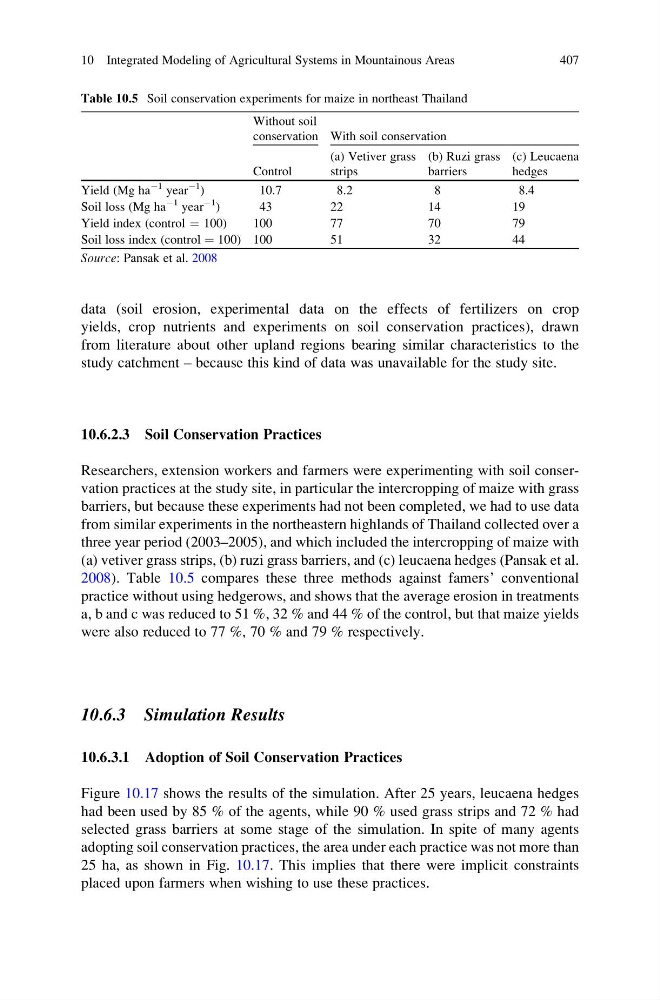
Researchers, extension workers and farmers were experimenting with soil conservation practices at the study site, in particular the intercropping of maize with grass
barriers, but because these experiments had not been completed, we had to use data
from similar experiments in the northeastern highlands of Thailand collected over a
three year period (2003–2005), and which included the intercropping of maize with
(a) vetiver grass strips, (b) ruzi grass barriers, and (c) leucaena hedges (Pansak et al.
2008). Table 10.5 compares these three methods against famers’ conventional
practice without using hedgerows, and shows that the average erosion in treatments
a, b and c was reduced to 51 %, 32 % and 44 % of the control, but that maize yields
were also reduced to 77 %, 70 % and 79 % respectively.
10.6.3 Simulation Results
10.6.3.1 Adoption of Soil Conservation Practices
Figure 10.17 shows the results of the simulation. After 25 years, leucaena hedges
had been used by 85 % of the agents, while 90 % used grass strips and 72 % had
selected grass barriers at some stage of the simulation. In spite of many agents
adopting soil conservation practices, the area under each practice was not more than
25 ha, as shown in Fig. 10.17. This implies that there were implicit constraints
placed upon farmers when wishing to use these practices.
Table 10.5 Soil conservation experiments for maize in northeast Thailand
Without soil
conservation With soil conservation
Control
(a) Vetiver grass
strips
(b) Ruzi grass
barriers
(c) Leucaena
hedges
Yield (Mg ha
À1 year
À1
)
10.7
8.2
8
8.4
Soil loss (Mg ha
À1 year
À1
)
4 3
2 2
1 4
1 9
Yield index (control ¼ 100)
100
77
70
79
Soil loss index (control ¼ 100) 100
51
32
44
Source: Pansak et al. 2008
10 Integrated Modeling of Agricultural Systems in Mountainous Areas
407
yields, crop nutrients and experiments on soil conservation practices), drawn
from literature about other upland regions bearing similar characteristics to the
study catchment – because this kind of data was unavailable for the study site.
10.6.2.3 Soil Conservation Practices
Researchers, extension workers and farmers were experimenting with soil conservation practices at the study site, in particular the intercropping of maize with grass
barriers, but because these experiments had not been completed, we had to use data
from similar experiments in the northeastern highlands of Thailand collected over a
three year period (2003–2005), and which included the intercropping of maize with
(a) vetiver grass strips, (b) ruzi grass barriers, and (c) leucaena hedges (Pansak et al.
2008). Table 10.5 compares these three methods against famers’ conventional
practice without using hedgerows, and shows that the average erosion in treatments
a, b and c was reduced to 51 %, 32 % and 44 % of the control, but that maize yields
were also reduced to 77 %, 70 % and 79 % respectively.
10.6.3 Simulation Results
10.6.3.1 Adoption of Soil Conservation Practices
Figure 10.17 shows the results of the simulation. After 25 years, leucaena hedges
had been used by 85 % of the agents, while 90 % used grass strips and 72 % had
selected grass barriers at some stage of the simulation. In spite of many agents
adopting soil conservation practices, the area under each practice was not more than
25 ha, as shown in Fig. 10.17. This implies that there were implicit constraints
placed upon farmers when wishing to use these practices.
Table 10.5 Soil conservation experiments for maize in northeast Thailand
Without soil
conservation With soil conservation
Control
(a) Vetiver grass
strips
(b) Ruzi grass
barriers
(c) Leucaena
hedges
Yield (Mg ha
À1 year
À1
)
10.7
8.2
8
8.4
Soil loss (Mg ha
À1 year
À1
)
4 3
2 2
1 4
1 9
Yield index (control ¼ 100)
100
77
70
79
Soil loss index (control ¼ 100) 100
51
32
44
Source: Pansak et al. 2008
10 Integrated Modeling of Agricultural Systems in Mountainous Areas
407