

were then converted to model soil fertility units using a linear, equidistant
approach. Overall, soil degradation was described as the overarching problem
constraining existing upland cropping systems. With the help of paper cards and
A0 paper sheets, participants linked an identified set of causes with those
consequences having a direct influence on soil fertility decline, these being:
(1) increased fertilizer application rates we used to circumvent declining crop
yields, (2) pest and disease pressure increased as a consequence of utilizing hybrid
seed varieties, (3) soil erosion and the abandonment of fallow periods reduced plot
water holding capacity, and (4) tillage by hoe and plow resulted in soil compaction.
10.4.2.4 FALLOW Model Simulations
The FALLOW model was calibrated based on the qualitative outputs of the focus
group discussions to simulate the period 1975–2008. Calibration was divided into
two parts by preparing factor maps to guide the location of future change, including
initial land cover, forest protection areas, inherent soil fertility and distance to
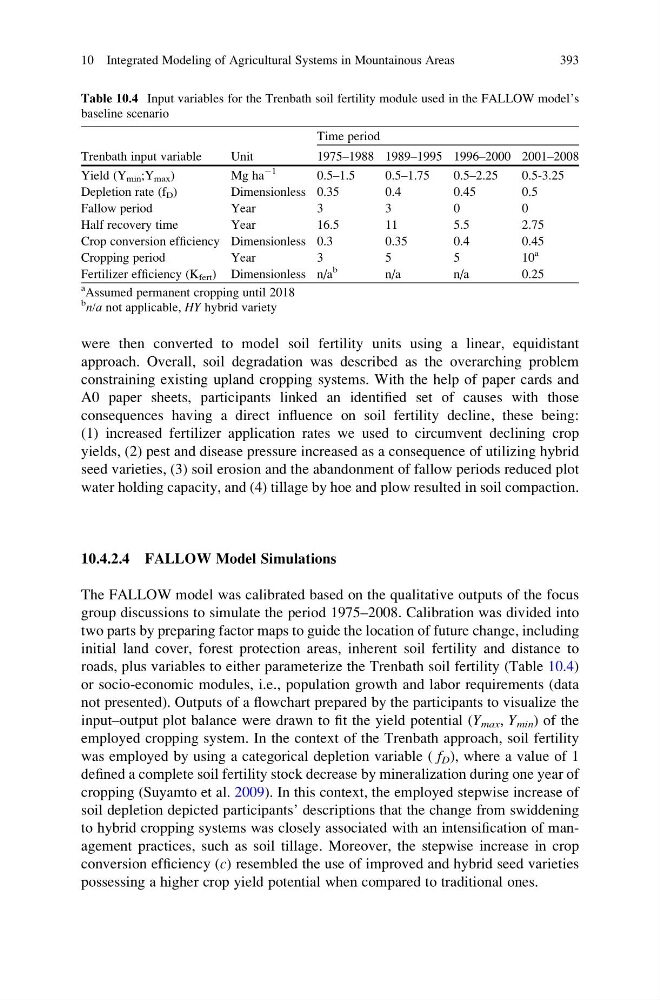
roads, plus variables to either parameterize the Trenbath soil fertility (Table 10.4)
or socio-economic modules, i.e., population growth and labor requirements (data
not presented). Outputs of a flowchart prepared by the participants to visualize the
input–output plot balance were drawn to fit the yield potential (Y max , Y min ) of the
employed cropping system. In the context of the Trenbath approach, soil fertility
was employed by using a categorical depletion variable ( f D ), where a value of 1
defined a complete soil fertility stock decrease by mineralization during one year of
cropping (Suyamto et al. 2009). In this context, the employed stepwise increase of
soil depletion depicted participants’ descriptions that the change from swiddening
to hybrid cropping systems was closely associated with an intensification of management practices, such as soil tillage. Moreover, the stepwise increase in crop
conversion efficiency (c) resembled the use of improved and hybrid seed varieties
possessing a higher crop yield potential when compared to traditional ones.
Table 10.4 Input variables for the Trenbath soil fertility module used in the FALLOW model’s
baseline scenario
Trenbath input variable
Unit
Time period
1975–1988 1989–1995 1996–2000 2001–2008
Yield (Y min ;Y max )
M gh a
À1
0.5–1.5
0.5–1.75
0.5–2.25
0.5-3.25
Depletion rate (f D )
Dimensionless 0.35
0.4
0.45
0.5
Fallow period
Year
3
3
0
0
Half recovery time
Year
16.5
11
5.5
2.75
Crop conversion efficiency Dimensionless 0.3
0.35
0.4
0.45
Cropping period
Year
3
5
5
10
a
Fertilizer efficiency (K fert ) Dimensionless n/a
b
n/a
n/a
0.25
a
Assumed permanent cropping until 2018
b
n/a not applicable, HY hybrid variety
10 Integrated Modeling of Agricultural Systems in Mountainous Areas
393
approach. Overall, soil degradation was described as the overarching problem
constraining existing upland cropping systems. With the help of paper cards and
A0 paper sheets, participants linked an identified set of causes with those
consequences having a direct influence on soil fertility decline, these being:
(1) increased fertilizer application rates we used to circumvent declining crop
yields, (2) pest and disease pressure increased as a consequence of utilizing hybrid
seed varieties, (3) soil erosion and the abandonment of fallow periods reduced plot
water holding capacity, and (4) tillage by hoe and plow resulted in soil compaction.
10.4.2.4 FALLOW Model Simulations
The FALLOW model was calibrated based on the qualitative outputs of the focus
group discussions to simulate the period 1975–2008. Calibration was divided into
two parts by preparing factor maps to guide the location of future change, including
initial land cover, forest protection areas, inherent soil fertility and distance to
roads, plus variables to either parameterize the Trenbath soil fertility (Table 10.4)
or socio-economic modules, i.e., population growth and labor requirements (data
not presented). Outputs of a flowchart prepared by the participants to visualize the
input–output plot balance were drawn to fit the yield potential (Y max , Y min ) of the
employed cropping system. In the context of the Trenbath approach, soil fertility
was employed by using a categorical depletion variable ( f D ), where a value of 1
defined a complete soil fertility stock decrease by mineralization during one year of
cropping (Suyamto et al. 2009). In this context, the employed stepwise increase of
soil depletion depicted participants’ descriptions that the change from swiddening
to hybrid cropping systems was closely associated with an intensification of management practices, such as soil tillage. Moreover, the stepwise increase in crop
conversion efficiency (c) resembled the use of improved and hybrid seed varieties
possessing a higher crop yield potential when compared to traditional ones.
Table 10.4 Input variables for the Trenbath soil fertility module used in the FALLOW model’s
baseline scenario
Trenbath input variable
Unit
Time period
1975–1988 1989–1995 1996–2000 2001–2008
Yield (Y min ;Y max )
M gh a
À1
0.5–1.5
0.5–1.75
0.5–2.25
0.5-3.25
Depletion rate (f D )
Dimensionless 0.35
0.4
0.45
0.5
Fallow period
Year
3
3
0
0
Half recovery time
Year
16.5
11
5.5
2.75
Crop conversion efficiency Dimensionless 0.3
0.35
0.4
0.45
Cropping period
Year
3
5
5
10
a
Fertilizer efficiency (K fert ) Dimensionless n/a
b
n/a
n/a
0.25
a
Assumed permanent cropping until 2018
b
n/a not applicable, HY hybrid variety
10 Integrated Modeling of Agricultural Systems in Mountainous Areas
393