

conducted with local stakeholders, to jointly analyze the determining factors leading
to the upland cropping patterns to be found in Ban Put village. For this purpose, a set of
model input parameters was chosen to guide the participative discussions, comprising
endogenous variables related to farmers’ decisions on land use intensification, field
management and its ecological consequences, and exogenous variables covering the
distance to cropping fields, population growth and the influence of land use policies.
Overall, 32 participants joined the focus group discussions – representing local
administrative organizations, villagers and upland farmers. To reduce output bias,
discussion groups were split into younger (18–40 years-old) and older (41–65 yearsold) participants, as well as male and female groups.
10.4.2.3 Summary of Participative Discussion Findings
Participants described four historical time periods in the evolution of their upland
cropping system, namely 1975–1988, 1988–1995, 1995–2000 and 2000–2008.
Over this period, land tenure changed from cooperative to individual land use
rights, and cropping areas expanded from foothills and moderate slopes to steep
slopes and hilltop positions. This change in upland cropping was characterized by
the abandonment of swidden agriculture and the adoption of continuous cropping
systems with a shift from upland rice, traditional maize and cassava, to hybrid
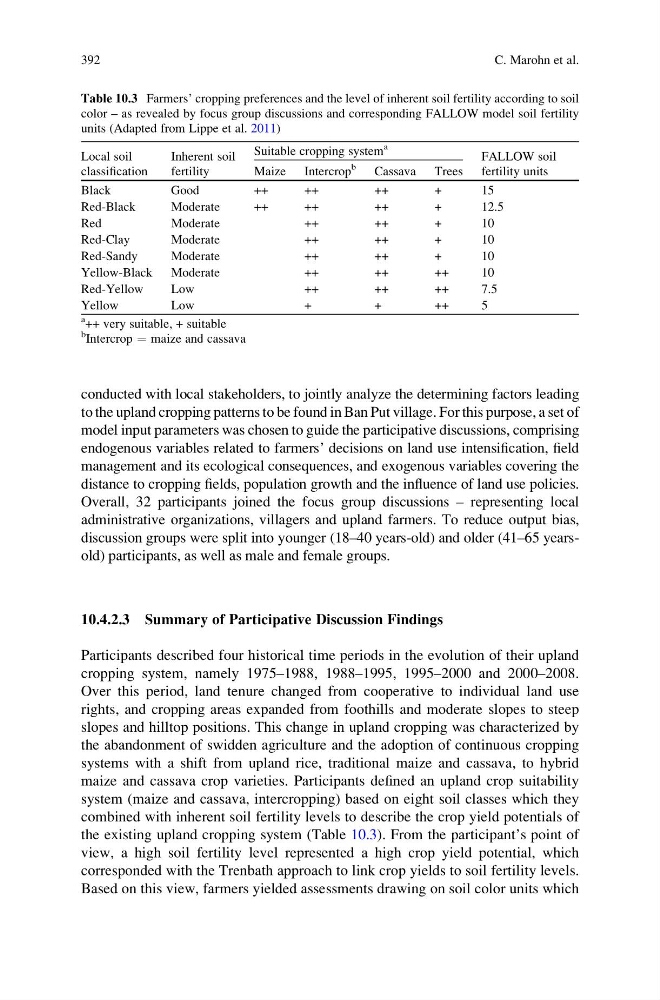
maize and cassava crop varieties. Participants defined an upland crop suitability
system (maize and cassava, intercropping) based on eight soil classes which they
combined with inherent soil fertility levels to describe the crop yield potentials of
the existing upland cropping system (Table 10.3). From the participant’s point of
view, a high soil fertility level represented a high crop yield potential, which
corresponded with the Trenbath approach to link crop yields to soil fertility levels.
Based on this view, farmers yielded assessments drawing on soil color units which
Table 10.3 Farmers’ cropping preferences and the level of inherent soil fertility according to soil
color – as revealed by focus group discussions and corresponding FALLOW model soil fertility
units (Adapted from Lippe et al. 2011)
Local soil
classification
Inherent soil
fertility
Suitable cropping system
a
FALLOW soil
fertility units
Maize Intercrop
b
Cassava Trees
Black
Good
++
++
++
+
15
Red-Black
Moderate
++
++
++
+
12.5
Red
Moderate
++
++
+
10
Red-Clay
Moderate
++
++
+
10
Red-Sandy
Moderate
++
++
+
10
Yellow-Black Moderate
++
++
++
10
Red-Yellow
Low
++
++
++
7.5
Yellow
Low
+
+
++
5
a
++ very suitable, + suitable
b
Intercrop ¼ maize and cassava
392
C. Marohn et al.
to the upland cropping patterns to be found in Ban Put village. For this purpose, a set of
model input parameters was chosen to guide the participative discussions, comprising
endogenous variables related to farmers’ decisions on land use intensification, field
management and its ecological consequences, and exogenous variables covering the
distance to cropping fields, population growth and the influence of land use policies.
Overall, 32 participants joined the focus group discussions – representing local
administrative organizations, villagers and upland farmers. To reduce output bias,
discussion groups were split into younger (18–40 years-old) and older (41–65 yearsold) participants, as well as male and female groups.
10.4.2.3 Summary of Participative Discussion Findings
Participants described four historical time periods in the evolution of their upland
cropping system, namely 1975–1988, 1988–1995, 1995–2000 and 2000–2008.
Over this period, land tenure changed from cooperative to individual land use
rights, and cropping areas expanded from foothills and moderate slopes to steep
slopes and hilltop positions. This change in upland cropping was characterized by
the abandonment of swidden agriculture and the adoption of continuous cropping
systems with a shift from upland rice, traditional maize and cassava, to hybrid
maize and cassava crop varieties. Participants defined an upland crop suitability
system (maize and cassava, intercropping) based on eight soil classes which they
combined with inherent soil fertility levels to describe the crop yield potentials of
the existing upland cropping system (Table 10.3). From the participant’s point of
view, a high soil fertility level represented a high crop yield potential, which
corresponded with the Trenbath approach to link crop yields to soil fertility levels.
Based on this view, farmers yielded assessments drawing on soil color units which
Table 10.3 Farmers’ cropping preferences and the level of inherent soil fertility according to soil
color – as revealed by focus group discussions and corresponding FALLOW model soil fertility
units (Adapted from Lippe et al. 2011)
Local soil
classification
Inherent soil
fertility
Suitable cropping system
a
FALLOW soil
fertility units
Maize Intercrop
b
Cassava Trees
Black
Good
++
++
++
+
15
Red-Black
Moderate
++
++
++
+
12.5
Red
Moderate
++
++
+
10
Red-Clay
Moderate
++
++
+
10
Red-Sandy
Moderate
++
++
+
10
Yellow-Black Moderate
++
++
++
10
Red-Yellow
Low
++
++
++
7.5
Yellow
Low
+
+
++
5
a
++ very suitable, + suitable
b
Intercrop ¼ maize and cassava
392
C. Marohn et al.