

et al. 2010), ponds and reservoirs. Nutrient cycles, erosion rates (Pansak et al.
2010), sediment loads, crop yields, efficacy and adoption of soil conservation
measures (Saint-Macary et al. 2010) have been researched intensively in both
Thailand and Vietnam. In Thailand, water is an important issue for irrigated periurban agriculture; and so the discharge from several sub-catchments under different
land cover regimes, as well as lateral water flows in the soil, were measured during
elaborate campaigns (Kahl et al. 2008). The impacts of de- and re-forestation, or
agricultural innovations like litchi or rubber plantations in these catchments on the
soil water balance, and also on carbon stocks, have also been subject to research
projects.
LUCIA was conceptualized to allow a priori assessment of such changes and
their consequences on the environment and on food security. A process-based
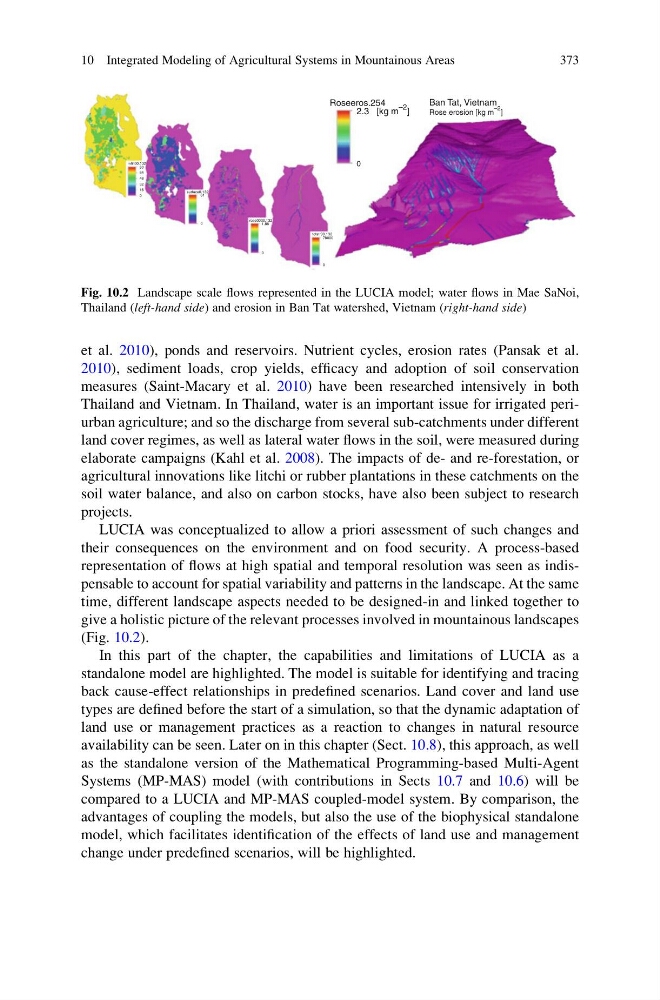
representation of flows at high spatial and temporal resolution was seen as indispensable to account for spatial variability and patterns in the landscape. At the same
time, different landscape aspects needed to be designed-in and linked together to
give a holistic picture of the relevant processes involved in mountainous landscapes
(Fig. 10.2).
In this part of the chapter, the capabilities and limitations of LUCIA as a
standalone model are highlighted. The model is suitable for identifying and tracing
back cause-effect relationships in predefined scenarios. Land cover and land use
types are defined before the start of a simulation, so that the dynamic adaptation of
land use or management practices as a reaction to changes in natural resource
availability can be seen. Later on in this chapter (Sect. 10.8), this approach, as well
as the standalone version of the Mathematical Programming-based Multi-Agent
Systems (MP-MAS) model (with contributions in Sects 10.7 and 10.6) will be
compared to a LUCIA and MP-MAS coupled-model system. By comparison, the
advantages of coupling the models, but also the use of the biophysical standalone
model, which facilitates identification of the effects of land use and management
change under predefined scenarios, will be highlighted.
Roseeros.254
2.3 [kg m
–2
]
Ban Tat, Vietnam
Rose erosion [kg m
–2
]
0
totstr00.132
rose0000.132
surface0.132
infilt00.132
78000
1.86
0
0
61
80
64
48
32
16
0
0
Fig. 10.2 Landscape scale flows represented in the LUCIA model; water flows in Mae SaNoi,
Thailand (left-hand side) and erosion in Ban Tat watershed, Vietnam (right-hand side)
10 Integrated Modeling of Agricultural Systems in Mountainous Areas
373
2010), sediment loads, crop yields, efficacy and adoption of soil conservation
measures (Saint-Macary et al. 2010) have been researched intensively in both
Thailand and Vietnam. In Thailand, water is an important issue for irrigated periurban agriculture; and so the discharge from several sub-catchments under different
land cover regimes, as well as lateral water flows in the soil, were measured during
elaborate campaigns (Kahl et al. 2008). The impacts of de- and re-forestation, or
agricultural innovations like litchi or rubber plantations in these catchments on the
soil water balance, and also on carbon stocks, have also been subject to research
projects.
LUCIA was conceptualized to allow a priori assessment of such changes and
their consequences on the environment and on food security. A process-based
representation of flows at high spatial and temporal resolution was seen as indispensable to account for spatial variability and patterns in the landscape. At the same
time, different landscape aspects needed to be designed-in and linked together to
give a holistic picture of the relevant processes involved in mountainous landscapes
(Fig. 10.2).
In this part of the chapter, the capabilities and limitations of LUCIA as a
standalone model are highlighted. The model is suitable for identifying and tracing
back cause-effect relationships in predefined scenarios. Land cover and land use
types are defined before the start of a simulation, so that the dynamic adaptation of
land use or management practices as a reaction to changes in natural resource
availability can be seen. Later on in this chapter (Sect. 10.8), this approach, as well
as the standalone version of the Mathematical Programming-based Multi-Agent
Systems (MP-MAS) model (with contributions in Sects 10.7 and 10.6) will be
compared to a LUCIA and MP-MAS coupled-model system. By comparison, the
advantages of coupling the models, but also the use of the biophysical standalone
model, which facilitates identification of the effects of land use and management
change under predefined scenarios, will be highlighted.
Roseeros.254
2.3 [kg m
–2
]
Ban Tat, Vietnam
Rose erosion [kg m
–2
]
0
totstr00.132
rose0000.132
surface0.132
infilt00.132
78000
1.86
0
0
61
80
64
48
32
16
0
0
Fig. 10.2 Landscape scale flows represented in the LUCIA model; water flows in Mae SaNoi,
Thailand (left-hand side) and erosion in Ban Tat watershed, Vietnam (right-hand side)
10 Integrated Modeling of Agricultural Systems in Mountainous Areas
373