

10.2.2 Scope and Description of the Model
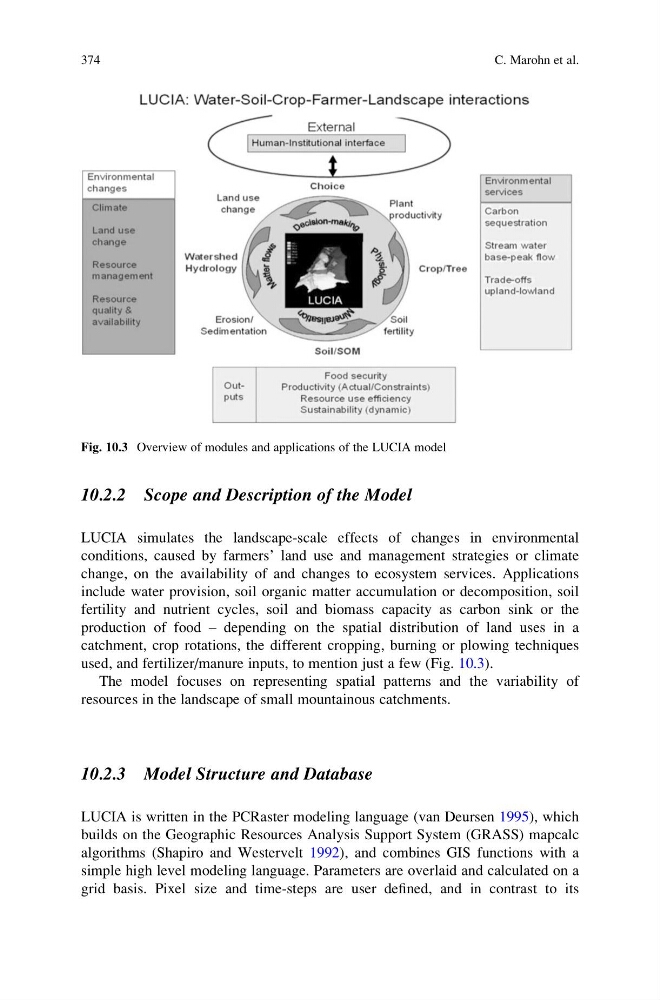
LUCIA simulates the landscape-scale effects of changes in environmental
conditions, caused by farmers’ land use and management strategies or climate
change, on the availability of and changes to ecosystem services. Applications
include water provision, soil organic matter accumulation or decomposition, soil
fertility and nutrient cycles, soil and biomass capacity as carbon sink or the
production of food – depending on the spatial distribution of land uses in a
catchment, crop rotations, the different cropping, burning or plowing techniques
used, and fertilizer/manure inputs, to mention just a few (Fig. 10.3).
The model focuses on representing spatial patterns and the variability of
resources in the landscape of small mountainous catchments.
10.2.3 Model Structure and Database
LUCIA is written in the PCRaster modeling language (van Deursen 1995), which
builds on the Geographic Resources Analysis Support System (GRASS) mapcalc
algorithms (Shapiro and Westervelt 1992), and combines GIS functions with a
simple high level modeling language. Parameters are overlaid and calculated on a
grid basis. Pixel size and time-steps are user defined, and in contrast to its
Fig. 10.3 Overview of modules and applications of the LUCIA model
374
C. Marohn et al.
LUCIA simulates the landscape-scale effects of changes in environmental
conditions, caused by farmers’ land use and management strategies or climate
change, on the availability of and changes to ecosystem services. Applications
include water provision, soil organic matter accumulation or decomposition, soil
fertility and nutrient cycles, soil and biomass capacity as carbon sink or the
production of food – depending on the spatial distribution of land uses in a
catchment, crop rotations, the different cropping, burning or plowing techniques
used, and fertilizer/manure inputs, to mention just a few (Fig. 10.3).
The model focuses on representing spatial patterns and the variability of
resources in the landscape of small mountainous catchments.
10.2.3 Model Structure and Database
LUCIA is written in the PCRaster modeling language (van Deursen 1995), which
builds on the Geographic Resources Analysis Support System (GRASS) mapcalc
algorithms (Shapiro and Westervelt 1992), and combines GIS functions with a
simple high level modeling language. Parameters are overlaid and calculated on a
grid basis. Pixel size and time-steps are user defined, and in contrast to its
Fig. 10.3 Overview of modules and applications of the LUCIA model
374
C. Marohn et al.