

new contacts, the most notable being with a French natural food retailer that later
ordered several shipments of both fresh and dried organic litchi.
In connection with the enhancement of litchi processing activities in the Doi SuthepPui area, fruit growers also expressed their intention to step-up their efforts at marketing
fresh litchis as part of a loosely organized producer network. Mediated by researchers
from the Uplands Program, the agricultural regional offices provided assistance plus
Good Agricultural Practice (GAP) certification for litchi growers in four Hmong
villages, starting from 2008.
6 German and Thai scientists established contacts with a
large European-based hypermarket chain which operates more than 400 branches
across Thailand. After a difficult start to the business relationship (see below), many
litchi growers sold a considerable share of their fresh fruit via a local Thai cooperative
7
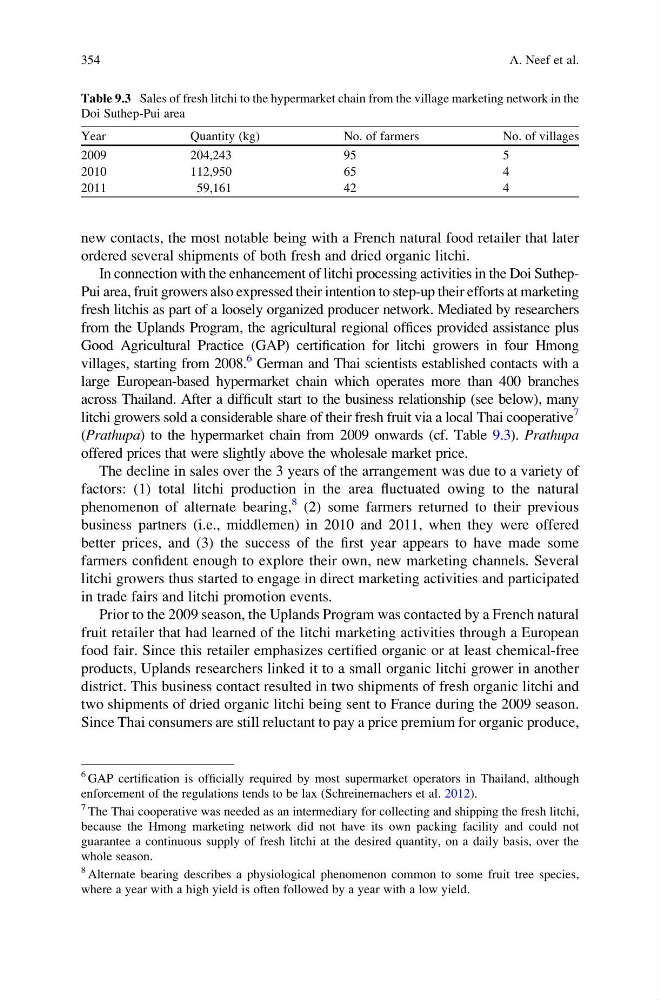
(Prathupa) to the hypermarket chain from 2009 onwards (cf. Table 9.3). Prathupa
offered prices that were slightly above the wholesale market price.
The decline in sales over the 3 years of the arrangement was due to a variety of
factors: (1) total litchi production in the area fluctuated owing to the natural
phenomenon of alternate bearing,
8 (2) some farmers returned to their previous
business partners (i.e., middlemen) in 2010 and 2011, when they were offered
better prices, and (3) the success of the first year appears to have made some
farmers confident enough to explore their own, new marketing channels. Several
litchi growers thus started to engage in direct marketing activities and participated
in trade fairs and litchi promotion events.
Prior to the 2009 season, the Uplands Program was contacted by a French natural
fruit retailer that had learned of the litchi marketing activities through a European
food fair. Since this retailer emphasizes certified organic or at least chemical-free
products, Uplands researchers linked it to a small organic litchi grower in another
district. This business contact resulted in two shipments of fresh organic litchi and
two shipments of dried organic litchi being sent to France during the 2009 season.
Since Thai consumers are still reluctant to pay a price premium for organic produce,
Table 9.3 Sales of fresh litchi to the hypermarket chain from the village marketing network in the
Doi Suthep-Pui area
Year
Quantity (kg)
No. of farmers
No. of villages
2009
204,243
95
5
2010
112,950
65
4
2011
59,161
42
4
6 GAP certification is officially required by most supermarket operators in Thailand, although
enforcement of the regulations tends to be lax (Schreinemachers et al. 2012).
7 The Thai cooperative was needed as an intermediary for collecting and shipping the fresh litchi,
because the Hmong marketing network did not have its own packing facility and could not
guarantee a continuous supply of fresh litchi at the desired quantity, on a daily basis, over the
whole season.
8 Alternate bearing describes a physiological phenomenon common to some fruit tree species,
where a year with a high yield is often followed by a year with a low yield.
354
A. Neef et al.
ordered several shipments of both fresh and dried organic litchi.
In connection with the enhancement of litchi processing activities in the Doi SuthepPui area, fruit growers also expressed their intention to step-up their efforts at marketing
fresh litchis as part of a loosely organized producer network. Mediated by researchers
from the Uplands Program, the agricultural regional offices provided assistance plus
Good Agricultural Practice (GAP) certification for litchi growers in four Hmong
villages, starting from 2008.
6 German and Thai scientists established contacts with a
large European-based hypermarket chain which operates more than 400 branches
across Thailand. After a difficult start to the business relationship (see below), many
litchi growers sold a considerable share of their fresh fruit via a local Thai cooperative
7
(Prathupa) to the hypermarket chain from 2009 onwards (cf. Table 9.3). Prathupa
offered prices that were slightly above the wholesale market price.
The decline in sales over the 3 years of the arrangement was due to a variety of
factors: (1) total litchi production in the area fluctuated owing to the natural
phenomenon of alternate bearing,
8 (2) some farmers returned to their previous
business partners (i.e., middlemen) in 2010 and 2011, when they were offered
better prices, and (3) the success of the first year appears to have made some
farmers confident enough to explore their own, new marketing channels. Several
litchi growers thus started to engage in direct marketing activities and participated
in trade fairs and litchi promotion events.
Prior to the 2009 season, the Uplands Program was contacted by a French natural
fruit retailer that had learned of the litchi marketing activities through a European
food fair. Since this retailer emphasizes certified organic or at least chemical-free
products, Uplands researchers linked it to a small organic litchi grower in another
district. This business contact resulted in two shipments of fresh organic litchi and
two shipments of dried organic litchi being sent to France during the 2009 season.
Since Thai consumers are still reluctant to pay a price premium for organic produce,
Table 9.3 Sales of fresh litchi to the hypermarket chain from the village marketing network in the
Doi Suthep-Pui area
Year
Quantity (kg)
No. of farmers
No. of villages
2009
204,243
95
5
2010
112,950
65
4
2011
59,161
42
4
6 GAP certification is officially required by most supermarket operators in Thailand, although
enforcement of the regulations tends to be lax (Schreinemachers et al. 2012).
7 The Thai cooperative was needed as an intermediary for collecting and shipping the fresh litchi,
because the Hmong marketing network did not have its own packing facility and could not
guarantee a continuous supply of fresh litchi at the desired quantity, on a daily basis, over the
whole season.
8 Alternate bearing describes a physiological phenomenon common to some fruit tree species,
where a year with a high yield is often followed by a year with a low yield.
354
A. Neef et al.