

the litchi grower was able to obtain a threefold farm-gate price as compared to the
local market price through this micro-trade arrangement, and by the end of the 2009
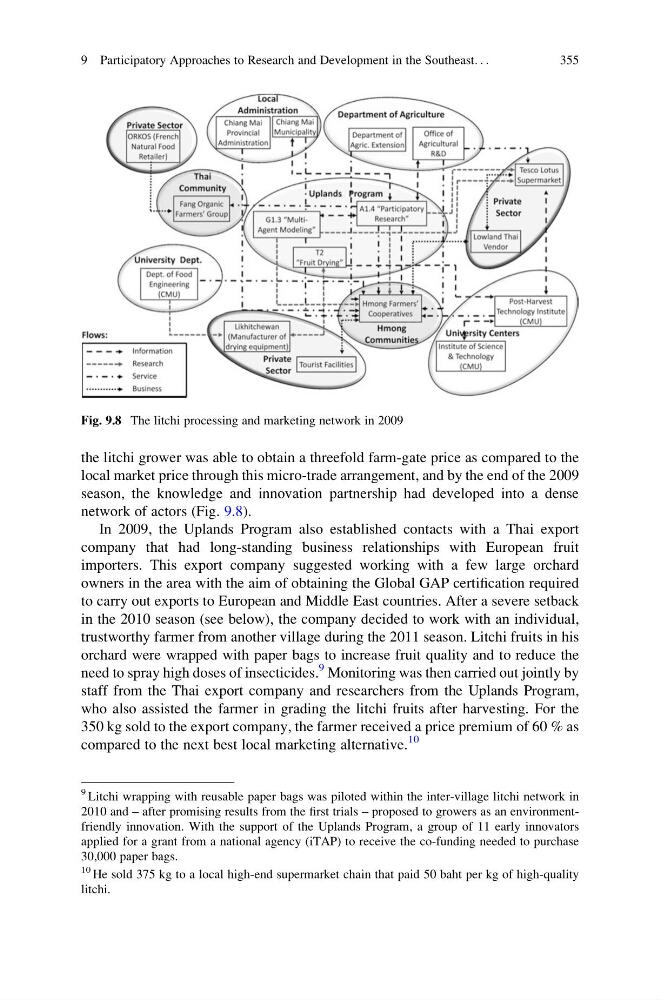
season, the knowledge and innovation partnership had developed into a dense
network of actors (Fig. 9.8).
In 2009, the Uplands Program also established contacts with a Thai export
company that had long-standing business relationships with European fruit
importers. This export company suggested working with a few large orchard
owners in the area with the aim of obtaining the Global GAP certification required
to carry out exports to European and Middle East countries. After a severe setback
in the 2010 season (see below), the company decided to work with an individual,
trustworthy farmer from another village during the 2011 season. Litchi fruits in his
orchard were wrapped with paper bags to increase fruit quality and to reduce the
need to spray high doses of insecticides.
9 Monitoring was then carried out jointly by
staff from the Thai export company and researchers from the Uplands Program,
who also assisted the farmer in grading the litchi fruits after harvesting. For the
350 kg sold to the export company, the farmer received a price premium of 60 % as
compared to the next best local marketing alternative.
10
Fig. 9.8 The litchi processing and marketing network in 2009
9 Litchi wrapping with reusable paper bags was piloted within the inter-village litchi network in
2010 and – after promising results from the first trials – proposed to growers as an environmentfriendly innovation. With the support of the Uplands Program, a group of 11 early innovators
applied for a grant from a national agency (iTAP) to receive the co-funding needed to purchase
30,000 paper bags.
10 He sold 375 kg to a local high-end supermarket chain that paid 50 baht per kg of high-quality
litchi.
9 Participatory Approaches to Research and Development in the Southeast. . .
355
local market price through this micro-trade arrangement, and by the end of the 2009
season, the knowledge and innovation partnership had developed into a dense
network of actors (Fig. 9.8).
In 2009, the Uplands Program also established contacts with a Thai export
company that had long-standing business relationships with European fruit
importers. This export company suggested working with a few large orchard
owners in the area with the aim of obtaining the Global GAP certification required
to carry out exports to European and Middle East countries. After a severe setback
in the 2010 season (see below), the company decided to work with an individual,
trustworthy farmer from another village during the 2011 season. Litchi fruits in his
orchard were wrapped with paper bags to increase fruit quality and to reduce the
need to spray high doses of insecticides.
9 Monitoring was then carried out jointly by
staff from the Thai export company and researchers from the Uplands Program,
who also assisted the farmer in grading the litchi fruits after harvesting. For the
350 kg sold to the export company, the farmer received a price premium of 60 % as
compared to the next best local marketing alternative.
10
Fig. 9.8 The litchi processing and marketing network in 2009
9 Litchi wrapping with reusable paper bags was piloted within the inter-village litchi network in
2010 and – after promising results from the first trials – proposed to growers as an environmentfriendly innovation. With the support of the Uplands Program, a group of 11 early innovators
applied for a grant from a national agency (iTAP) to receive the co-funding needed to purchase
30,000 paper bags.
10 He sold 375 kg to a local high-end supermarket chain that paid 50 baht per kg of high-quality
litchi.
9 Participatory Approaches to Research and Development in the Southeast. . .
355