

composition of the cultivar is the most important factor, followed by many other
determinants such as fruit load, vegetative growth and the carbon/nitrogen ratio,
which is influenced by environmental variables such as wind, water, light and
temperature. Management practices, such as irrigation, fertilizer application and
the singling-out of fruits, as well as soil type, also affect fruit growth (Lechaudel
and Joas 2007).
Fruit growth was monitored dependent on the different irrigation practices used,
and although mango production in Thailand has become increasingly professional
over recent years, most farmers still have no proper irrigation facilities. As a result,
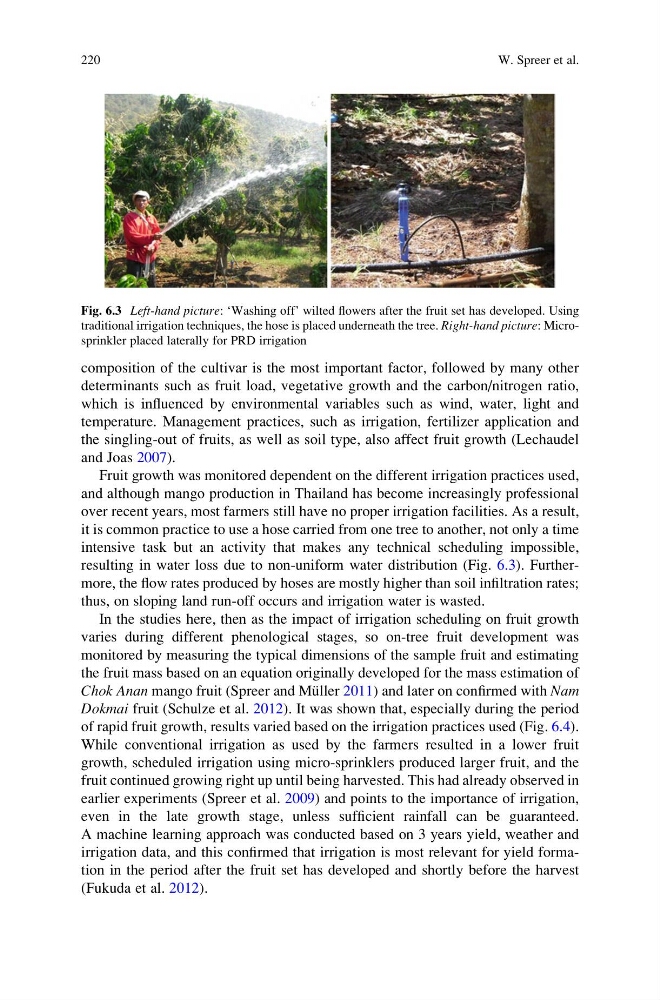
it is common practice to use a hose carried from one tree to another, not only a time
intensive task but an activity that makes any technical scheduling impossible,
resulting in water loss due to non-uniform water distribution (Fig. 6.3). Furthermore, the flow rates produced by hoses are mostly higher than soil infiltration rates;
thus, on sloping land run-off occurs and irrigation water is wasted.
In the studies here, then as the impact of irrigation scheduling on fruit growth
varies during different phenological stages, so on-tree fruit development was
monitored by measuring the typical dimensions of the sample fruit and estimating
the fruit mass based on an equation originally developed for the mass estimation of
Chok Anan mango fruit (Spreer and Mu ¨ller 2011) and later on confirmed with Nam
Dokmai fruit (Schulze et al. 2012). It was shown that, especially during the period
of rapid fruit growth, results varied based on the irrigation practices used (Fig. 6.4).
While conventional irrigation as used by the farmers resulted in a lower fruit
growth, scheduled irrigation using micro-sprinklers produced larger fruit, and the
fruit continued growing right up until being harvested. This had already observed in
earlier experiments (Spreer et al. 2009) and points to the importance of irrigation,
even in the late growth stage, unless sufficient rainfall can be guaranteed.
A machine learning approach was conducted based on 3 years yield, weather and
irrigation data, and this confirmed that irrigation is most relevant for yield formation in the period after the fruit set has developed and shortly before the harvest
(Fukuda et al. 2012).
Fig. 6.3 Left-hand picture: ‘Washing off’ wilted flowers after the fruit set has developed. Using
traditional irrigation techniques, the hose is placed underneath the tree. Right-hand picture: Microsprinkler placed laterally for PRD irrigation
220
W. Spreer et al.
determinants such as fruit load, vegetative growth and the carbon/nitrogen ratio,
which is influenced by environmental variables such as wind, water, light and
temperature. Management practices, such as irrigation, fertilizer application and
the singling-out of fruits, as well as soil type, also affect fruit growth (Lechaudel
and Joas 2007).
Fruit growth was monitored dependent on the different irrigation practices used,
and although mango production in Thailand has become increasingly professional
over recent years, most farmers still have no proper irrigation facilities. As a result,
it is common practice to use a hose carried from one tree to another, not only a time
intensive task but an activity that makes any technical scheduling impossible,
resulting in water loss due to non-uniform water distribution (Fig. 6.3). Furthermore, the flow rates produced by hoses are mostly higher than soil infiltration rates;
thus, on sloping land run-off occurs and irrigation water is wasted.
In the studies here, then as the impact of irrigation scheduling on fruit growth
varies during different phenological stages, so on-tree fruit development was
monitored by measuring the typical dimensions of the sample fruit and estimating
the fruit mass based on an equation originally developed for the mass estimation of
Chok Anan mango fruit (Spreer and Mu ¨ller 2011) and later on confirmed with Nam
Dokmai fruit (Schulze et al. 2012). It was shown that, especially during the period
of rapid fruit growth, results varied based on the irrigation practices used (Fig. 6.4).
While conventional irrigation as used by the farmers resulted in a lower fruit
growth, scheduled irrigation using micro-sprinklers produced larger fruit, and the
fruit continued growing right up until being harvested. This had already observed in
earlier experiments (Spreer et al. 2009) and points to the importance of irrigation,
even in the late growth stage, unless sufficient rainfall can be guaranteed.
A machine learning approach was conducted based on 3 years yield, weather and
irrigation data, and this confirmed that irrigation is most relevant for yield formation in the period after the fruit set has developed and shortly before the harvest
(Fukuda et al. 2012).
Fig. 6.3 Left-hand picture: ‘Washing off’ wilted flowers after the fruit set has developed. Using
traditional irrigation techniques, the hose is placed underneath the tree. Right-hand picture: Microsprinkler placed laterally for PRD irrigation
220
W. Spreer et al.