

6.2.4 Introduction of Micro-irrigation to the Mango
Production Process
Irrigation using hoses placed underneath the mango trees is still commonly
practiced in northern Thailand. While the installation costs of this method are
low, running costs are high in terms of electricity and labor. Apart from a volume
independent access fee, irrigation water is not priced in northern Thailand; however, a previous study showed that under these conditions, micro-sprinkler irrigation based on a climatic water balance can improve farmers’ revenues after a rather
short pay-back time of 4.6 years, while PRD only results in higher returns as
compared to full irrigation if a water price is assumed (Satienperakul et al. 2009).
By comparing traditional techniques and micro-sprinklers, we have found that the
introduction of micro-sprinklers into irrigated mango production activities in northern Thailand has the potential to increase both yields and WUE (Spreer et al. 2011),
and that farmers can well handle and operate such systems, even if they receive no
additional extension in terms of irrigation scheduling. Interestingly, in our studies,
farmers’ experiences matched quite well with the calculated irrigation water requirement. If scheduling is done based on a climatic water balance, it is possible to further
increase WUE and obtain fruit of a more uniform shape and size. As fruit size is a
crucial factor in the marketing of exports, we believe that farmers who produce for
export need to rely on improved irrigation scheduling to exploit the full benefits of
installing a micro-irrigation system. It is; therefore, considered necessary to support
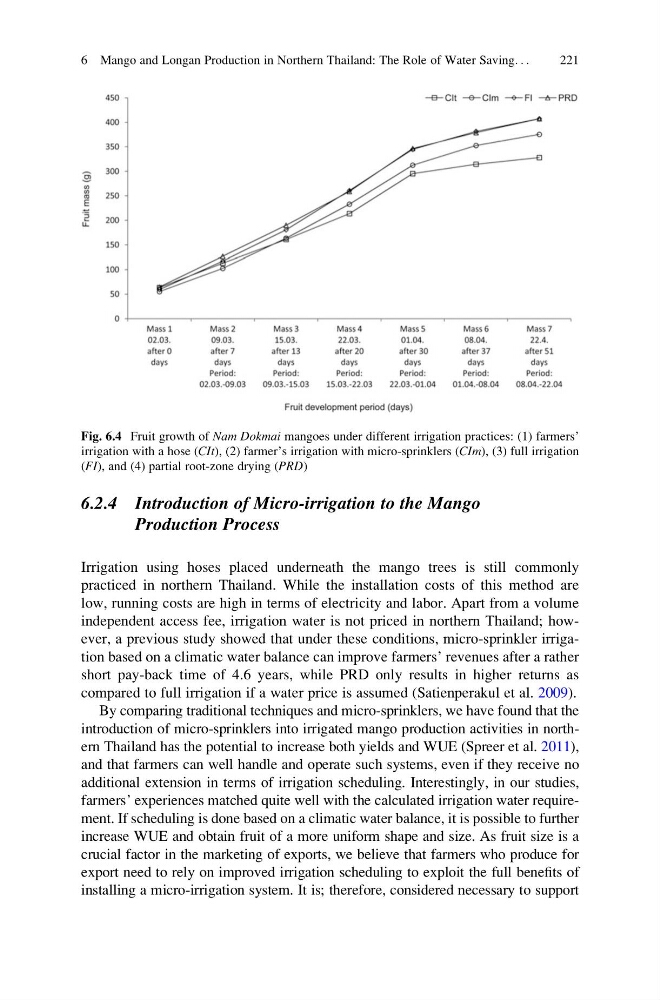
Fig. 6.4 Fruit growth of Nam Dokmai mangoes under different irrigation practices: (1) farmers’
irrigation with a hose (CIt), (2) farmer’s irrigation with micro-sprinklers (CIm), (3) full irrigation
(FI), and (4) partial root-zone drying (PRD)
6 Mango and Longan Production in Northern Thailand: The Role of Water Saving. . .
221
Production Process
Irrigation using hoses placed underneath the mango trees is still commonly
practiced in northern Thailand. While the installation costs of this method are
low, running costs are high in terms of electricity and labor. Apart from a volume
independent access fee, irrigation water is not priced in northern Thailand; however, a previous study showed that under these conditions, micro-sprinkler irrigation based on a climatic water balance can improve farmers’ revenues after a rather
short pay-back time of 4.6 years, while PRD only results in higher returns as
compared to full irrigation if a water price is assumed (Satienperakul et al. 2009).
By comparing traditional techniques and micro-sprinklers, we have found that the
introduction of micro-sprinklers into irrigated mango production activities in northern Thailand has the potential to increase both yields and WUE (Spreer et al. 2011),
and that farmers can well handle and operate such systems, even if they receive no
additional extension in terms of irrigation scheduling. Interestingly, in our studies,
farmers’ experiences matched quite well with the calculated irrigation water requirement. If scheduling is done based on a climatic water balance, it is possible to further
increase WUE and obtain fruit of a more uniform shape and size. As fruit size is a
crucial factor in the marketing of exports, we believe that farmers who produce for
export need to rely on improved irrigation scheduling to exploit the full benefits of
installing a micro-irrigation system. It is; therefore, considered necessary to support
Fig. 6.4 Fruit growth of Nam Dokmai mangoes under different irrigation practices: (1) farmers’
irrigation with a hose (CIt), (2) farmer’s irrigation with micro-sprinklers (CIm), (3) full irrigation
(FI), and (4) partial root-zone drying (PRD)
6 Mango and Longan Production in Northern Thailand: The Role of Water Saving. . .
221