

run-off-deposition processes during land preparation and storm events (Kim et al.
2006; Maruyama et al. 2008; Zhao et al. 2009). Sediment associated nutrient
reallocation takes place through various pathways and depends on biophysical
characteristics, those that influence the travel time and deposition rate of the
material (Gao et al. 2007; Mingzhou et al. 2007). The spatial variability of soils
in response to sedimentation processes is a combined result of land management
practices (e.g., plowing) and long distance catchment processes such as irrigation
and erosion. Spatial variations in soil properties in turn affect crop productivity. The
question remains as to how the dynamic process of material reallocation triggers
soil spatial variability, besides the intrinsic soil properties that are related to the
geomorphology of a catchment. In relation to the spatial variation in crop production levels, additional factors play a role, such as field preparation, fertilizer
application and water management. All these factors also influence nutrient depletion and enrichment.
Schmitter et al. (2010, 2011) investigated the sediment delivery pathways by
monitoring several irrigated paddy rice topo-sequences during a dry and a wet
season. Besides irrigation water, two more sediment delivery pathways were
identified: (1) direct run-off from upland areas, and (2) flooding from the neighboring river. The latter pathway only occurred during typhoon Lekima (see Sect. 3.3).
The study investigated the physical and chemical soil properties (including particle
size, organic C and total N, P, K and CEC) of the topsoil found in the paddy fields,
as a function of the sediment delivery pathway. Any linkage between the alterations
in spatial variation and rice performance was assessed using multiple linear regression on all the data with regard to topsoil properties and yield indicators (i.e., grain
yield, biomass).
The positive gain in irrigated C and N loads was confirmed by physical and
chemical topsoil analysis. Topsoil organic C and total N contents displayed a spatial
gradient, with nutrient enrichment increasing with distance from the irrigation
channel (Fig. 3.13). The opposite enrichment pattern was found for the sand
fraction along these fields, as coarser, less nutrient rich sediments were deposited
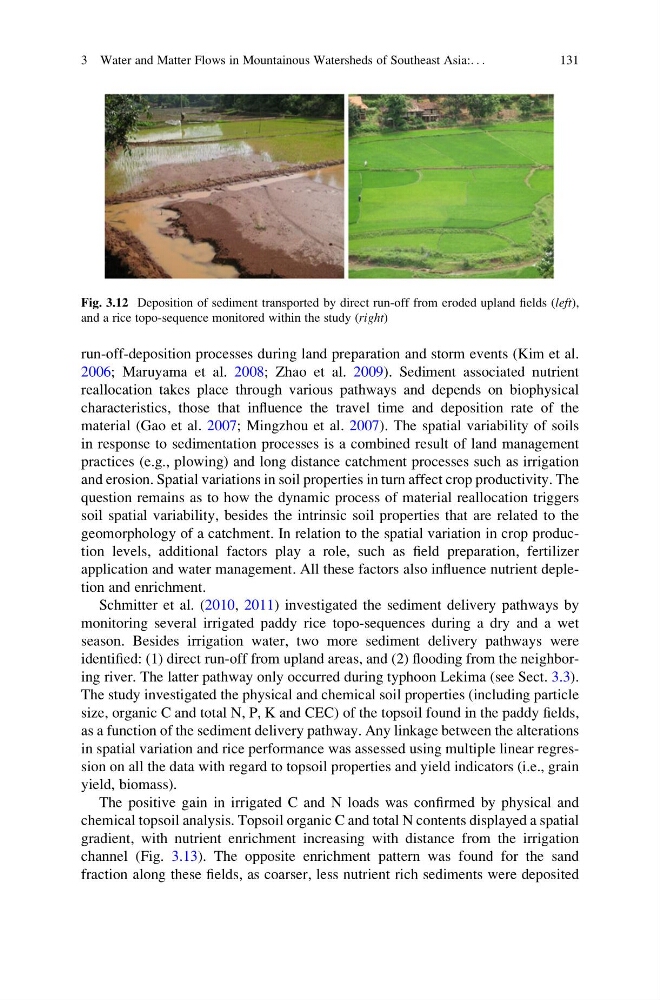
Fig. 3.12 Deposition of sediment transported by direct run-off from eroded upland fields (left),
and a rice topo-sequence monitored within the study (right)
3 Water and Matter Flows in Mountainous Watersheds of Southeast Asia:. . .
131
2006; Maruyama et al. 2008; Zhao et al. 2009). Sediment associated nutrient
reallocation takes place through various pathways and depends on biophysical
characteristics, those that influence the travel time and deposition rate of the
material (Gao et al. 2007; Mingzhou et al. 2007). The spatial variability of soils
in response to sedimentation processes is a combined result of land management
practices (e.g., plowing) and long distance catchment processes such as irrigation
and erosion. Spatial variations in soil properties in turn affect crop productivity. The
question remains as to how the dynamic process of material reallocation triggers
soil spatial variability, besides the intrinsic soil properties that are related to the
geomorphology of a catchment. In relation to the spatial variation in crop production levels, additional factors play a role, such as field preparation, fertilizer
application and water management. All these factors also influence nutrient depletion and enrichment.
Schmitter et al. (2010, 2011) investigated the sediment delivery pathways by
monitoring several irrigated paddy rice topo-sequences during a dry and a wet
season. Besides irrigation water, two more sediment delivery pathways were
identified: (1) direct run-off from upland areas, and (2) flooding from the neighboring river. The latter pathway only occurred during typhoon Lekima (see Sect. 3.3).
The study investigated the physical and chemical soil properties (including particle
size, organic C and total N, P, K and CEC) of the topsoil found in the paddy fields,
as a function of the sediment delivery pathway. Any linkage between the alterations
in spatial variation and rice performance was assessed using multiple linear regression on all the data with regard to topsoil properties and yield indicators (i.e., grain
yield, biomass).
The positive gain in irrigated C and N loads was confirmed by physical and
chemical topsoil analysis. Topsoil organic C and total N contents displayed a spatial
gradient, with nutrient enrichment increasing with distance from the irrigation
channel (Fig. 3.13). The opposite enrichment pattern was found for the sand
fraction along these fields, as coarser, less nutrient rich sediments were deposited
Fig. 3.12 Deposition of sediment transported by direct run-off from eroded upland fields (left),
and a rice topo-sequence monitored within the study (right)
3 Water and Matter Flows in Mountainous Watersheds of Southeast Asia:. . .
131