

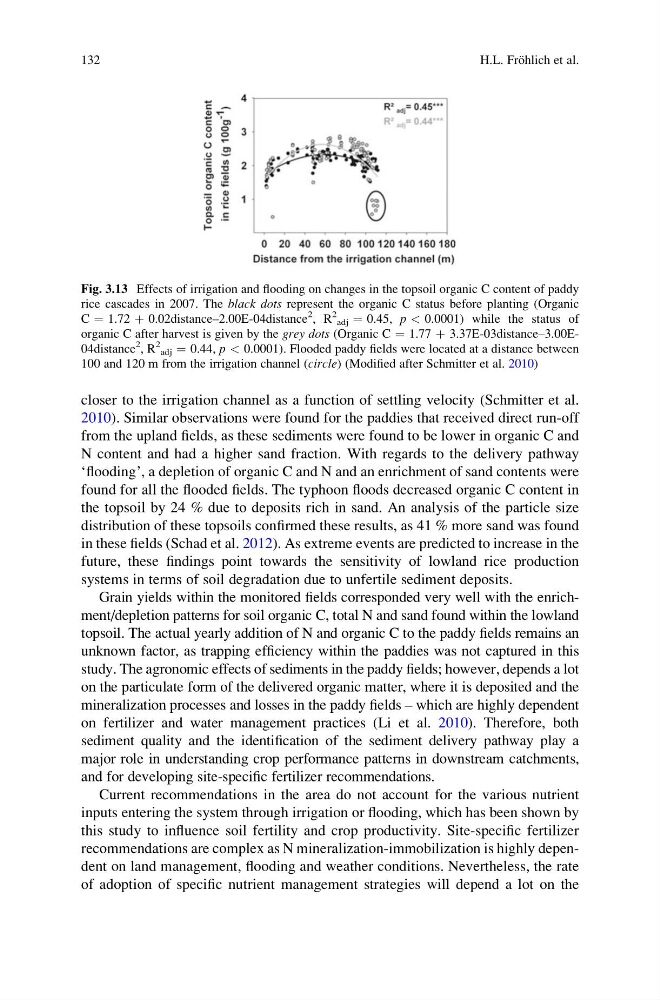
closer to the irrigation channel as a function of settling velocity (Schmitter et al.
2010). Similar observations were found for the paddies that received direct run-off
from the upland fields, as these sediments were found to be lower in organic C and
N content and had a higher sand fraction. With regards to the delivery pathway
‘flooding’, a depletion of organic C and N and an enrichment of sand contents were
found for all the flooded fields. The typhoon floods decreased organic C content in
the topsoil by 24 % due to deposits rich in sand. An analysis of the particle size
distribution of these topsoils confirmed these results, as 41 % more sand was found
in these fields (Schad et al. 2012). As extreme events are predicted to increase in the
future, these findings point towards the sensitivity of lowland rice production
systems in terms of soil degradation due to unfertile sediment deposits.
Grain yields within the monitored fields corresponded very well with the enrichment/depletion patterns for soil organic C, total N and sand found within the lowland
topsoil. The actual yearly addition of N and organic C to the paddy fields remains an
unknown factor, as trapping efficiency within the paddies was not captured in this
study. The agronomic effects of sediments in the paddy fields; however, depends a lot
on the particulate form of the delivered organic matter, where it is deposited and the
mineralization processes and losses in the paddy fields – which are highly dependent
on fertilizer and water management practices (Li et al. 2010). Therefore, both
sediment quality and the identification of the sediment delivery pathway play a
major role in understanding crop performance patterns in downstream catchments,
and for developing site-specific fertilizer recommendations.
Current recommendations in the area do not account for the various nutrient
inputs entering the system through irrigation or flooding, which has been shown by
this study to influence soil fertility and crop productivity. Site-specific fertilizer
recommendations are complex as N mineralization-immobilization is highly dependent on land management, flooding and weather conditions. Nevertheless, the rate
of adoption of specific nutrient management strategies will depend a lot on the
Fig. 3.13 Effects of irrigation and flooding on changes in the topsoil organic C content of paddy
rice cascades in 2007. The black dots represent the organic C status before planting (Organic
C ¼ 1.72 þ 0.02distance–2.00E-04distance
2
, R
2
adj ¼ 0.45, p < 0.0001) while the status of
organic C after harvest is given by the grey dots (Organic C ¼ 1.77 þ 3.37E-03distance–3.00E04distance
2
, R
2
adj ¼ 0.44, p < 0.0001). Flooded paddy fields were located at a distance between
100 and 120 m from the irrigation channel (circle) (Modified after Schmitter et al. 2010)
132
H.L. Fro ¨hlich et al.
2010). Similar observations were found for the paddies that received direct run-off
from the upland fields, as these sediments were found to be lower in organic C and
N content and had a higher sand fraction. With regards to the delivery pathway
‘flooding’, a depletion of organic C and N and an enrichment of sand contents were
found for all the flooded fields. The typhoon floods decreased organic C content in
the topsoil by 24 % due to deposits rich in sand. An analysis of the particle size
distribution of these topsoils confirmed these results, as 41 % more sand was found
in these fields (Schad et al. 2012). As extreme events are predicted to increase in the
future, these findings point towards the sensitivity of lowland rice production
systems in terms of soil degradation due to unfertile sediment deposits.
Grain yields within the monitored fields corresponded very well with the enrichment/depletion patterns for soil organic C, total N and sand found within the lowland
topsoil. The actual yearly addition of N and organic C to the paddy fields remains an
unknown factor, as trapping efficiency within the paddies was not captured in this
study. The agronomic effects of sediments in the paddy fields; however, depends a lot
on the particulate form of the delivered organic matter, where it is deposited and the
mineralization processes and losses in the paddy fields – which are highly dependent
on fertilizer and water management practices (Li et al. 2010). Therefore, both
sediment quality and the identification of the sediment delivery pathway play a
major role in understanding crop performance patterns in downstream catchments,
and for developing site-specific fertilizer recommendations.
Current recommendations in the area do not account for the various nutrient
inputs entering the system through irrigation or flooding, which has been shown by
this study to influence soil fertility and crop productivity. Site-specific fertilizer
recommendations are complex as N mineralization-immobilization is highly dependent on land management, flooding and weather conditions. Nevertheless, the rate
of adoption of specific nutrient management strategies will depend a lot on the
Fig. 3.13 Effects of irrigation and flooding on changes in the topsoil organic C content of paddy
rice cascades in 2007. The black dots represent the organic C status before planting (Organic
C ¼ 1.72 þ 0.02distance–2.00E-04distance
2
, R
2
adj ¼ 0.45, p < 0.0001) while the status of
organic C after harvest is given by the grey dots (Organic C ¼ 1.77 þ 3.37E-03distance–3.00E04distance
2
, R
2
adj ¼ 0.44, p < 0.0001). Flooded paddy fields were located at a distance between
100 and 120 m from the irrigation channel (circle) (Modified after Schmitter et al. 2010)
132
H.L. Fro ¨hlich et al.