

7.5 Friction Optimization
493
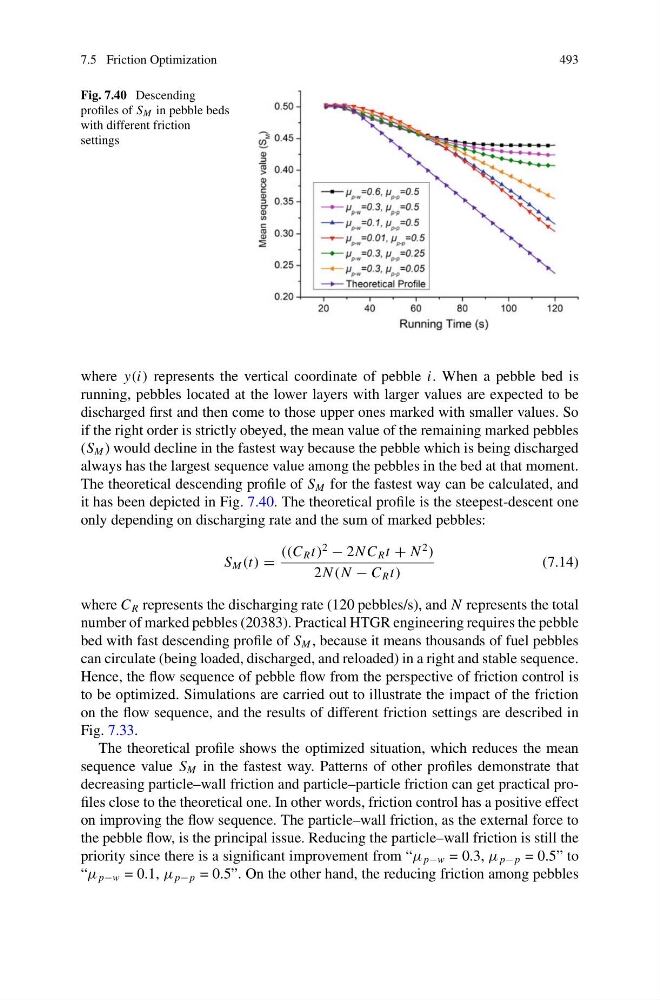
Fig. 7.40 Descending
profiles of S M in pebble beds
with different friction
settings
where y(i) represents the vertical coordinate of pebble i. When a pebble bed is
running, pebbles located at the lower layers with larger values are expected to be
discharged first and then come to those upper ones marked with smaller values. So
if the right order is strictly obeyed, the mean value of the remaining marked pebbles
(S M ) would decline in the fastest way because the pebble which is being discharged
always has the largest sequence value among the pebbles in the bed at that moment.
The theoretical descending profile of S M for the fastest way can be calculated, and
it has been depicted in Fig. 7.40. The theoretical profile is the steepest-descent one
only depending on discharging rate and the sum of marked pebbles:
S M (t) =
((C R t)
2
− 2N C R t + N
2
)
2N (N − C R t)
(7.14)
where C R represents the discharging rate (120 pebbles/s), and N represents the total
number of marked pebbles (20383). Practical HTGR engineering requires the pebble
bed with fast descending profile of S M , because it means thousands of fuel pebbles
can circulate (being loaded, discharged, and reloaded) in a right and stable sequence.
Hence, the flow sequence of pebble flow from the perspective of friction control is
to be optimized. Simulations are carried out to illustrate the impact of the friction
on the flow sequence, and the results of different friction settings are described in
Fig. 7.33.
The theoretical profile shows the optimized situation, which reduces the mean
sequence value S M in the fastest way. Patterns of other profiles demonstrate that
decreasing particle–wall friction and particle–particle friction can get practical profiles close to the theoretical one. In other words, friction control has a positive effect
on improving the flow sequence. The particle–wall friction, as the external force to
the pebble flow, is the principal issue. Reducing the particle–wall friction is still the
priority since there is a significant improvement from “μ p−w = 0.3, μ p− p = 0.5” to
“μ p−w = 0.1, μ p− p = 0.5”. On the other hand, the reducing friction among pebbles
493
Fig. 7.40 Descending
profiles of S M in pebble beds
with different friction
settings
where y(i) represents the vertical coordinate of pebble i. When a pebble bed is
running, pebbles located at the lower layers with larger values are expected to be
discharged first and then come to those upper ones marked with smaller values. So
if the right order is strictly obeyed, the mean value of the remaining marked pebbles
(S M ) would decline in the fastest way because the pebble which is being discharged
always has the largest sequence value among the pebbles in the bed at that moment.
The theoretical descending profile of S M for the fastest way can be calculated, and
it has been depicted in Fig. 7.40. The theoretical profile is the steepest-descent one
only depending on discharging rate and the sum of marked pebbles:
S M (t) =
((C R t)
2
− 2N C R t + N
2
)
2N (N − C R t)
(7.14)
where C R represents the discharging rate (120 pebbles/s), and N represents the total
number of marked pebbles (20383). Practical HTGR engineering requires the pebble
bed with fast descending profile of S M , because it means thousands of fuel pebbles
can circulate (being loaded, discharged, and reloaded) in a right and stable sequence.
Hence, the flow sequence of pebble flow from the perspective of friction control is
to be optimized. Simulations are carried out to illustrate the impact of the friction
on the flow sequence, and the results of different friction settings are described in
Fig. 7.33.
The theoretical profile shows the optimized situation, which reduces the mean
sequence value S M in the fastest way. Patterns of other profiles demonstrate that
decreasing particle–wall friction and particle–particle friction can get practical profiles close to the theoretical one. In other words, friction control has a positive effect
on improving the flow sequence. The particle–wall friction, as the external force to
the pebble flow, is the principal issue. Reducing the particle–wall friction is still the
priority since there is a significant improvement from “μ p−w = 0.3, μ p− p = 0.5” to
“μ p−w = 0.1, μ p− p = 0.5”. On the other hand, the reducing friction among pebbles