

492
7 Applications: Pebble Flow Optimizations
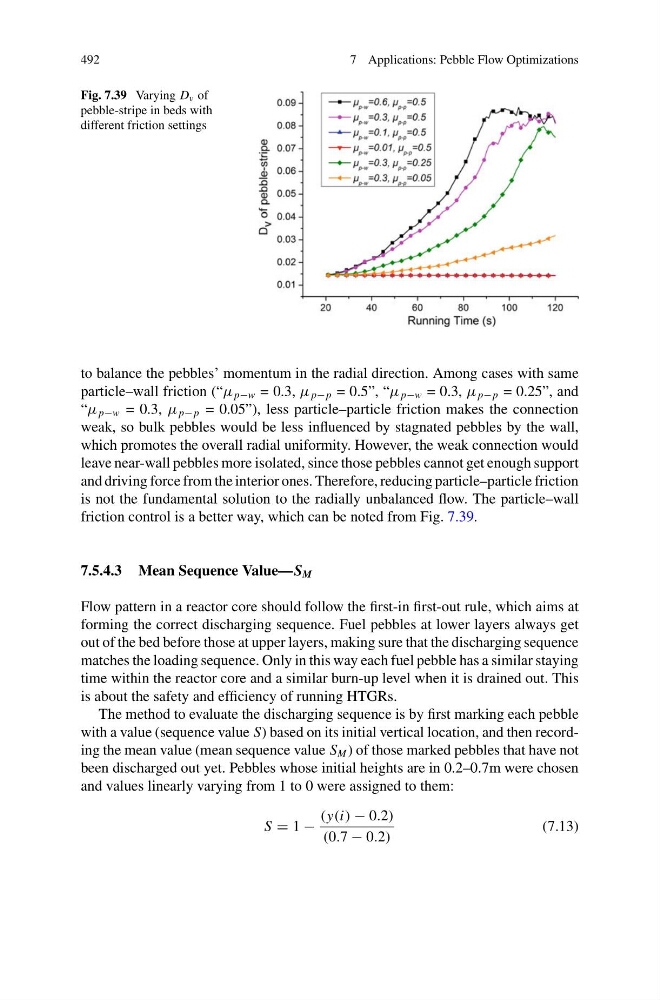
Fig. 7.39 Varying D v of
pebble-stripe in beds with
different friction settings
to balance the pebbles’ momentum in the radial direction. Among cases with same
particle–wall friction (“μ p−w = 0.3, μ p− p = 0.5”, “μ p−w = 0.3, μ p− p = 0.25”, and
“μ p−w = 0.3, μ p− p = 0.05”), less particle–particle friction makes the connection
weak, so bulk pebbles would be less influenced by stagnated pebbles by the wall,
which promotes the overall radial uniformity. However, the weak connection would
leave near-wall pebbles more isolated, since those pebbles cannot get enough support
and driving force from the interior ones. Therefore, reducing particle–particle friction
is not the fundamental solution to the radially unbalanced flow. The particle–wall
friction control is a better way, which can be noted from Fig. 7.39.
7.5.4.3 Mean Sequence Value—S M
Flow pattern in a reactor core should follow the first-in first-out rule, which aims at
forming the correct discharging sequence. Fuel pebbles at lower layers always get
out of the bed before those at upper layers, making sure that the discharging sequence
matches the loading sequence. Only in this way each fuel pebble has a similar staying
time within the reactor core and a similar burn-up level when it is drained out. This
is about the safety and efficiency of running HTGRs.
The method to evaluate the discharging sequence is by first marking each pebble
with a value (sequence value S) based on its initial vertical location, and then recording the mean value (mean sequence value S M ) of those marked pebbles that have not
been discharged out yet. Pebbles whose initial heights are in 0.2–0.7m were chosen
and values linearly varying from 1 to 0 were assigned to them:
S = 1 −
(y(i) − 0.2)
(0.7 − 0.2)
(7.13)
7 Applications: Pebble Flow Optimizations
Fig. 7.39 Varying D v of
pebble-stripe in beds with
different friction settings
to balance the pebbles’ momentum in the radial direction. Among cases with same
particle–wall friction (“μ p−w = 0.3, μ p− p = 0.5”, “μ p−w = 0.3, μ p− p = 0.25”, and
“μ p−w = 0.3, μ p− p = 0.05”), less particle–particle friction makes the connection
weak, so bulk pebbles would be less influenced by stagnated pebbles by the wall,
which promotes the overall radial uniformity. However, the weak connection would
leave near-wall pebbles more isolated, since those pebbles cannot get enough support
and driving force from the interior ones. Therefore, reducing particle–particle friction
is not the fundamental solution to the radially unbalanced flow. The particle–wall
friction control is a better way, which can be noted from Fig. 7.39.
7.5.4.3 Mean Sequence Value—S M
Flow pattern in a reactor core should follow the first-in first-out rule, which aims at
forming the correct discharging sequence. Fuel pebbles at lower layers always get
out of the bed before those at upper layers, making sure that the discharging sequence
matches the loading sequence. Only in this way each fuel pebble has a similar staying
time within the reactor core and a similar burn-up level when it is drained out. This
is about the safety and efficiency of running HTGRs.
The method to evaluate the discharging sequence is by first marking each pebble
with a value (sequence value S) based on its initial vertical location, and then recording the mean value (mean sequence value S M ) of those marked pebbles that have not
been discharged out yet. Pebbles whose initial heights are in 0.2–0.7m were chosen
and values linearly varying from 1 to 0 were assigned to them:
S = 1 −
(y(i) − 0.2)
(0.7 − 0.2)
(7.13)