

7.5 Friction Optimization
489
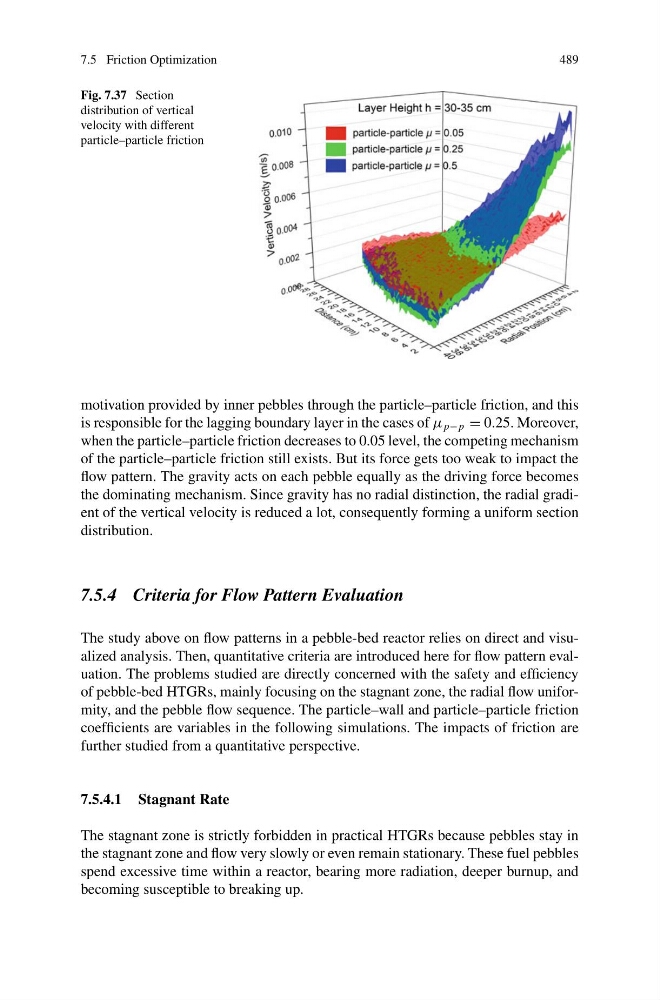
Fig. 7.37 Section
distribution of vertical
velocity with different
particle–particle friction
motivation provided by inner pebbles through the particle–particle friction, and this
is responsible for the lagging boundary layer in the cases of μ p− p = 0.25. Moreover,
when the particle–particle friction decreases to 0.05 level, the competing mechanism
of the particle–particle friction still exists. But its force gets too weak to impact the
flow pattern. The gravity acts on each pebble equally as the driving force becomes
the dominating mechanism. Since gravity has no radial distinction, the radial gradient of the vertical velocity is reduced a lot, consequently forming a uniform section
distribution.
7.5.4 Criteria for Flow Pattern Evaluation
The study above on flow patterns in a pebble-bed reactor relies on direct and visualized analysis. Then, quantitative criteria are introduced here for flow pattern evaluation. The problems studied are directly concerned with the safety and efficiency
of pebble-bed HTGRs, mainly focusing on the stagnant zone, the radial flow uniformity, and the pebble flow sequence. The particle–wall and particle–particle friction
coefficients are variables in the following simulations. The impacts of friction are
further studied from a quantitative perspective.
7.5.4.1 Stagnant Rate
The stagnant zone is strictly forbidden in practical HTGRs because pebbles stay in
the stagnant zone and flow very slowly or even remain stationary. These fuel pebbles
spend excessive time within a reactor, bearing more radiation, deeper burnup, and
becoming susceptible to breaking up.
489
Fig. 7.37 Section
distribution of vertical
velocity with different
particle–particle friction
motivation provided by inner pebbles through the particle–particle friction, and this
is responsible for the lagging boundary layer in the cases of μ p− p = 0.25. Moreover,
when the particle–particle friction decreases to 0.05 level, the competing mechanism
of the particle–particle friction still exists. But its force gets too weak to impact the
flow pattern. The gravity acts on each pebble equally as the driving force becomes
the dominating mechanism. Since gravity has no radial distinction, the radial gradient of the vertical velocity is reduced a lot, consequently forming a uniform section
distribution.
7.5.4 Criteria for Flow Pattern Evaluation
The study above on flow patterns in a pebble-bed reactor relies on direct and visualized analysis. Then, quantitative criteria are introduced here for flow pattern evaluation. The problems studied are directly concerned with the safety and efficiency
of pebble-bed HTGRs, mainly focusing on the stagnant zone, the radial flow uniformity, and the pebble flow sequence. The particle–wall and particle–particle friction
coefficients are variables in the following simulations. The impacts of friction are
further studied from a quantitative perspective.
7.5.4.1 Stagnant Rate
The stagnant zone is strictly forbidden in practical HTGRs because pebbles stay in
the stagnant zone and flow very slowly or even remain stationary. These fuel pebbles
spend excessive time within a reactor, bearing more radiation, deeper burnup, and
becoming susceptible to breaking up.