

488
7 Applications: Pebble Flow Optimizations
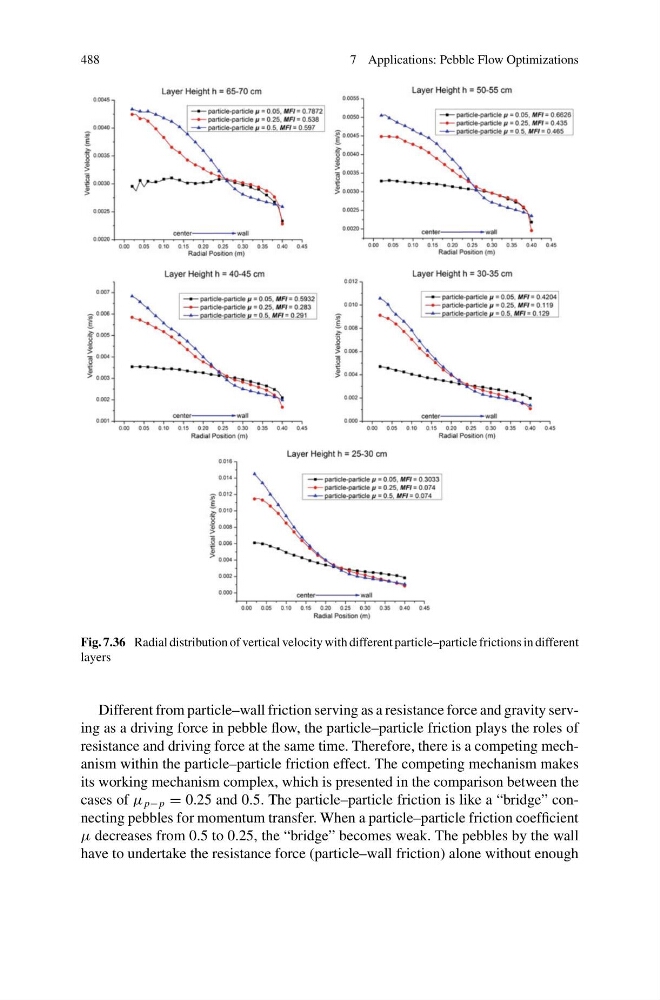
Fig. 7.36 Radial distribution of vertical velocity with different particle–particle frictions in different
layers
Different from particle–wall friction serving as a resistance force and gravity serving as a driving force in pebble flow, the particle–particle friction plays the roles of
resistance and driving force at the same time. Therefore, there is a competing mechanism within the particle–particle friction effect. The competing mechanism makes
its working mechanism complex, which is presented in the comparison between the
cases of μ p− p = 0.25 and 0.5. The particle–particle friction is like a “bridge” connecting pebbles for momentum transfer. When a particle–particle friction coefficient
μ decreases from 0.5 to 0.25, the “bridge” becomes weak. The pebbles by the wall
have to undertake the resistance force (particle–wall friction) alone without enough
7 Applications: Pebble Flow Optimizations
Fig. 7.36 Radial distribution of vertical velocity with different particle–particle frictions in different
layers
Different from particle–wall friction serving as a resistance force and gravity serving as a driving force in pebble flow, the particle–particle friction plays the roles of
resistance and driving force at the same time. Therefore, there is a competing mechanism within the particle–particle friction effect. The competing mechanism makes
its working mechanism complex, which is presented in the comparison between the
cases of μ p− p = 0.25 and 0.5. The particle–particle friction is like a “bridge” connecting pebbles for momentum transfer. When a particle–particle friction coefficient
μ decreases from 0.5 to 0.25, the “bridge” becomes weak. The pebbles by the wall
have to undertake the resistance force (particle–wall friction) alone without enough