

7.3 Flow-Corrective Insert Optimization
459
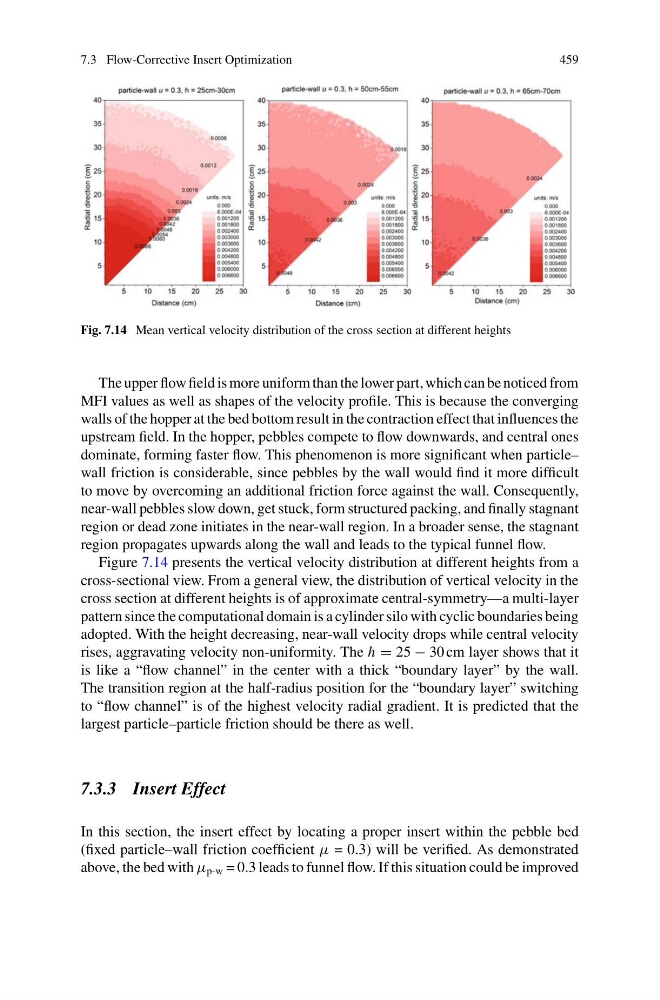
Fig. 7.14 Mean vertical velocity distribution of the cross section at different heights
The upper flow field is more uniform than the lower part, which can be noticed from
MFI values as well as shapes of the velocity profile. This is because the converging
walls of the hopper at the bed bottom result in the contraction effect that influences the
upstream field. In the hopper, pebbles compete to flow downwards, and central ones
dominate, forming faster flow. This phenomenon is more significant when particle–
wall friction is considerable, since pebbles by the wall would find it more difficult
to move by overcoming an additional friction force against the wall. Consequently,
near-wall pebbles slow down, get stuck, form structured packing, and finally stagnant
region or dead zone initiates in the near-wall region. In a broader sense, the stagnant
region propagates upwards along the wall and leads to the typical funnel flow.
Figure 7.14 presents the vertical velocity distribution at different heights from a
cross-sectional view. From a general view, the distribution of vertical velocity in the
cross section at different heights is of approximate central-symmetry—a multi-layer
pattern since the computational domain is a cylinder silo with cyclic boundaries being
adopted. With the height decreasing, near-wall velocity drops while central velocity
rises, aggravating velocity non-uniformity. The h = 25 − 30 cm layer shows that it
is like a “flow channel” in the center with a thick “boundary layer” by the wall.
The transition region at the half-radius position for the “boundary layer” switching
to “flow channel” is of the highest velocity radial gradient. It is predicted that the
largest particle–particle friction should be there as well.
7.3.3 Insert Effect
In this section, the insert effect by locating a proper insert within the pebble bed
(fixed particle–wall friction coefficient μ = 0.3) will be verified. As demonstrated
above, the bed with μ p-w = 0.3 leads to funnel flow. If this situation could be improved
459
Fig. 7.14 Mean vertical velocity distribution of the cross section at different heights
The upper flow field is more uniform than the lower part, which can be noticed from
MFI values as well as shapes of the velocity profile. This is because the converging
walls of the hopper at the bed bottom result in the contraction effect that influences the
upstream field. In the hopper, pebbles compete to flow downwards, and central ones
dominate, forming faster flow. This phenomenon is more significant when particle–
wall friction is considerable, since pebbles by the wall would find it more difficult
to move by overcoming an additional friction force against the wall. Consequently,
near-wall pebbles slow down, get stuck, form structured packing, and finally stagnant
region or dead zone initiates in the near-wall region. In a broader sense, the stagnant
region propagates upwards along the wall and leads to the typical funnel flow.
Figure 7.14 presents the vertical velocity distribution at different heights from a
cross-sectional view. From a general view, the distribution of vertical velocity in the
cross section at different heights is of approximate central-symmetry—a multi-layer
pattern since the computational domain is a cylinder silo with cyclic boundaries being
adopted. With the height decreasing, near-wall velocity drops while central velocity
rises, aggravating velocity non-uniformity. The h = 25 − 30 cm layer shows that it
is like a “flow channel” in the center with a thick “boundary layer” by the wall.
The transition region at the half-radius position for the “boundary layer” switching
to “flow channel” is of the highest velocity radial gradient. It is predicted that the
largest particle–particle friction should be there as well.
7.3.3 Insert Effect
In this section, the insert effect by locating a proper insert within the pebble bed
(fixed particle–wall friction coefficient μ = 0.3) will be verified. As demonstrated
above, the bed with μ p-w = 0.3 leads to funnel flow. If this situation could be improved