

430
6 Applications: Two-Region Pebble Beds
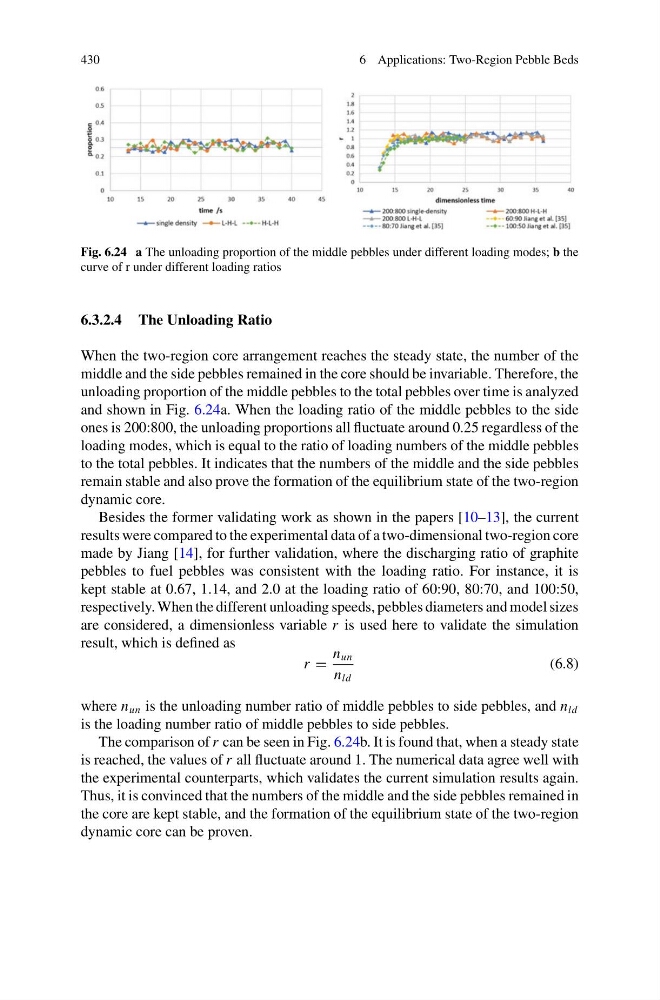
Fig. 6.24 a The unloading proportion of the middle pebbles under different loading modes; b the
curve of r under different loading ratios
6.3.2.4 The Unloading Ratio
When the two-region core arrangement reaches the steady state, the number of the
middle and the side pebbles remained in the core should be invariable. Therefore, the
unloading proportion of the middle pebbles to the total pebbles over time is analyzed
and shown in Fig. 6.24a. When the loading ratio of the middle pebbles to the side
ones is 200:800, the unloading proportions all fluctuate around 0.25 regardless of the
loading modes, which is equal to the ratio of loading numbers of the middle pebbles
to the total pebbles. It indicates that the numbers of the middle and the side pebbles
remain stable and also prove the formation of the equilibrium state of the two-region
dynamic core.
Besides the former validating work as shown in the papers [10–13], the current
results were compared to the experimental data of a two-dimensional two-region core
made by Jiang [14], for further validation, where the discharging ratio of graphite
pebbles to fuel pebbles was consistent with the loading ratio. For instance, it is
kept stable at 0.67, 1.14, and 2.0 at the loading ratio of 60:90, 80:70, and 100:50,
respectively. When the different unloading speeds, pebbles diameters and model sizes
are considered, a dimensionless variable r is used here to validate the simulation
result, which is defined as
r =
n un
n ld
(6.8)
where n un is the unloading number ratio of middle pebbles to side pebbles, and n ld
is the loading number ratio of middle pebbles to side pebbles.
The comparison of r can be seen in Fig. 6.24b. It is found that, when a steady state
is reached, the values of r all fluctuate around 1. The numerical data agree well with
the experimental counterparts, which validates the current simulation results again.
Thus, it is convinced that the numbers of the middle and the side pebbles remained in
the core are kept stable, and the formation of the equilibrium state of the two-region
dynamic core can be proven.
6 Applications: Two-Region Pebble Beds
Fig. 6.24 a The unloading proportion of the middle pebbles under different loading modes; b the
curve of r under different loading ratios
6.3.2.4 The Unloading Ratio
When the two-region core arrangement reaches the steady state, the number of the
middle and the side pebbles remained in the core should be invariable. Therefore, the
unloading proportion of the middle pebbles to the total pebbles over time is analyzed
and shown in Fig. 6.24a. When the loading ratio of the middle pebbles to the side
ones is 200:800, the unloading proportions all fluctuate around 0.25 regardless of the
loading modes, which is equal to the ratio of loading numbers of the middle pebbles
to the total pebbles. It indicates that the numbers of the middle and the side pebbles
remain stable and also prove the formation of the equilibrium state of the two-region
dynamic core.
Besides the former validating work as shown in the papers [10–13], the current
results were compared to the experimental data of a two-dimensional two-region core
made by Jiang [14], for further validation, where the discharging ratio of graphite
pebbles to fuel pebbles was consistent with the loading ratio. For instance, it is
kept stable at 0.67, 1.14, and 2.0 at the loading ratio of 60:90, 80:70, and 100:50,
respectively. When the different unloading speeds, pebbles diameters and model sizes
are considered, a dimensionless variable r is used here to validate the simulation
result, which is defined as
r =
n un
n ld
(6.8)
where n un is the unloading number ratio of middle pebbles to side pebbles, and n ld
is the loading number ratio of middle pebbles to side pebbles.
The comparison of r can be seen in Fig. 6.24b. It is found that, when a steady state
is reached, the values of r all fluctuate around 1. The numerical data agree well with
the experimental counterparts, which validates the current simulation results again.
Thus, it is convinced that the numbers of the middle and the side pebbles remained in
the core are kept stable, and the formation of the equilibrium state of the two-region
dynamic core can be proven.