

6.3 Density Difference and Loading Ratio Effects
429
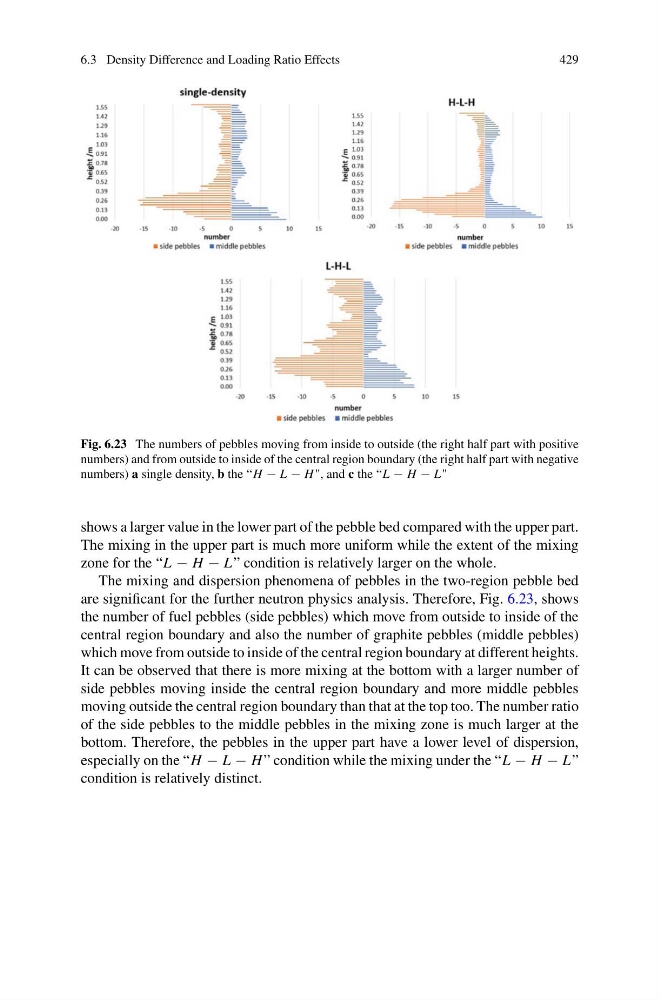
Fig. 6.23 The numbers of pebbles moving from inside to outside (the right half part with positive
numbers) and from outside to inside of the central region boundary (the right half part with negative
numbers) a single density, b the “H − L − H ", and c the “L − H − L"
shows a larger value in the lower part of the pebble bed compared with the upper part.
The mixing in the upper part is much more uniform while the extent of the mixing
zone for the “L − H − L” condition is relatively larger on the whole.
The mixing and dispersion phenomena of pebbles in the two-region pebble bed
are significant for the further neutron physics analysis. Therefore, Fig. 6.23, shows
the number of fuel pebbles (side pebbles) which move from outside to inside of the
central region boundary and also the number of graphite pebbles (middle pebbles)
which move from outside to inside of the central region boundary at different heights.
It can be observed that there is more mixing at the bottom with a larger number of
side pebbles moving inside the central region boundary and more middle pebbles
moving outside the central region boundary than that at the top too. The number ratio
of the side pebbles to the middle pebbles in the mixing zone is much larger at the
bottom. Therefore, the pebbles in the upper part have a lower level of dispersion,
especially on the “H − L − H ” condition while the mixing under the “L − H − L”
condition is relatively distinct.
429
Fig. 6.23 The numbers of pebbles moving from inside to outside (the right half part with positive
numbers) and from outside to inside of the central region boundary (the right half part with negative
numbers) a single density, b the “H − L − H ", and c the “L − H − L"
shows a larger value in the lower part of the pebble bed compared with the upper part.
The mixing in the upper part is much more uniform while the extent of the mixing
zone for the “L − H − L” condition is relatively larger on the whole.
The mixing and dispersion phenomena of pebbles in the two-region pebble bed
are significant for the further neutron physics analysis. Therefore, Fig. 6.23, shows
the number of fuel pebbles (side pebbles) which move from outside to inside of the
central region boundary and also the number of graphite pebbles (middle pebbles)
which move from outside to inside of the central region boundary at different heights.
It can be observed that there is more mixing at the bottom with a larger number of
side pebbles moving inside the central region boundary and more middle pebbles
moving outside the central region boundary than that at the top too. The number ratio
of the side pebbles to the middle pebbles in the mixing zone is much larger at the
bottom. Therefore, the pebbles in the upper part have a lower level of dispersion,
especially on the “H − L − H ” condition while the mixing under the “L − H − L”
condition is relatively distinct.