

6.3 Density Difference and Loading Ratio Effects
427
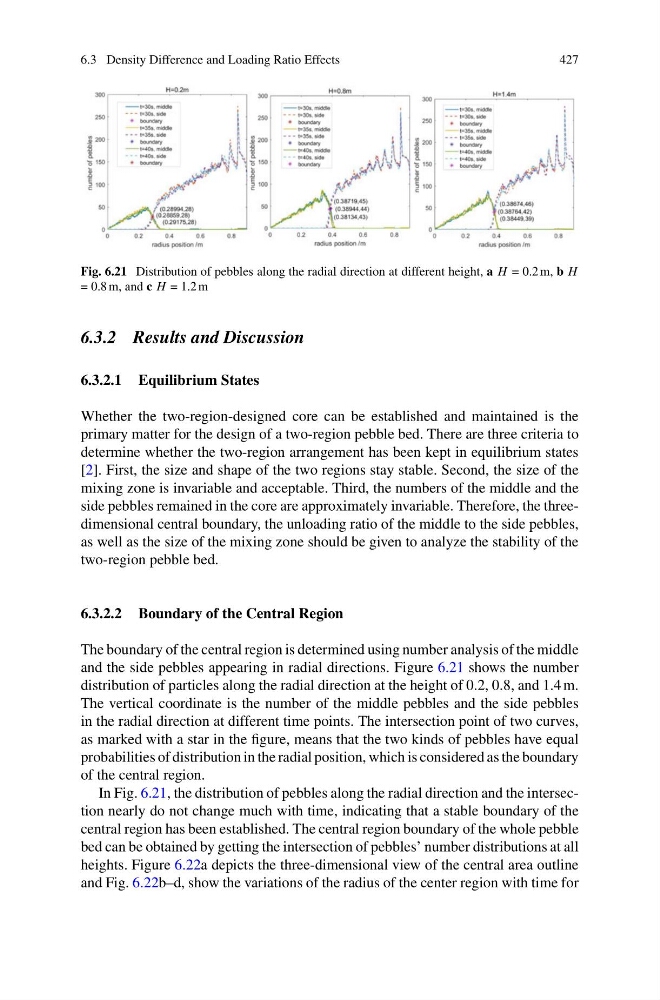
Fig. 6.21 Distribution of pebbles along the radial direction at different height, a H = 0.2m, b H
= 0.8 m, and c H = 1.2m
6.3.2 Results and Discussion
6.3.2.1 Equilibrium States
Whether the two-region-designed core can be established and maintained is the
primary matter for the design of a two-region pebble bed. There are three criteria to
determine whether the two-region arrangement has been kept in equilibrium states
[2]. First, the size and shape of the two regions stay stable. Second, the size of the
mixing zone is invariable and acceptable. Third, the numbers of the middle and the
side pebbles remained in the core are approximately invariable. Therefore, the threedimensional central boundary, the unloading ratio of the middle to the side pebbles,
as well as the size of the mixing zone should be given to analyze the stability of the
two-region pebble bed.
6.3.2.2 Boundary of the Central Region
The boundary of the central region is determined using number analysis of the middle
and the side pebbles appearing in radial directions. Figure 6.21 shows the number
distribution of particles along the radial direction at the height of 0.2, 0.8, and 1.4 m.
The vertical coordinate is the number of the middle pebbles and the side pebbles
in the radial direction at different time points. The intersection point of two curves,
as marked with a star in the figure, means that the two kinds of pebbles have equal
probabilities of distribution in the radial position, which is considered as the boundary
of the central region.
In Fig. 6.21, the distribution of pebbles along the radial direction and the intersection nearly do not change much with time, indicating that a stable boundary of the
central region has been established. The central region boundary of the whole pebble
bed can be obtained by getting the intersection of pebbles’ number distributions at all
heights. Figure 6.22a depicts the three-dimensional view of the central area outline
and Fig. 6.22b–d, show the variations of the radius of the center region with time for
427
Fig. 6.21 Distribution of pebbles along the radial direction at different height, a H = 0.2m, b H
= 0.8 m, and c H = 1.2m
6.3.2 Results and Discussion
6.3.2.1 Equilibrium States
Whether the two-region-designed core can be established and maintained is the
primary matter for the design of a two-region pebble bed. There are three criteria to
determine whether the two-region arrangement has been kept in equilibrium states
[2]. First, the size and shape of the two regions stay stable. Second, the size of the
mixing zone is invariable and acceptable. Third, the numbers of the middle and the
side pebbles remained in the core are approximately invariable. Therefore, the threedimensional central boundary, the unloading ratio of the middle to the side pebbles,
as well as the size of the mixing zone should be given to analyze the stability of the
two-region pebble bed.
6.3.2.2 Boundary of the Central Region
The boundary of the central region is determined using number analysis of the middle
and the side pebbles appearing in radial directions. Figure 6.21 shows the number
distribution of particles along the radial direction at the height of 0.2, 0.8, and 1.4 m.
The vertical coordinate is the number of the middle pebbles and the side pebbles
in the radial direction at different time points. The intersection point of two curves,
as marked with a star in the figure, means that the two kinds of pebbles have equal
probabilities of distribution in the radial position, which is considered as the boundary
of the central region.
In Fig. 6.21, the distribution of pebbles along the radial direction and the intersection nearly do not change much with time, indicating that a stable boundary of the
central region has been established. The central region boundary of the whole pebble
bed can be obtained by getting the intersection of pebbles’ number distributions at all
heights. Figure 6.22a depicts the three-dimensional view of the central area outline
and Fig. 6.22b–d, show the variations of the radius of the center region with time for