

426
6 Applications: Two-Region Pebble Beds
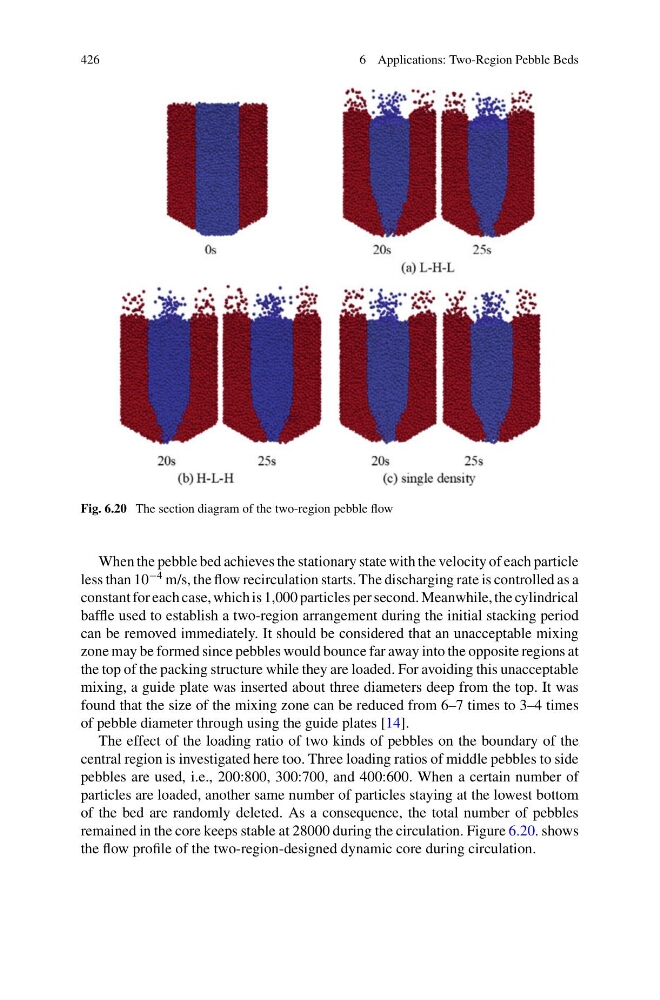
Fig. 6.20 The section diagram of the two-region pebble flow
When the pebble bed achieves the stationary state with the velocity of each particle
less than 10
−4 m/s, the flow recirculation starts. The discharging rate is controlled as a
constant for each case, which is 1,000 particles per second. Meanwhile, the cylindrical
baffle used to establish a two-region arrangement during the initial stacking period
can be removed immediately. It should be considered that an unacceptable mixing
zone may be formed since pebbles would bounce far away into the opposite regions at
the top of the packing structure while they are loaded. For avoiding this unacceptable
mixing, a guide plate was inserted about three diameters deep from the top. It was
found that the size of the mixing zone can be reduced from 6–7 times to 3–4 times
of pebble diameter through using the guide plates [14].
The effect of the loading ratio of two kinds of pebbles on the boundary of the
central region is investigated here too. Three loading ratios of middle pebbles to side
pebbles are used, i.e., 200:800, 300:700, and 400:600. When a certain number of
particles are loaded, another same number of particles staying at the lowest bottom
of the bed are randomly deleted. As a consequence, the total number of pebbles
remained in the core keeps stable at 28000 during the circulation. Figure 6.20. shows
the flow profile of the two-region-designed dynamic core during circulation.
6 Applications: Two-Region Pebble Beds
Fig. 6.20 The section diagram of the two-region pebble flow
When the pebble bed achieves the stationary state with the velocity of each particle
less than 10
−4 m/s, the flow recirculation starts. The discharging rate is controlled as a
constant for each case, which is 1,000 particles per second. Meanwhile, the cylindrical
baffle used to establish a two-region arrangement during the initial stacking period
can be removed immediately. It should be considered that an unacceptable mixing
zone may be formed since pebbles would bounce far away into the opposite regions at
the top of the packing structure while they are loaded. For avoiding this unacceptable
mixing, a guide plate was inserted about three diameters deep from the top. It was
found that the size of the mixing zone can be reduced from 6–7 times to 3–4 times
of pebble diameter through using the guide plates [14].
The effect of the loading ratio of two kinds of pebbles on the boundary of the
central region is investigated here too. Three loading ratios of middle pebbles to side
pebbles are used, i.e., 200:800, 300:700, and 400:600. When a certain number of
particles are loaded, another same number of particles staying at the lowest bottom
of the bed are randomly deleted. As a consequence, the total number of pebbles
remained in the core keeps stable at 28000 during the circulation. Figure 6.20. shows
the flow profile of the two-region-designed dynamic core during circulation.