

6.2 Size Effects
421
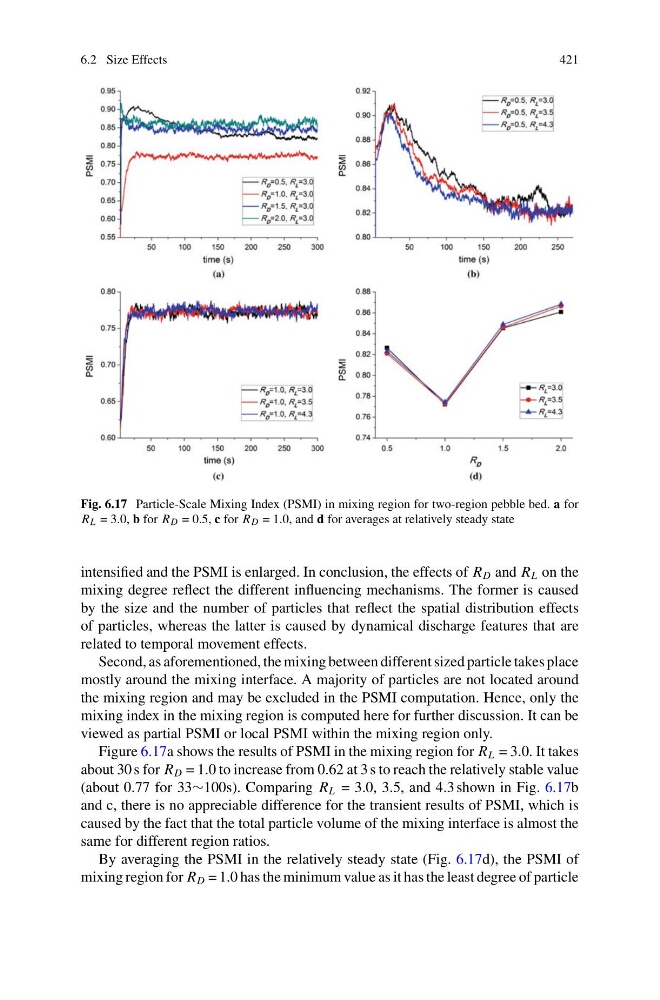
Fig. 6.17 Particle-Scale Mixing Index (PSMI) in mixing region for two-region pebble bed. a for
R L = 3.0, b for R D = 0.5, c for R D = 1.0, and d for averages at relatively steady state
intensified and the PSMI is enlarged. In conclusion, the effects of R D and R L on the
mixing degree reflect the different influencing mechanisms. The former is caused
by the size and the number of particles that reflect the spatial distribution effects
of particles, whereas the latter is caused by dynamical discharge features that are
related to temporal movement effects.
Second, as aforementioned, the mixing between different sized particle takes place
mostly around the mixing interface. A majority of particles are not located around
the mixing region and may be excluded in the PSMI computation. Hence, only the
mixing index in the mixing region is computed here for further discussion. It can be
viewed as partial PSMI or local PSMI within the mixing region only.
Figure 6.17a shows the results of PSMI in the mixing region for R L = 3.0. It takes
about 30 s for R D = 1.0 to increase from 0.62 at 3 s to reach the relatively stable value
(about 0.77 for 33∼100s). Comparing R L = 3.0, 3.5, and 4.3 shown in Fig. 6.17b
and c, there is no appreciable difference for the transient results of PSMI, which is
caused by the fact that the total particle volume of the mixing interface is almost the
same for different region ratios.
By averaging the PSMI in the relatively steady state (Fig. 6.17d), the PSMI of
mixing region for R D = 1.0 has the minimum value as it has the least degree of particle
421
Fig. 6.17 Particle-Scale Mixing Index (PSMI) in mixing region for two-region pebble bed. a for
R L = 3.0, b for R D = 0.5, c for R D = 1.0, and d for averages at relatively steady state
intensified and the PSMI is enlarged. In conclusion, the effects of R D and R L on the
mixing degree reflect the different influencing mechanisms. The former is caused
by the size and the number of particles that reflect the spatial distribution effects
of particles, whereas the latter is caused by dynamical discharge features that are
related to temporal movement effects.
Second, as aforementioned, the mixing between different sized particle takes place
mostly around the mixing interface. A majority of particles are not located around
the mixing region and may be excluded in the PSMI computation. Hence, only the
mixing index in the mixing region is computed here for further discussion. It can be
viewed as partial PSMI or local PSMI within the mixing region only.
Figure 6.17a shows the results of PSMI in the mixing region for R L = 3.0. It takes
about 30 s for R D = 1.0 to increase from 0.62 at 3 s to reach the relatively stable value
(about 0.77 for 33∼100s). Comparing R L = 3.0, 3.5, and 4.3 shown in Fig. 6.17b
and c, there is no appreciable difference for the transient results of PSMI, which is
caused by the fact that the total particle volume of the mixing interface is almost the
same for different region ratios.
By averaging the PSMI in the relatively steady state (Fig. 6.17d), the PSMI of
mixing region for R D = 1.0 has the minimum value as it has the least degree of particle