

420
6 Applications: Two-Region Pebble Beds
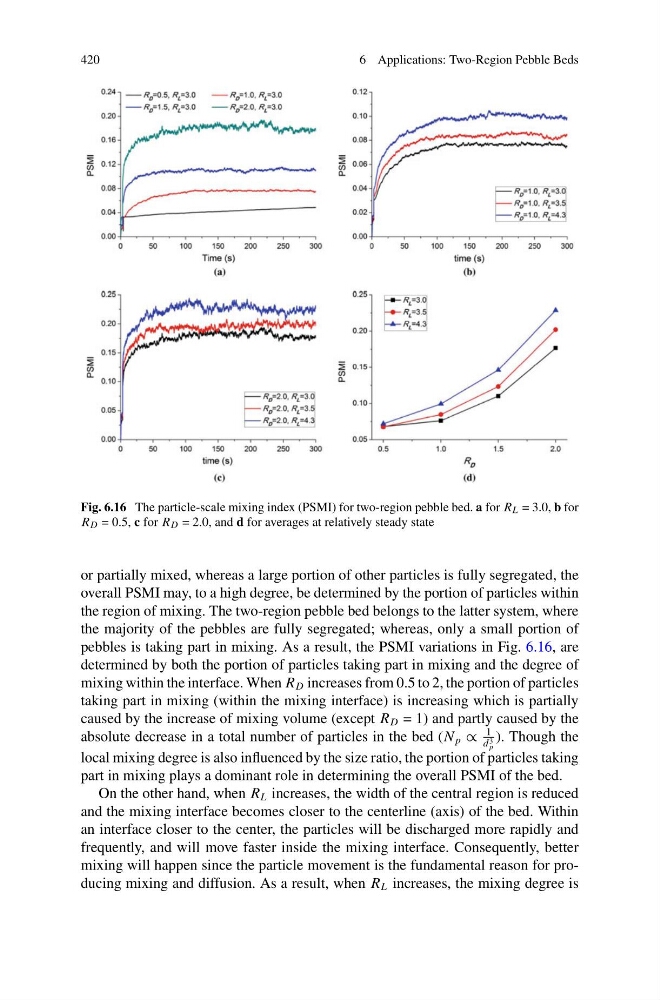
Fig. 6.16 The particle-scale mixing index (PSMI) for two-region pebble bed. a for R L = 3.0, b for
R D = 0.5, c for R D = 2.0, and d for averages at relatively steady state
or partially mixed, whereas a large portion of other particles is fully segregated, the
overall PSMI may, to a high degree, be determined by the portion of particles within
the region of mixing. The two-region pebble bed belongs to the latter system, where
the majority of the pebbles are fully segregated; whereas, only a small portion of
pebbles is taking part in mixing. As a result, the PSMI variations in Fig. 6.16, are
determined by both the portion of particles taking part in mixing and the degree of
mixing within the interface. When R D increases from 0.5 to 2, the portion of particles
taking part in mixing (within the mixing interface) is increasing which is partially
caused by the increase of mixing volume (except R D = 1) and partly caused by the
absolute decrease in a total number of particles in the bed (N p ∝
1
d 3
p
). Though the
local mixing degree is also influenced by the size ratio, the portion of particles taking
part in mixing plays a dominant role in determining the overall PSMI of the bed.
On the other hand, when R L increases, the width of the central region is reduced
and the mixing interface becomes closer to the centerline (axis) of the bed. Within
an interface closer to the center, the particles will be discharged more rapidly and
frequently, and will move faster inside the mixing interface. Consequently, better
mixing will happen since the particle movement is the fundamental reason for producing mixing and diffusion. As a result, when R L increases, the mixing degree is
6 Applications: Two-Region Pebble Beds
Fig. 6.16 The particle-scale mixing index (PSMI) for two-region pebble bed. a for R L = 3.0, b for
R D = 0.5, c for R D = 2.0, and d for averages at relatively steady state
or partially mixed, whereas a large portion of other particles is fully segregated, the
overall PSMI may, to a high degree, be determined by the portion of particles within
the region of mixing. The two-region pebble bed belongs to the latter system, where
the majority of the pebbles are fully segregated; whereas, only a small portion of
pebbles is taking part in mixing. As a result, the PSMI variations in Fig. 6.16, are
determined by both the portion of particles taking part in mixing and the degree of
mixing within the interface. When R D increases from 0.5 to 2, the portion of particles
taking part in mixing (within the mixing interface) is increasing which is partially
caused by the increase of mixing volume (except R D = 1) and partly caused by the
absolute decrease in a total number of particles in the bed (N p ∝
1
d 3
p
). Though the
local mixing degree is also influenced by the size ratio, the portion of particles taking
part in mixing plays a dominant role in determining the overall PSMI of the bed.
On the other hand, when R L increases, the width of the central region is reduced
and the mixing interface becomes closer to the centerline (axis) of the bed. Within
an interface closer to the center, the particles will be discharged more rapidly and
frequently, and will move faster inside the mixing interface. Consequently, better
mixing will happen since the particle movement is the fundamental reason for producing mixing and diffusion. As a result, when R L increases, the mixing degree is